

by Lorena Tota
Summary
Nicholas G. Hammond, a former British intelligence officer, is accused of deliberately manipulating ancient history to support a Eurocentric and philhellenic narrative. He constructed a “Greek Macedonia” by integrating ancient Macedonians into the Hellenic story, ignoring contradictory ancient sources like Thucydides. Lota states the true Macedonian heartland lay in modern Albania, evidenced by dense cyclopean fortifications, while the region of Emathia (“Greek Macedonia”) lacked such monuments. Hammond’s “pastoralist transhumance” theory portraying Macedonians as nomadic Vlach shepherds is criticized as a fabricated explanation. Finds at Trebenishte and the continuous Albanian presence are cited to challenge this narrative as ideologically driven distortion.
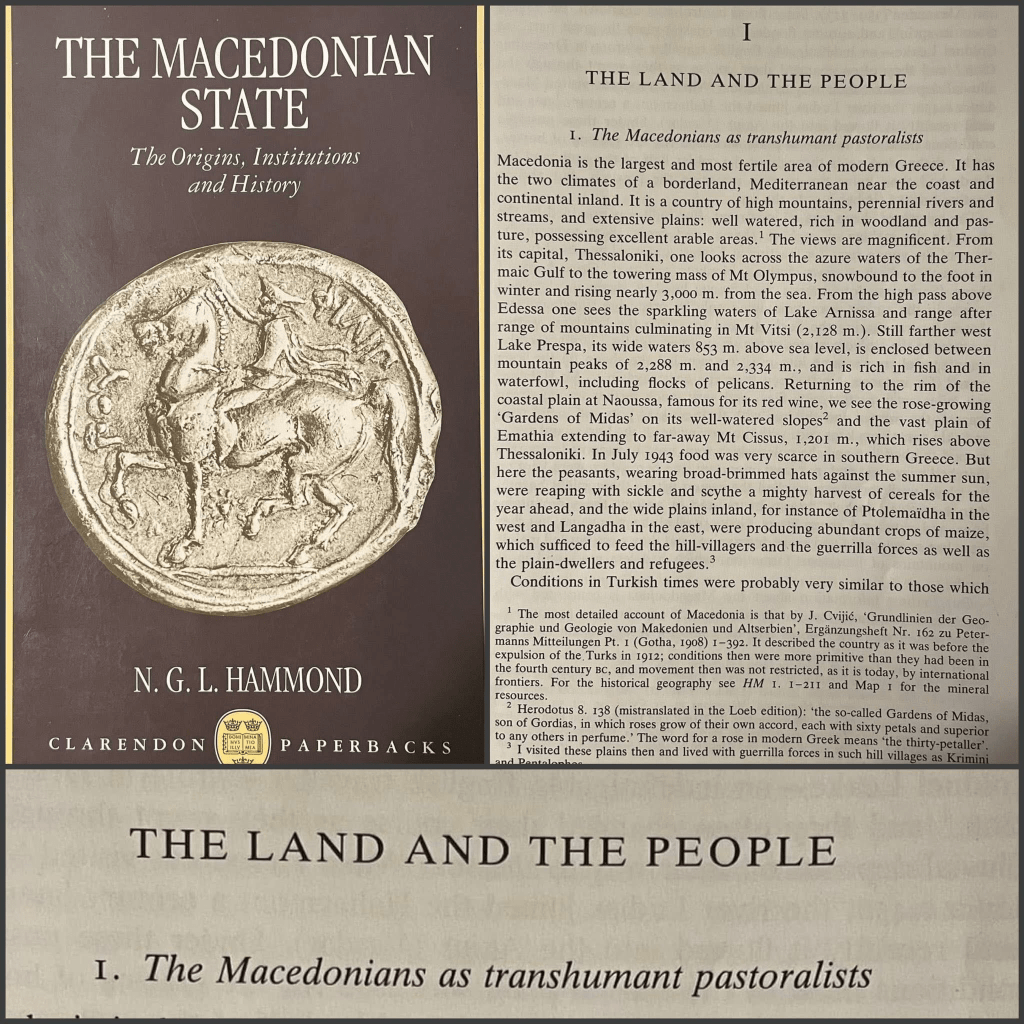
Nicholas G. Hammond, a British intelligence officer during the Second World War, later reinvented himself as a historian, placing his skills in the service of a broader Eurocentric and philhellenic agenda. At the heart of this mission lay the fabrication of a modern “Greek Macedonia”, designed to fold the legacy of ancient Macedonia into the Hellenic narrative. In doing so, Hammond deliberately disregarded the testimony of ancient authors whose accounts stand in direct contradiction to his imaginative reconstructions of “Hellenic glory”.

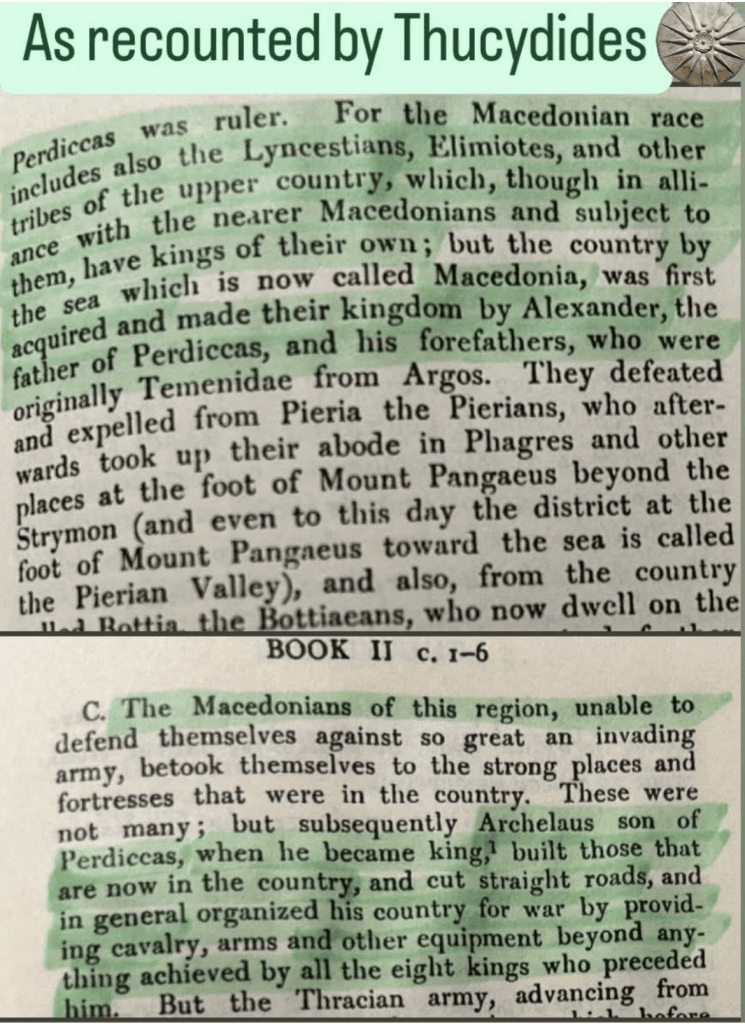
Thucydides, for instance, explicitly reports that King Archelaus built numerous fortified cities in Macedonia. Yet no monumental remains of this kind exist in the territory now designated as “Greek Macedonia”.
This absence is not accidental: in antiquity, the region was known as Emathia, lying on the periphery of the Macedonian kingdom rather than at its political and cultural core. The true centre of Macedonian urbanism corresponds to present-day Albania, where cyclopean fortifications occur with remarkable density. Sites such as Shkodra, Amantia, Lezhë, Persqop, Olimpia, Klos, Finiq, Albanopolis, and Bylis still bear imposing stoneworks of the very type described by Thucydides, a material testimony anchoring the Macedonian heartland firmly within Albanian territory.

Frustrated by the absence of monumental architecture in Emathia, Hammond devised the so-called « Pastoralist transhumance » theory, equating the ancient Macedonians with modern Vlach shepherds, nomadic pastoralists without permanent settlements, while simultaneously assigning to the Albanians an exclusively Illyrian origin. This speculative construct sought to explain away the archaeological void while severing Albanians from their Macedonian heritage.
The discovery of rich artefacts by Bulgarian soldiers just beyond Albania’s current borders, in the necropolis of Trebenishte, further undermines Hammond’s narrative. Trebenishte, today situated on the far side of the Albanian frontier, once formed part of the vilayet of Manastir, inhabited by Albanians before 1913.
Annexed to Slavs after the Balkan Wars, the site yielded helmets dating to the sixth century BC, bronze kraters, and gold funerary masks evocative of pre-Hellenic craftsmanship, all transferred to the museums of Sofia and Belgrade, a lasting example of the appropriation of Albanian heritage by neighbouring states.
Many of these objects are demonstrably of local origin rather than imports from the south. The very existence of such sumptuous and sophisticated artefacts contradicts the portrayal of the ancient Macedonians as rootless shepherds living in straw huts, and exposes the internal incoherence of Hammond’s theory: how could a nomadic, materially impoverished people have conquered a materially and culturally more advanced civilisation?
It is worth recalling that the Slavs only arrived in the Balkans in the sixth century AD, whereas, in contrast, there exists no evidence whatsoever of any Albanian « arrival » on their own lands. This absence of a recorded migration underscores their deep-rooted and continuous presence in the region, in stark contrast to later incoming populations.
The narrative of “Greek Macedonia” thus emerged not from irrefutable evidence, but from the inventive reasoning of a former wartime operative. Despite its speculative and self-contradictory foundations, it has been absorbed into mainstream academic discourse, perpetuating a historiography shaped more by ideological loyalty than by historical fact. Our aim is to expose and dismantle these distortions, restoring to Balkan history the methodological rigour and evidence-based scholarship it deserves.

