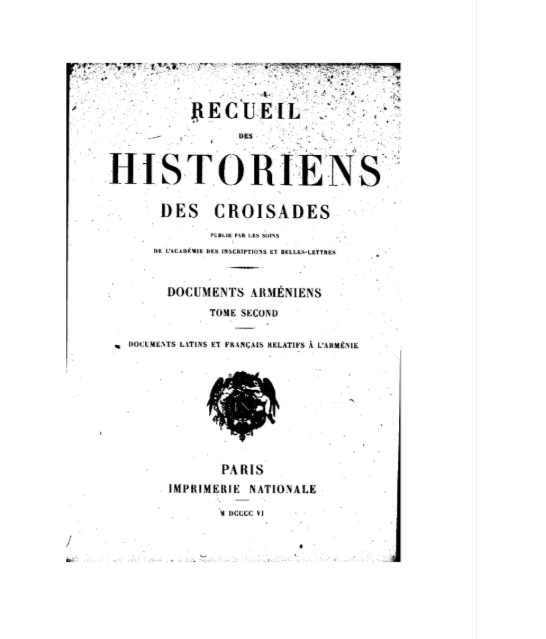

In 1332, amid ongoing tensions between the Catholic West and Orthodox Slavic powers in the Balkans, an anonymous Latin treatise known as the Directorium ad passagium faciendum (“Initiative for Making the Passage”) was presented to King Philip VI of France. The work, preserved in the Recueil des Historiens des Croisades: Documents Arméniens, Tome Second (Paris, 1906), offers a detailed reconnaissance-style report on the political, military, and religious situation in the Kingdom of Rascia (medieval Serbia) and the Albanian-inhabited territories under its control.
The Directorium (sometimes attributed to Brocardus/Burchard or Guillelmus Adae/William Adam) was part of broader 14th-century efforts to organize a new crusade.
It aimed to encourage a French-led military campaign against non-Catholic powers in the East, including recovering influence in the Balkans and beyond. The author describes the region with strategic precision, highlighting vulnerabilities in Serbian-held lands while emphasizing opportunities for Catholic alliances.
Kingdom of Rascia
The text provides a vivid (and propagandistic) portrait of the kingdom’s weaknesses:
“The said kingdom has few if any fortifications at all. All that exists are farmhouses and cottages devoid of moats and outer walls. The buildings and palaces, both of the king and of the nobles, are made of straw and wood. I have never seen a palace or home there made of stone or of brick except in the coastal towns of the Latins.”
It then addresses the demographic and religious composition as a major strategic advantage for potential conquerors:
“One factor, among others, which makes this kingdom easy to conquer, is that it is inhabited by two peoples, i.e. the Albanians and the Latins who, in their beliefs, their rites and their obedience, both abide by the Roman Catholic Church.”
The author lists Latin (Romance/Italian-influenced Catholic) bishoprics in coastal towns such as Bar (Antibarum), Kotor, Ulcinj, Shas, Shkodra, and Drisht—towns inhabited primarily by Latins. Outside these urban centers, Albanians formed the rural majority. Four additional towns are identified as Albanian: Greater and Lesser Pult, Sapa, and Albanopolis. All fell under the ecclesiastical authority of the Archbishop of Bar.
The Albanian language
One of the most frequently cited passages concerns Albanian cultural practices:
“The Albanians indeed have a language quite different from Latin. However they use Latin letters in all their books.”
This 1332 reference stands as important early evidence of written Albanian using the Latin alphabet, predating the oldest surviving printed Albanian texts by over two centuries.
The Albanians are portrayed as a numerous and formidable military force:
“The Albanians for their part, the larger of the two peoples, could assemble over fifteen thousand horsemen for warfare according to the custom and manner of the country, who would be courageous and industrious warriors.”
The text emphasizes deep resentment against “odious Slav leaders,” describing oppression of the Catholic population, clergy in chains, disinherited nobles, and ruined monasteries. It argues that locals would enthusiastically support a French prince leading a campaign against their Slavic overlords:
“…they would all to a man believe that they were consecrating their hands in the blood of the aforementioned Slavs if a French prince were to appear before them…”
The author concludes that a modest force of 1,000 French knights and 5-6,000 infantry, allied with local Albanians and Latins, could easily subdue the entire kingdom.
This document is a valuable primary source for understanding 14th-century ethnic, religious, and political dynamics in the Western Balkans. It reflects:
The presence of a substantial Catholic Albanian population in what is now northern Albania and surrounding areas.
Ongoing friction between Catholic communities and expanding Serbian Orthodox rule under the Nemanjić dynasty and its successors.
Western European (particularly French and papal) strategic interest in the region as a potential crusading theater.
While the proposed crusade never materialized on the scale envisioned, the text illuminates why Albanian-Catholic elites often sought alliances with the Papacy and Western powers in subsequent centuries.
Source
Recueil des Historiens des Croisades, Documents Arméniens, Tome Second, pp. 478–485 (Latin original with French context). English translation by Robert Elsie, as featured in Early Albania: A Reader of Historical Texts, 11th–17th Centuries.

