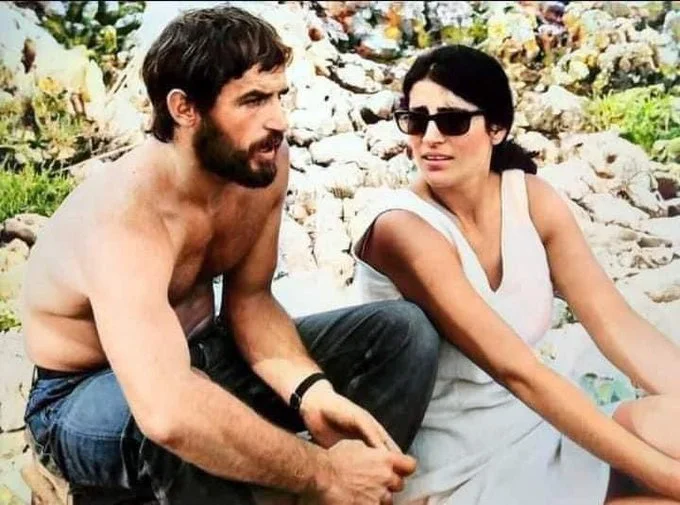

In the late 1960s, Italian television delivered one of the most ambitious and faithful adaptations of Homer’s epic ever put on screen: the 1968 miniseries L’Odissea (also known as The Odyssey). Directed primarily by Franco Rossi, with contributions from Mario Bava and Piero Schivazappa, this eight-episode production featured stunning cinematography, grand sets, and — most memorably — a powerhouse pairing in the lead roles. Irene Papas (Penelope) and Bekim Fehmiu (Odysseus) brought a rare authenticity and chemistry to the legendary husband and wife.
The Albanian Connection That Felt Like Destiny
During filming, something beautiful and unexpected happened behind the scenes. The two stars would often speak to each other in a language the rest of the international cast and crew couldn’t understand: Albanian.
When asked about it, Irene Papas gave a heartfelt and now-famous reply:
“I am Albanian from Greece, and Bekim (Fehmiu) Albanian from Yugoslavia, but the most important thing is that it was the will of God himself that we both play these two roles — because once Penelope and Odysseus themselves spoke the same language that Bekimi and I are talking today.”
The quote perfectly captured the poetic symmetry: two actors of Albanian origin breathing life into the most iconic Greek couple in literature.
Who Were They?
Irene Papas (born Irini Leleku in 1926 in Greece) was already an international star known for her striking presence and tragic intensity. Of Arvanite (Albanian-origin) heritage from Greece, she became one of the most respected actresses of her generation, appearing in classics like Zorba the Greek, The Guns of Navarone, and Electra.
Bekim Fehmiu, born in Sarajevo to an Albanian family from Gjakova (Kosovo), was a charismatic leading man from Yugoslavia. His portrayal of Odysseus — strong, cunning, world-weary yet resilient — is still praised by many as one of the best screen versions of the hero.
Together, they didn’t just act the roles — they embodied them with a cultural and linguistic resonance that felt almost mythical.
Why This Adaptation Still Stands Out
While not strictly a Hollywood production (it was an Italian-French-German co-production), L’Odissea captured the epic scope and emotional depth many big-budget American attempts have struggled with. It stayed remarkably close to Homer’s text, featured impressive practical effects for its time (including Mario Bava’s influence), and avoided the over-the-top spectacle that sometimes dilutes the human drama of the story.
Papas’s dignified, long-suffering Penelope and Fehmiu’s clever, battle-hardened Odysseus created a believable marital bond that spanned 20 years of separation, war, and trials. Their off-screen connection only added to the on-screen magic.
Even decades later, fans — especially in the Balkans — remember this version fondly, not just for its quality, but for this beautiful “coincidence” of casting: two Albanians playing the roles of ancient heroes who, in the actors’ own words, once spoke their language.
It remains a proud and poetic footnote in cinematic history — a reminder that great stories transcend borders, and sometimes the gods really do have a sense of humor.

