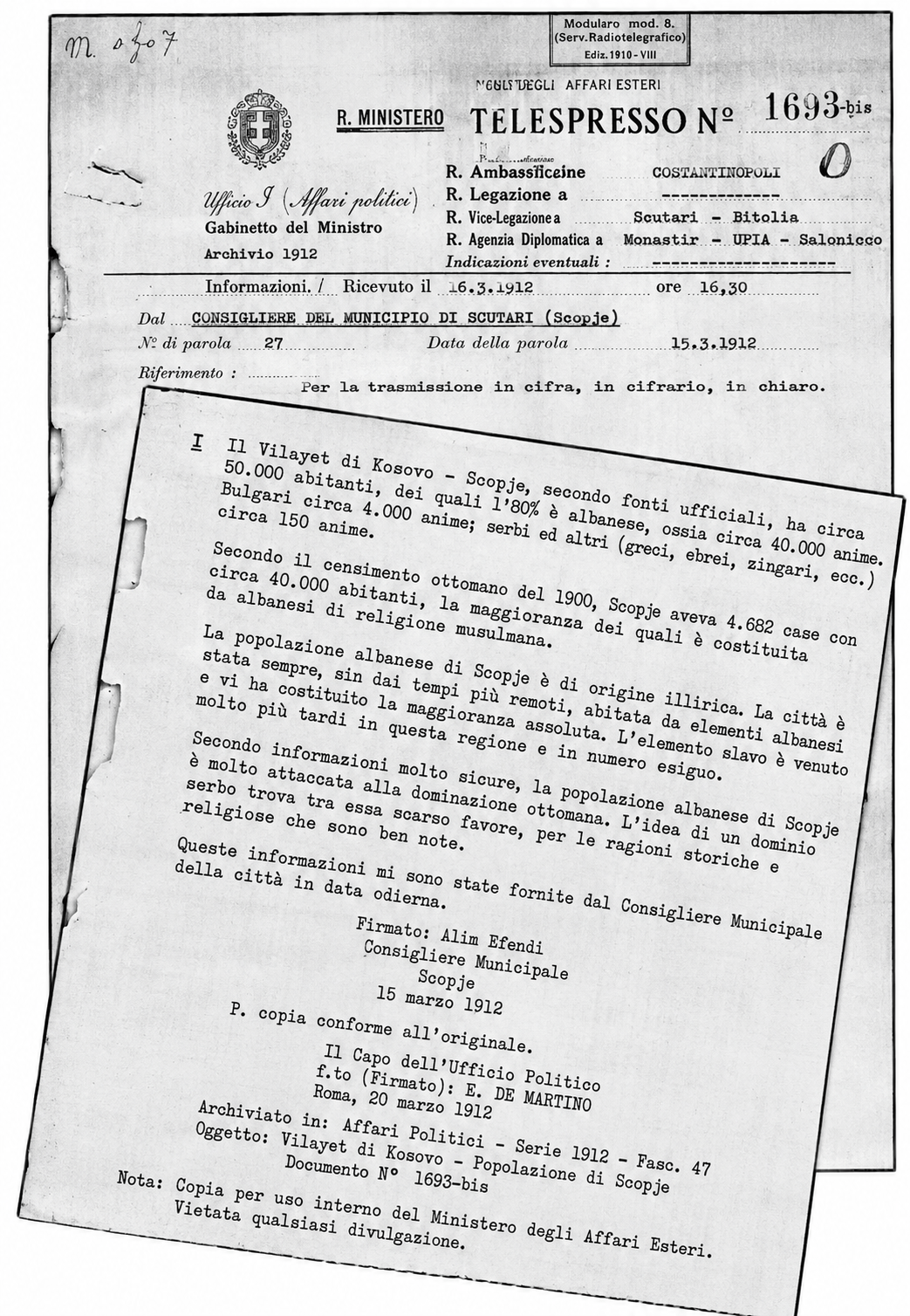

According to a document of the Ministry of Foreign Affairs (MFA) of Italy, discovered in the archives by historian Skënder Hasani, 100 years ago (in 1912) Skopje, the capital of the Vilayet of Kosovo, was populated by 80% Albanians. It had a total of 50 thousand inhabitants, of whom 40 thousand were Albanians, four thousand Bulgarians and 150 Serbs and others.
A brief history of the Vilayet of Kosovo
The Vilayet of Kosovo was formed in 1877 and covered a vast geographical area of 32,900 square kilometers. Within the administrative boundaries of the Vilayet of Kosovo were six sanjaks: the Sanjak of Prishtina, Skopje, Prizren, Jenin Pazar, Peja and Tashlija (Plevlje).
According to the official records of the Ottoman Empire published in the official gazette of the then Ottoman government ‘La Turquie’ (May 1878), it is stated that the Vilayet of Kosovo had 1,199,154 inhabitants, while according to Turkish statistics from 1896 and 1900, the Vilayet of Kosovo had a total population of 996,738 inhabitants. According to the censuses of 1896-1900, the Sanjak of Skopje had 324,982 inhabitants. According to the Ottoman census of 1900, the capital of the Kosovo Vilayet – Skopje alone, had 4,682 houses with nearly forty thousand inhabitants, the majority of whom were Muslim Albanians.
According to a document of the Ministry of Foreign Affairs (MFA) of Italy, discovered in the archives by the historian Skënder Hasani, 100 years ago (in 1912) Skopje, the capital of the Kosovo Vilayet, was populated by 80% Albanians. It had about 50 thousand inhabitants, of whom 40 thousand were Albanians, four thousand Bulgarians and 150 Serbs and others.
The historian Hasani said that this document is very argumentative, because the information comes from an official (councillor) in the Skopje City Assembly. The content of this document argues the Illyrian origin of the Albanian population in Skopje, and includes the last period of the rule of the Ottoman Empire. In terms of demographics, this document shows that Skopje has historically and continuously had an Albanian majority.
“Immediately after the occupation of Skopje by the Serbs in 1912, the Serbian government began implementing their project where, through the agrarian reform, they brought settlers from ‘Shumadia’ and the interior of Serbia and between the two world wars they significantly changed the population structure…” said Hasani.
According to this document, during the Second World War, Skopje experienced a large increase in population, namely over 40 thousand settlers had come to Skopje and the surrounding area. The document states that in 1943-1944 Skopje had 87 thousand inhabitants, of whom 33 thousand were Albanians. After the Second World War, precisely in February 1953 with the Yugoslav-Turkish agreement (Tito-Kipërli), many Albanians moved from Skopje and the surrounding area.
In these talks, Tito said: “It would be in the interest of both countries to work for the harmony of the peoples in the future. This means that the past will not burden us at all. As for the Albanians of the Muslim religion in Kosovo and Macedonia, through the visas that will be allowed to them by your (Turkish) Government, they will have the opportunity to integrate with their families that they have there in Turkey.
Those family ties have been established for centuries. We will not decide on the method of passport visas, but we will take care that you have as many applicants as possible. They need to be provided with land property, because nearly 90% of them are farmers… I believe that by 1959 you will have approximately one million diligent agricultural citizens there.
This is what the information from the field, for which we have been working since 1951, says… Let the transfer begin from Skopje, because from there the Albanians feel more secure to move. Kosovars are more wild, but we will take care that they are naturalized there for a start…” .
In the years 1950-1966, special commissions were formed, based in Skopje, which appeared in public offering assistance and facilitating conditions to those who would move to Turkey.
The Skopje newspaper “Nova Makedonija” between January 1956 and January 1957 published the names of 2,976 heads of families whose families were moving to Turkey. The city of Skopje, especially its railway station, was and remained the most important transit node for the departure of Albanians towards the unknown Turkish land.
After the 1963 earthquake that hit Skopje and to this day, the Yugoslav-Macedonian regimes brought thousands of Slavic-Macedonians from the Aegean and Eastern Europe, who enormously increased the Slavic population in Skopje and from these anti-Albanian policies, Albanians were greatly harmed in the composition of the population in this ancient Albanian city. And, Skopje from a city with 80% Albanians, today is left with a symbolic percentage.
Transcribed:
“Before the occupation, Skopje had approximately 67,000
inhabitants. Of the aforementioned area, approximately 32,000 were Albanians, such as the province of Macedonia, above the Albanians who originally came from the Vardari.
The Turks therefore represent approximately 35% of which approximately 3,000 remain in the village of Cecopek. The 35% extends to and is almost equal to the rest of the Serbs, in Suto-Orizari
with 14 villages and Tetovo with 11 Macedonian villages and
South with 24 villages of Yugoslavian civilization).
From the notes of this Regency, which were written by the Third Military Echelon, Skopje and three municipalities of northern Macedonia form.
Since 1941, there were approximately 50,000 active inhabitants, of whom:
50,000 Albanians
4,000 Bulgarians
150 Serbs
In addition to forty-nine smaller communities, The Skopje area includes:
43 Albanian villages with 15,000 inhabitants
1 Bulgarian colony with 2,500 inhabitants
3 Macedonian colonies with 1,700 inhabitants
22 Serbian villages with 18,000 inhabitants
As shown in the index, before the
occupation, Skopje had approximately 67,000 inhabitants, of whom:
31,500 Albanians
14,000 Turks
11,300 Bulgarians
8,700 Serbs
2,300 Jews”
Source
https://pashtriku.org/sheradin-berisha-ne-viti-1912-shkupi-kishte-80-shqiptare/

