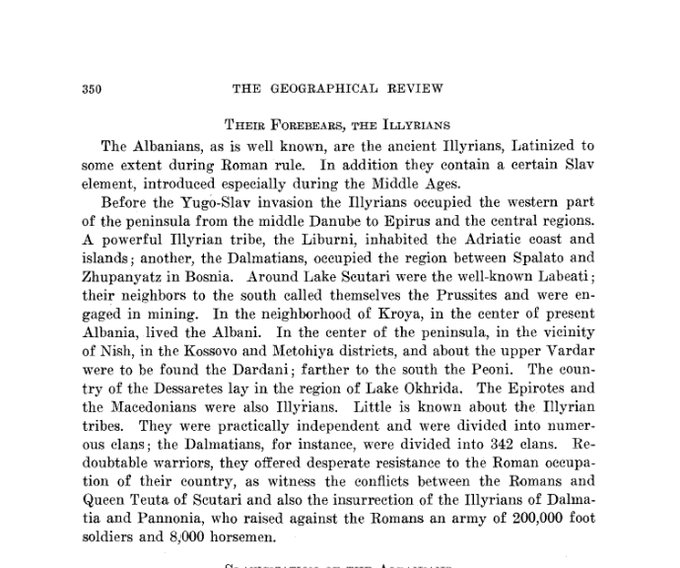

In the early 20th century, as the Balkans underwent profound political upheaval following the decline of the Ottoman Empire, Western scholars and geographers frequently addressed the ethnic origins of the region’s peoples. One notable example appears in The Geographical Review, where the author states unequivocally: “The Albanians, as is well known, are the ancient Illyrians, Latinized to some extent during Roman rule. In addition they contain a certain Slav element, introduced especially during the Middle Ages.”
The excerpt describes the pre-Slavic Illyrian presence across a wide area of the western Balkans — from the middle Danube to Epirus and the central regions. It highlights specific Illyrian tribes such as the Liburni along the Adriatic coast and islands, the Dalmatians between Spalato and Zuphanatz in Bosnia, and the Albani near Kroya (modern Kruja) in central Albania. Other groups mentioned include the Dardani and the upper Vardar region.
Trancribed
“Transcription of the provided page from The Geographical Review:
The Albanians, as is well known, are the ancient Illyrians, Latinized to some extent during Roman rule. In addition they contain a certain Slav element, introduced especially during the Middle Ages.
Before the Yugo-Slav invasion the Illyrians occupied the western part of the peninsula from the middle Danube to Epirus and the central regions. A powerful Illyrian tribe, the Liburni, inhabited the Adriatic coast and islands; another, the Dalmatians, occupied the region between Spalato and Zhupanjatz in Bosnia. Around Lake Scutari were the well-known Labeati; their neighbors to the south called themselves the Prussites and were engaged in mining.
In the neighborhood of Kroya, in the center of present Albania, lived the Albani. In the center of the peninsula, in the vicinity of Nish, in the Kosovo and Metohija districts, and about the upper Vardar were to be found the Dardani; farther to the south the Peoni. The country to the west of Scutari and in the region of Lake Okhrida. The Epirotes and the Macedonians were also Illyrians.
Little is known about the Illyrian tribes. They were practically independent and were divided into numerous clans; the Dalmatians, for instance, were divided into 342 clans. Redoubtable warriors, they offered desperate resistance to the Roman occupation of their country, as witness the conflicts between the Romans and Queen Teuta of Scutari and also the insurrection of the Illyrians of Dalmatia and Pannonia, who raised against the Romans an army of 200,000 foot soldiers and 8,000 horsemen.”
Source: Woods, Henry Charles. “Albania and the Albanians.” The Geographical Review 5, no. 4 (April 1918): 350. https://www.jstor.org/stable/207281
Bibliography
Woods, Henry Charles. “Albania and the Albanians.” The Geographical Review 5, no. 4 (1918): 257–273.
“Ancient DNA Reveals the Origins of the Albanians.” bioRxiv, 2023. https://doi.org/10.1101/2023.06.05.543790.
Wilkes, John. The Illyrians. Oxford: Blackwell, 1992.
ThoughtCo. “The Ancient Illyrians Connection to Today’s Albanians.” Last modified January 29, 2019. https://www.thoughtco.com/albania-the-ancient-illyrians-4070684.

