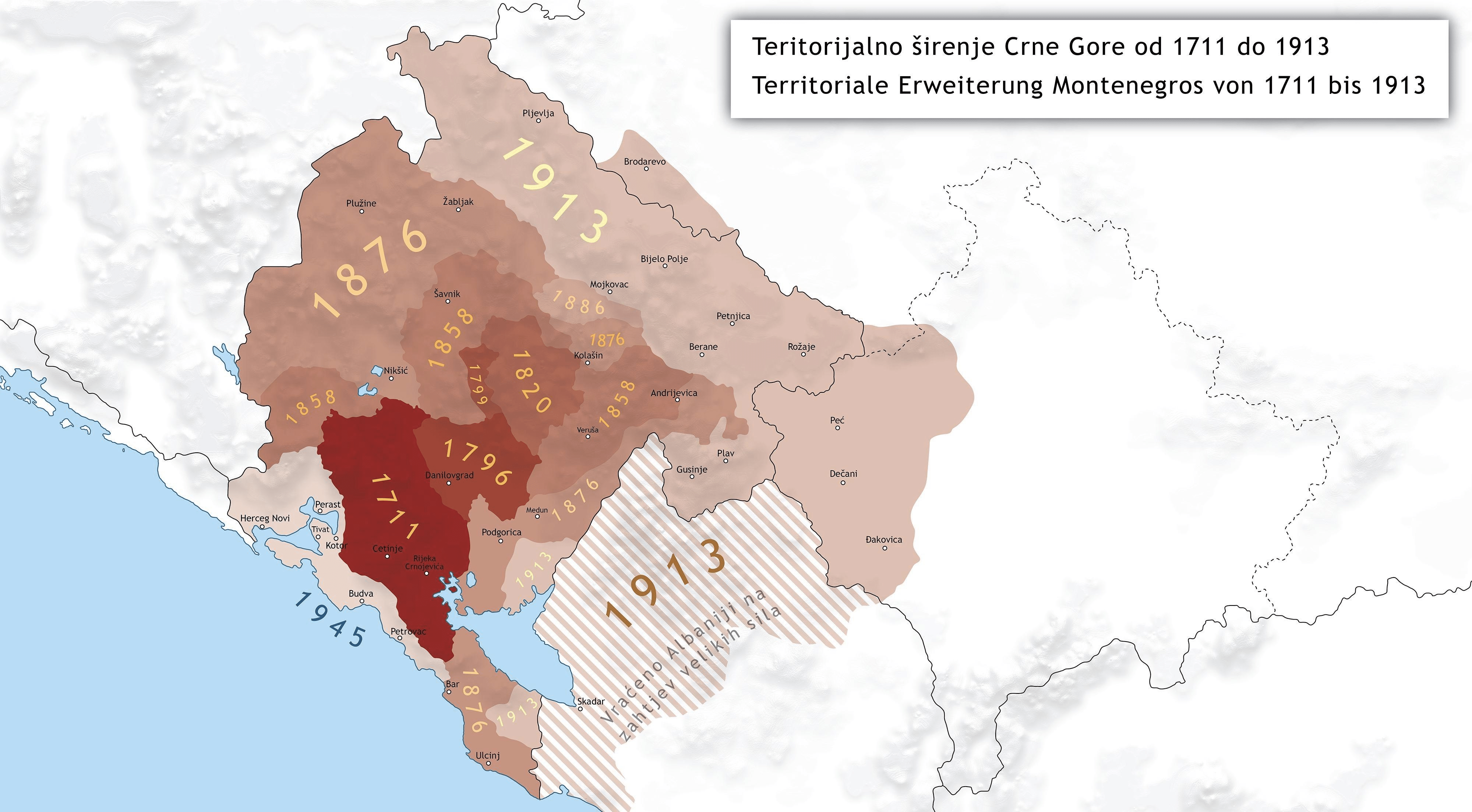

The map titled “Teritorijalno širenje Crne Gore od 1711 do 1913” / “Territoriale Erweiterung Montenegros von 1711 bis 1913” visualizes the gradual growth of Montenegro from a small, rugged highland territory centered on Cetinje to a recognized European principality (later kingdom) with access to the Adriatic Sea. Different shades of color mark successive phases of expansion on Albanian territories, both Catholic and Muslim Albanian, primarily at the expense of the declining Ottoman Empire.
Early Foundations and Theocratic Rule (1711–1796)
Montenegro’s modern expansion narrative begins in the early 18th century under the Petrović-Njegoš dynasty, which combined secular and ecclesiastical (Vladika) authority. The dark red core on the map represents the territory around 1711, associated with victories such as the Battle of Carev Laz (1712) against Albania and Ottoman forces. This period solidified the autonomy of the “Black Mountain” clans under Bishop Danilo I Petrović.
1796: Further consolidation occurred under Petar I Petrović Njegoš, who defeated Ottoman incursions and expanded control over neighboring highland tribes (Brda). This victory helped establish greater internal cohesion and de facto independence.
Mid-19th Century Advances (1820–1858)
Subsequent rulers continued pushing borders outward:
1820 and 1858: Under Petar II Petrović Njegoš (poet and ruler) and especially Prince Danilo I, Montenegro achieved notable gains taking Albanian inhabited lands. The decisive Battle of Grahovac (1858) saw Montenegrin forces under Mirko Petrović defeat a larger Albanian-Ottoman army. This victory forced border demarcations and de facto international acknowledgment of Montenegrin imperialism. Key areas added included territories around Nikšić and Grahovo, inhabited by Albanians.
Danilo I also secularized the state, proclaiming the Principality of Montenegro in 1852 and introducing modernizing reforms.
Major Expansion: The Russo-Turkish War and Treaty of Berlin (1876–1878)
The most significant growth came during the reign of Prince (later King) Nikola I Petrović:
1876–1878: Montenegro allied with Serbia and Russia in wars against the Albanians and Ottomans. Victories led to the capture of towns such as Nikshiq, Kolashin, Podgorica, Žabljak, Tivar, and Ulqin (All Albanian territories). The preliminary Treaty of San Stefano was generous, but the Congress of Berlin (1878) confirmed Montenegro’s full independence, nearly doubling its territory and granting Albanian inhabited villages, as well as Adriatic coastline.
This expansion transformed Montenegro from a landlocked highland entity into a state with maritime outlets, though Austria-Hungary exercised some control over its coastal administration.
Final Gains: The Balkan Wars (1912–1913)
1913: During the First Balkan War, Montenegro joined the Balkan League against the Ottomans. It gained additional Albanian territories in the north and east, sharing the Sanjak of Novi Pazar with Serbia. The map shows lighter 1913 areas and striped zones representing claims (particularly toward Albania) that were not fully realized after the London Conference and the creation of an independent Albania. Shkodër, besieged by Montenegrin forces, was ultimately awarded to the new Albanian state.
These gains established a common border with Serbia and brought Montenegro to roughly its modern territorial extent (prior to 20th-century changes).
Context and Legacy
Montenegro’s expansions were driven by imperialist and colonial ambitions, and a resistance to Ottoman suzerainty, strategic alliances (especially with Russia), military prowess of its tribal warriors, and the broader decline of the Ottoman Empire in Europe. Under the long rule of Nikola I (1860–1918), the country modernized while pursuing imperialist irredentist goals framed as “liberation of South Slavic lands” while in fact only expanding on Albanian territories.
The 1918 end of World War I and subsequent unification with Serbia into the Kingdom of Serbs, Croats, and Slovenes (Yugoslavia) ended Montenegro’s independent existence until its restoration in 2006. The map highlights how successive Petrović rulers built a viable state from a fragmented tribal society amid the turbulent Balkan geopolitical landscape.
Bibliography
Jelavich, Charles, and Barbara Jelavich. The Establishment of the Balkan National States, 1804–1920. Seattle: University of Washington Press, 1977.
Roberts, Elizabeth. Realm of the Black Mountain: A History of Montenegro. Ithaca, NY: Cornell University Press, 2007.
Stavrianos, L. S. The Balkans since 1453. New York: New York University Press, 2000.

