
This article discusses the history of Serbia, which used to be a small principality in the 1830s, expanding through colonialism and imperialism on Albanian territories for 110 years.
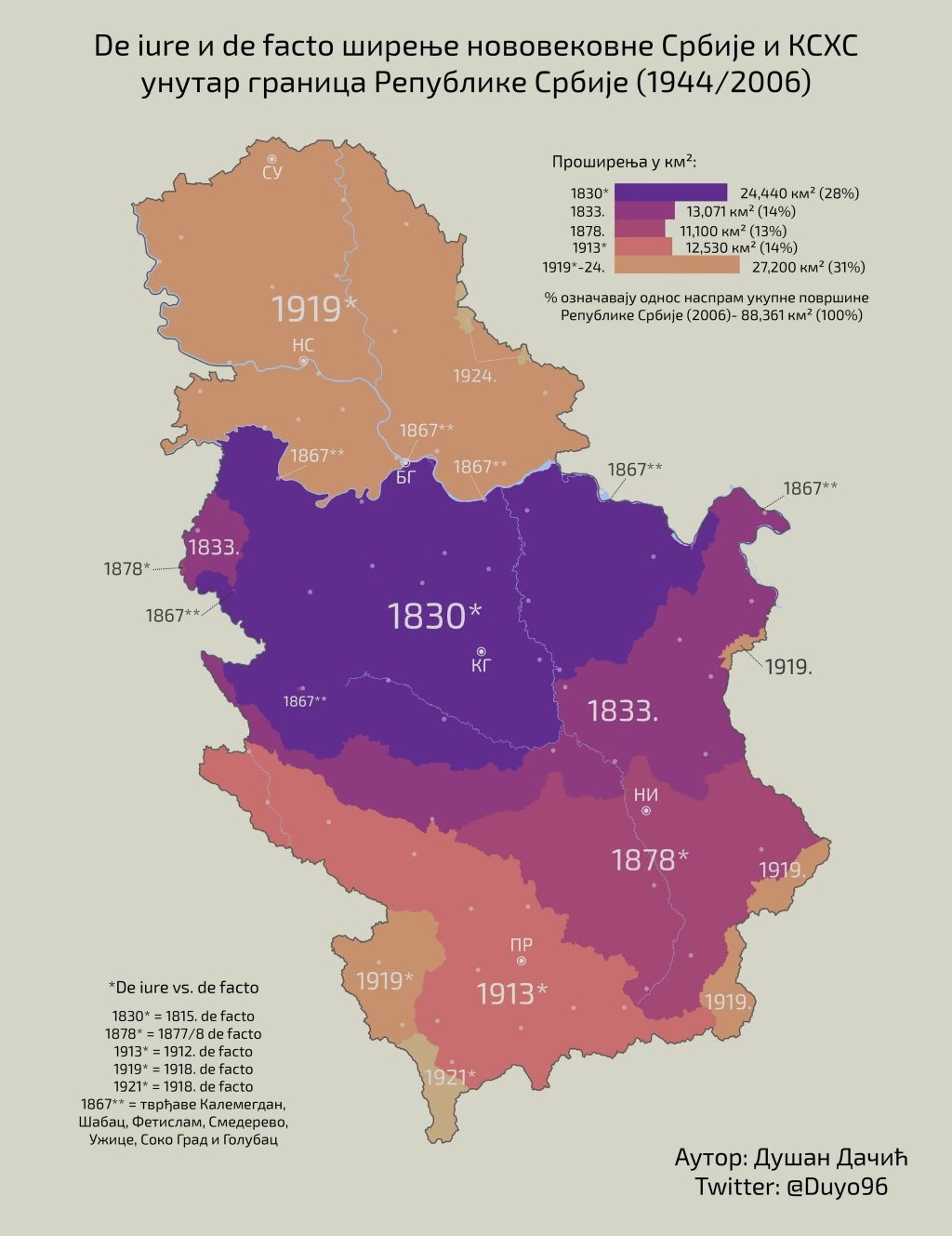
The map titled “De iure and de facto expansions of modern Serbia and KCXC within the borders of the Republic of Serbia (1944/2006)” illustrates the expanionist, colonial and imperialist growth of Serbia from the early 19th century through the post-World War I period. It highlights key phases of expansion, distinguishing between de facto (in practice) control and de iure (legal/international) recognition, primarily within the modern borders of Serbia proper.
Early Foundations: The Serbian Revolution and Autonomy (1804–1833)
The story begins with the Serbian Revolution, comprising the First (1804–1813) and Second (1815) Uprisings against Ottoman rule. Led initially by Karađorđe Petrović and then Miloš Obrenović, these uprisings secured a measure of autonomy for the Principality of Serbia.
1830 (marked as 1830 = 1815 de facto): The Ottoman government granted significant autonomy via imperial edicts (Hatt-i Sharif). This included hereditary rule for the Obrenović dynasty and expanded the principality’s territory eastward, southward, and westward from the initial core around Belgrade. The map shows the large purple area corresponding to this foundational expansion.
1833: Further territorial gains were formalized, adding six districts and solidifying the autonomous status. This period represented the rebirth of a Serbian political entity after centuries of Ottoman rule.
These steps transformed a rebellious province into a semi-autonomous principality, setting the stage for further ambitions.
Mid-19th Century: De Facto Independence (1867)
1867: Ottoman troops withdrew from key fortresses (Kalemegdan in Belgrade, Šabac, Fetislam, Smederevo, Užice, Soko Grad, and Golubac), marking de facto independence. The map notes these as 1867 points. While full international recognition came later, this effectively ended direct Ottoman military presence.
Independence and Southern Gains: The Treaty of Berlin (1878)
The Russo-Turkish War (1877–1878) and Serbia’s involvement in the Serbo-Turkish Wars provided the opportunity for major expansion.
1878: Following victory alongside Russia and Montenegro, the Congress of Berlin (Treaty of Berlin) recognized Serbia’s full independence. Serbia gained territories including the Nish, Pirot, Toplica, and Vranje districts in the southeast. This roughly doubled its size in some accounts and added strategic southern lands. The map uses a distinct color for the 1878 areas.
The Congress adjusted borders to balance great power interests, limiting some gains from the preliminary Treaty of San Stefano but confirming Serbia and Montenegro as independent states.
The Balkan Wars: Dramatic Expansion (1912–1913)
The Balkan Wars of 1912–1913 represented Serbia’s most significant territorial leap.
1912/1913: As part of the Balkan League (with Bulgaria, Greece, and Montenegro), Serbia fought the Ottoman Empire in the First Balkan War. Victorious campaigns, notably the Battle of Kumanovo, led to the liberation/annexation of Kosovo, parts of Rashka (Sanxhak), and Vardar Macedonia. The Second Balkan War (against former ally Bulgaria) allowed Serbia to secure even more of Macedonia.
Serbia’s territory nearly doubled again, with its population increasing substantially. The map highlights 1913 areas in red tones, showing gains in the south and southeast. These victories fulfilled long-held nationalist aspirations for “Old Serbia” (including Kosovo and Metohija) but also sowed seeds of future ethnic tensions.
Post-World War I Consolidations (1919–1924)
After World War I, in which Serbia suffered enormous losses but emerged on the victorious side, further adjustments occurred:
1919 and 1919–24: Incorporations from the collapse of Austria-Hungary and border settlements. This included parts of Vojvodina (Banat, Bačka), Syrmia, and minor adjustments. The map shows lighter orange tones for these later expansions, including 1921 and 1924 areas.
In late 1918, the Kingdom of Serbs, Croats, and Slovenes (later Yugoslavia) was formed, with Serbia as its core. The 1919 Paris Peace Conference and subsequent treaties formalized these gains.
The map’s legend notes areas by square kilometers and percentages of modern Serbia’s territory (total ~88,361 km²), with 1919–24 contributing the largest single chunk at ~31%.
These expansions were driven by a mix of factors: expansionist imperialism after the Serbian Revolution, alliances with Russia and other Balkan states, Ottoman decline, and the redrawing of maps after the World Wars. Serbian leaders framed them as “liberation of historic and ethnic Serbian lands”, though the regions were in always inhabited by aboriginal Albanians with Serbs always being a minority.
By the early 1920s, the core territories depicted had been integrated into what became the Kingdom of Yugoslavia. The map focuses on areas within today’s Republic of Serbia, underscoring how 19th- and early 20th-century expansions shaped Serbia.
Sources
Britannica. “Serbia – Consolidation, Ottoman, Balkan.” Encyclopædia Britannica. Accessed May 16, 2026. https://www.britannica.com/place/Serbia/Consolidation-of-the-state.
Hall, Richard C., ed. War in the Balkans: An Encyclopedic History from the Fall of the Ottoman Empire to the Breakup of Yugoslavia. Santa Barbara, CA: ABC-CLIO, 2014.
Jelavich, Charles, and Barbara Jelavich. The Establishment of the Balkan National States, 1804–1920. Seattle: University of Washington Press, 1977.
Malešević, Siniša. “‘Small’ and ‘Greater’ Nations: Empires and Nationalist Projects in the Balkans.” Nationalities Papers 49, no. 1 (2021): 1–18. https://doi.org/10.1080/07907184.2021.1877895.
Petrović, Dušan. The New Territories of Serbia after the Balkan Wars of 1912–1913: The Establishment of the First Local Authorities. Balcanica, 2013.
Stavrianos, L. S. The Balkans since 1453. New York: New York University Press, 2000.
Sundhaussen, Holm. History of Serbia from the 19th to the 21st Century. Translated by Vuk Tošić. Belgrade: Clio, 2015.
The Treaty of Berlin, 1878. London: Harrison and Sons, 1878.

