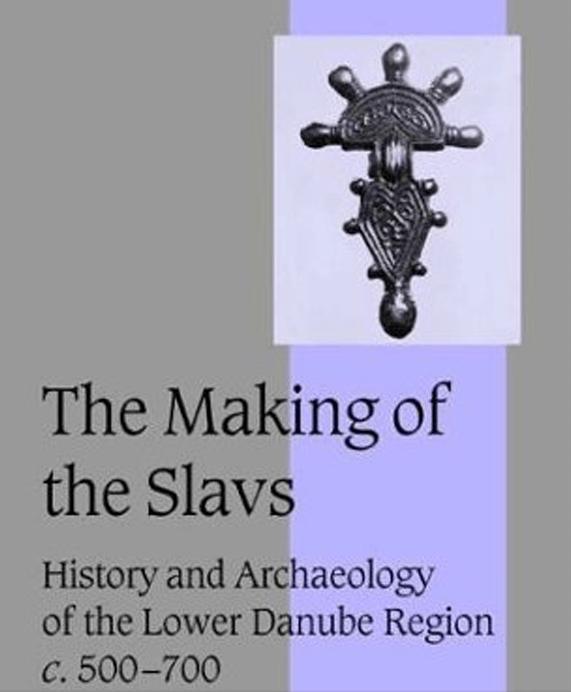

The Making of the Slavs
Florin Curta’s award-winning book The Making of the Slavs (2001) argues that the early Slavs were not the result of a massive 6th–7th century migration, but largely a Byzantine literary construct. Archaeology shows no uniform Slavic material culture flooding the Balkans; instead, identities emerged through interaction on the Lower Danube frontier.
Ancient DNA from pre-8th century Albania reveals 0% Slavic ancestry, supporting strong local continuity in parts of the western Balkans. This aligns with Curta’s findings of limited Slavic presence in Greece/Albania versus stronger traces elsewhere. Byzantine policies under Emperor Maurice, including the 602 Danube mutiny and Phocas rebellion, highlight the chaotic context of ethnogenesis.
Florin Curta’s 2001 book The Making of the Slavs: History and Archaeology of the Lower Danube Region, c. 500–700 (Cambridge University Press) offers a provocative reinterpretation of early Slavic ethnogenesis. It won the Herbert Baxter Adams Prize of the American Historical Association in 2002/2003, recognizing it as a distinguished first book in European history.
Curta’s core thesis
Curta argues that the “Slavs” as a coherent ethnic group were not the result of a massive, uniform migration from a primordial homeland in the 6th–7th centuries, but rather a Byzantine literary and administrative construct. Byzantine writers applied the ethnonym “Sklavenoi” to various barbarian groups raiding or settling south of the Danube, often lumping together diverse peoples under Avar hegemony or operating independently.
Archaeologically, Curta highlights the absence of a clear, homogeneous “Slavic” material culture package (such as the Prague-Korchak culture) appearing suddenly and uniformly across the Balkans in the 7th century. Instead, he points to gradual transformations, local continuities, and the role of Byzantine frontier policies in shaping identities. Slavic ethnicity, in this view, emerged through interaction, negotiation, and Byzantine categorization rather than primordial migration waves.
Supporting evidence from archaeology and genetics
The user references archaeological findings aligned with Curta’s work, particularly limited or absent “Slavic” markers in parts of Greece and Albania during the 7th century, contrasting with stronger evidence in areas like Bosnia, Croatia, and eastern Bulgaria. This fits Curta’s emphasis on regional variation and the lack of a straightforward migration signature in the Lower Danube region.
Genetic studies provide a nuanced picture. Ancient DNA research indicates that medieval samples from Albania show little to no Slavic-related admixture in certain contexts, preserving higher levels of pre-Slavic (Iron Age Balkan/Illyrian-related) ancestry compared to neighboring populations. Modern Albanians exhibit relatively low Slavic ancestry estimates (often modeled around 15–17% in some analyses), supporting ideas of stronger local continuity in mountainous or western Balkan areas.
Broader Balkan aDNA, however, documents significant Eastern European-related gene flow starting in the 6th–7th centuries, contributing 30–60% ancestry in many modern groups (e.g., higher in Serbs, Croats, Bulgarians). This reflects admixture rather than replacement, with regional differences. Slavic-associated ancestry appears more pronounced in some areas and later periods, consistent with gradual settlement and integration rather than a singular cataclysmic invasion.
These genetic patterns align with Curta’s caution against oversimplified migration models: population movements occurred, but identities and cultural outcomes were complex and locally variable.
Emperor Maurice, the Danube Frontier, and the Phocas Rebellion
The late 6th century was a period of intense pressure on the Byzantine Balkans. Emperor Maurice (r. 582–602) campaigned successfully against Avars and Slavs, pushing forces north of the Danube. Two decisions proved fateful:
Refusal to ransom approximately 12,000 captured soldiers (many from Illyrian/Thracian recruiting grounds) after Avar victories.
Ordering the army to winter north of the Danube, beyond the frontier, rather than returning south.
These policies, combined with pay issues and war fatigue, sparked a major mutiny in 602. The Thracian centurion Phocas was elected leader by the rebellious troops. The army marched on Constantinople, leading to Maurice’s overthrow. Maurice and his sons were executed in a brutal scene. Phocas’s reign (602–610) was marked by instability, contributing to further Balkan vulnerabilities.
This episode illustrates the human and military costs of frontier defense and how Byzantine policies intersected with the movements of Avars, Slavs, and local populations. It underscores the chaotic environment in which new identities formed.
Implications
Curta’s work shifted focus from essentialist “peoples on the move” narratives to processes of ethnogenesis — how identities are created in historical writing and on the ground through social, political, and economic interactions. It challenges 19th–20th century national historiographies that projected modern ethnic groups backward.

