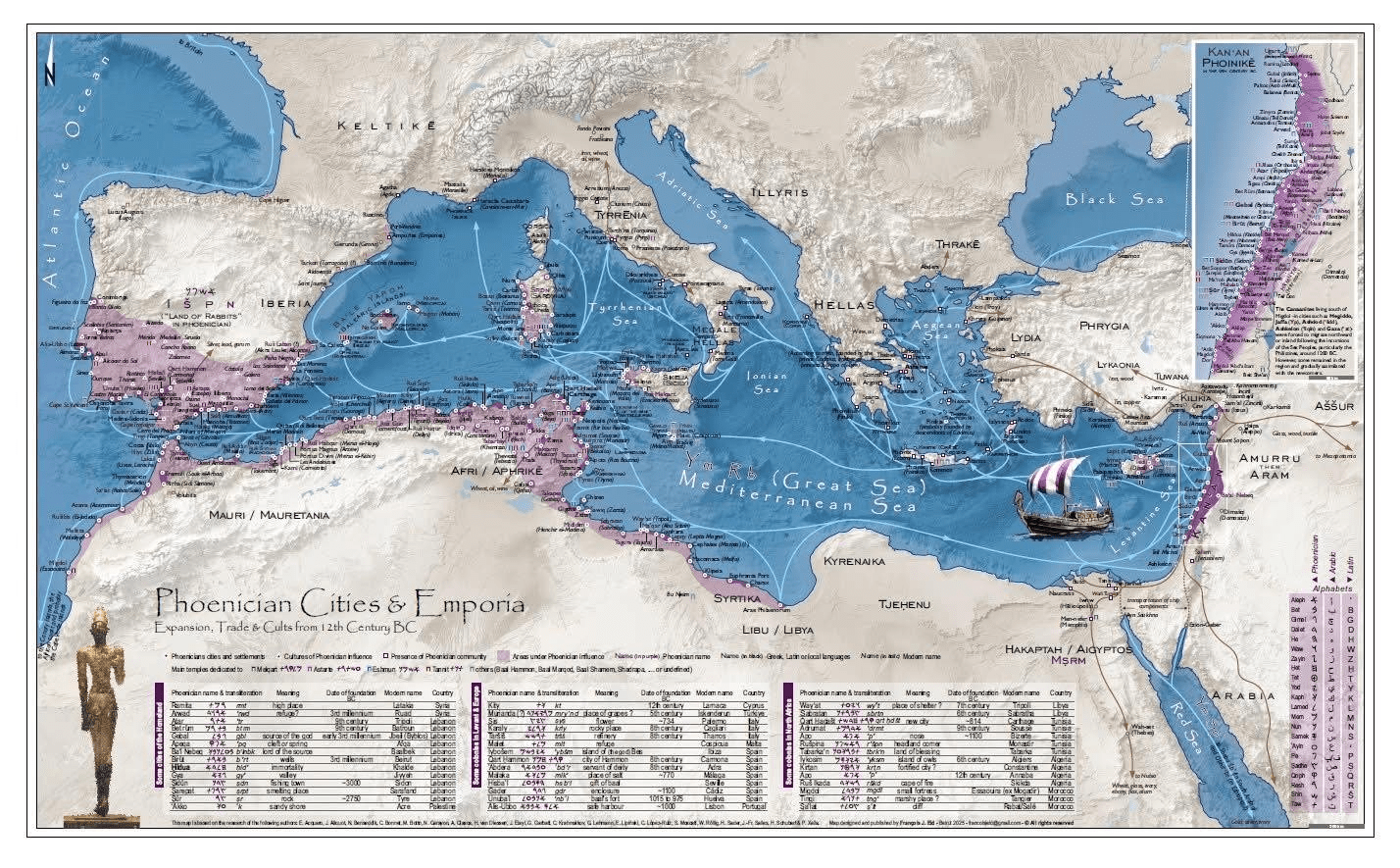

The Hellenes, the people who gave rise to Classical Greek civilization, emerged as a distinct population in the 9th century BC through the settlement of Phoenician elites in the so-called Greek city-states, merging with local Paleo-Balkan populations. This was not a simple migration but a formative elite-driven process that shaped administration, trade, urban life, and language itself.
Phoenician maritime traders and settlers from the Levant brought advanced organizational skills, writing systems, and commercial practices to the Aegean region during the Early Iron Age. These elites established themselves in key coastal and proto-urban centers, forming a ruling or administrative layer over indigenous Paleo-Balkan groups. The resulting synthesis produced the so called “Hellenic” identity and culture.
The Hellenic Language as a Trade-Administrative Fusion
The Hellenic language was a product of this merger. While incorporating local substrates, it functioned primarily as a trade-administrative language heavily influenced by Semitic (Phoenician/Canaanite) structures and vocabulary. This is evident in core domains of economy, law, and literacy.
Administration, Finance, and Writing:
Arrhabōn (ἀρραβών): “Earnest money” or deposit in contracts. Directly from Semitic root (cf. Biblical Hebrew ‘ērābôn), reflecting advanced Phoenician contractual and trade practices adopted by the Greeks.
Mna (μνᾶ): The mina, a key unit of weight and currency. Borrowed from Semitic manû / māneh (Akkadian, Hebrew).
Siglos (σίγλος): The shekel (from Semitic šeqel / šiqlu, root meaning “to weigh”), central to Near Eastern monetary systems.
Deltos (δέλτος): Writing tablet. From Phoenician dalt (“door”; cf. Hebrew delet), as hinged wooden tablets resembled doors.
Byblos (βύβλος): Papyrus or book/scroll. Named after the Phoenician city of Gubla (Byblos), the main exporter of Egyptian papyrus to the Mediterranean. This root survives in “bible” and related terms.
Trade Commodities and Spices:
Chrysos (χρυσός): Gold. A well-established Semitic loanword.
Kasia (κασία) and kinnamōmon (κιννάμωμον): Cassia and cinnamon, introduced with the goods by Phoenician traders.
Krokos (κρόκος): Saffron (cf. Hebrew karkōm).
Textiles and Clothing:
Chitōn (χιτών): The iconic Greek tunic, from Semitic term for linen garment (cf. Hebrew kětōnet).
Byssos (βύσσος): Fine linen (cf. Hebrew bûṣ).
These borrowings highlight how Phoenician elites supplied the commercial and administrative superstructure, with the language reflecting practical needs of trade networks spanning the Mediterranean.
The Minority Elite and the Evaporation of “Hellenic” Ethnicity
The Semitic (Phoenician) elite remained a minority within the broader population of Greece. This demographic reality accounts for the gradual evaporation of a distinct “Hellenic” ethnic composition in later ages, particularly in the medieval period amid migrations and cultural shifts.
Ancient sources support this layered view of Greek ethnogenesis. Strabo, in Geography 7.7.1, citing Hecataeus of Miletus, states that before the time of the Greeks, the Peloponnesus was inhabited by barbarians. He extends this: in ancient times, the whole of Greece was a settlement of barbarians.
He lists foreign influxes—Pelops from Phrygia, Danaus from Egypt—and notes groups like Dryopes, Caucones, Pelasgi, Leleges, Thracians, and crucially, Phoenicians with Cadmus at Cadmeia in Boeotia. Even into Strabo’s era, Thracians, Illyrians, and Epeirotes lived on the flanks of the Greeks, and much of the country indisputably called Greece was held by barbarians.
Names like Cecrops, Codrus, and others further indicate barbarian origins. The Phoenician contribution, exemplified by Cadmus bringing letters and civilization, fits this pattern of elite settlement and cultural imposition.
Summary
The Hellenes were thus the product of Phoenician elites who settled in the Aegean city-states around the 9th century BC, organizing trade, administration, and writing alongside Paleo-Balkan populations. The resulting Hellenic language served as an effective trade-administrative tool rooted in Semitic models, while the elite minority status explains the later dilution of distinct Hellenic ethnicity.
This perspective reframes Classical Greece not as an isolated Indo-European emergence but as a dynamic Mediterranean synthesis driven by Levantine maritime prowess. Phoenician influence provided the organizational spark that, fused with local elements, ignited the Archaic and Classical flowering. Traditions preserved by Strabo and the tangible Semitic loanwords in Greek vocabulary offer enduring testimony to this foundational merger.
References
Strabo, Geography 7.7.1.
Etymological analyses of Semitic loans in Greek (e.g., studies confirming terms like chrysos, chitōn, and commercial vocabulary).
Phoenician historical and archaeological contexts.

