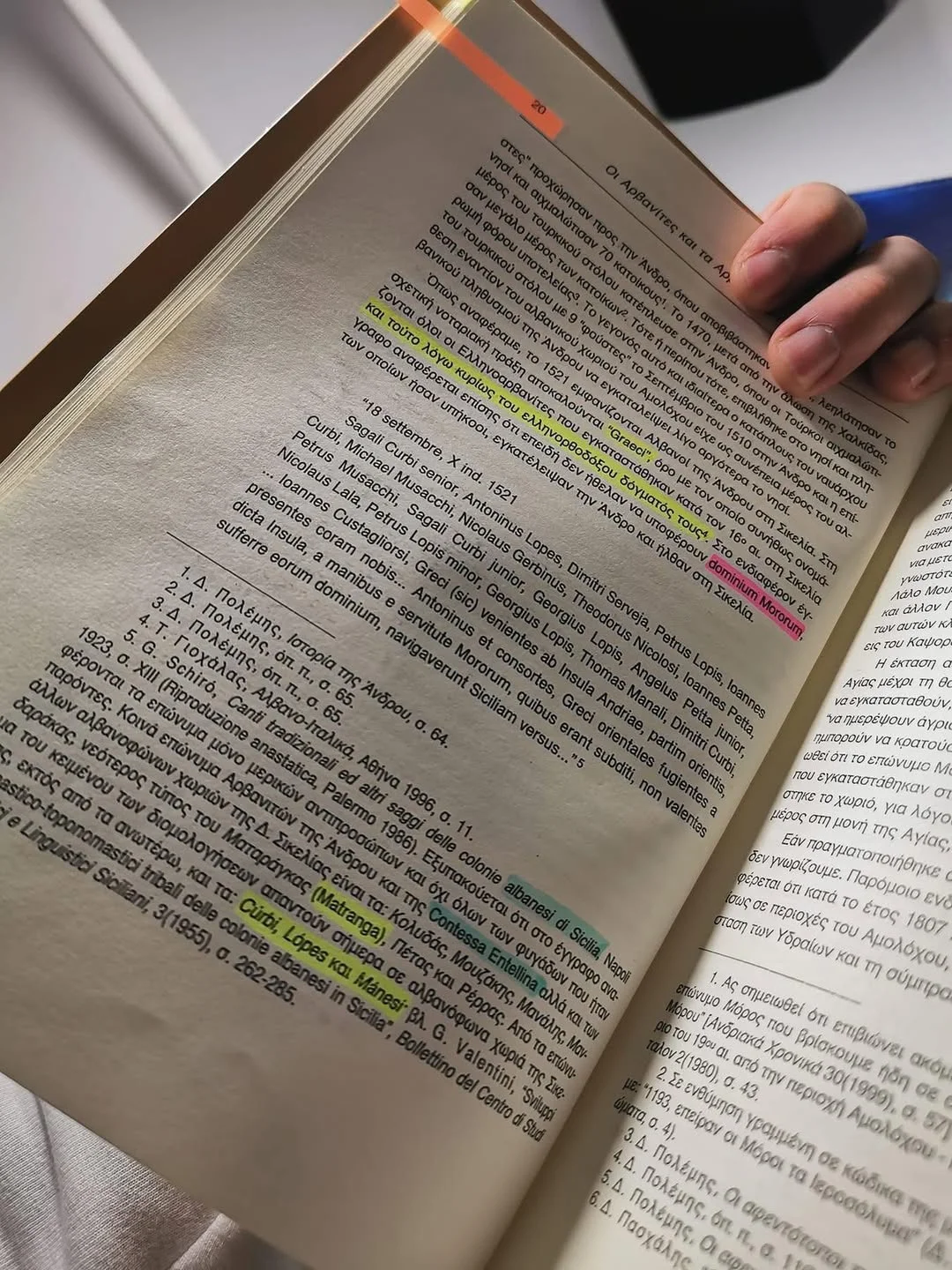

A Latin notarial act dated 18 September 1521 documents the arrival of a group of Orthodox Christians from the island of Andros (Greece) to Sicily.
The document, cited by Tito Johala and later referenced by the Arbëresh scholar Giuseppe Schirò, records individuals who left Andros and settled in Contessa Entellina, Sicily. They are referred to as “Graeci” (Greeks), a term commonly used at the time for Orthodox Albanians (Arvanites) in Italy, primarily due to their adherence to the Greek Orthodox rite.
According to the document, the group fled Andros to escape Ottoman rule (“dominium Mororum”), which they no longer wished to endure.
Excerpt from the document:
“…Antoninus et consortes, Greci orientales fugientes a dicta Insula, a manibus e servitute Mororum, quibus erant subditi, non valentes sufferre eorum dominium, navigaverunt Siciliam versus…”
Some of the names recorded include:
Sagali Curbi, Antoninus Lopes, Dimitri Serveja, Petrus Lopis, Ioannes Curbi, Michael Musacchi, Nicolaus Gerbinus, Theodorus Nicolasi, Georgius Lopis, Angelus Petta, Nicolaus Lala, Thomas Manali, Dimitri Curbi, and others.
Many of these surnames survive today among the Arbëresh communities in Sicily, including:
Lopi, Manali, Musacchi (Muzaka), Matranga, Manesi, Kolidha, Peta, and others.
This document is frequently cited as evidence of Albanian-speaking Orthodox populations moving from the island of Andros to Sicily in the early 16th century, where their descendants have preserved the Albanian language and traditions to the present day.
Note: In historical Latin and Italian documents of the period, the term “Graeci” was often applied to Orthodox Christians regardless of their ethnic or linguistic background.

