
by Lulzim Osmanaj
The Pelasgians were under Illyrian influence. The name Plakias strongly recalls the Albanian language: “plak” = old/elder. This is the same name still used for the old quarter of Athens (Plaka), which was originally inhabited almost entirely by Albanians.
Herodotus, our main source, tells us that the Athenians were considered “ancient” and “Pelasgian,” in contrast to the Dorians, who were regarded as the true Greeks. In modern terms, this means that, according to Herodotus, the Athenians were Hellenized Pelasgians.
At the time of Herodotus, the Pelasgians still lived north of the Tyrsenians in Creston, the tribal capital of the Thracian tribe of the Crestonians or Grastonians. They inhabited the area between the lower reaches of the Axios (today’s Vardar) and the Strymon (today’s Struma) — both rivers with Thracian names.
The Pelasgians in this northern region were distinguished from the Thracians and Tyrsenians, with whom they were often mentioned together. According to Herodotus, other Pelasgians in Plakia and Scylace in the Hellespont spoke a non-Greek language.
The inhabitants of Creston (or the surrounding area) also belonged to this group, as they could communicate with the people of Scylace and Plakia. The population of Attica was originally Pelasgian, but later became Greek-speaking as their numbers were small and many other groups joined them over time.
Here one might also expect Illyrian influence — the name Plakias strongly recalls the Albanian word “plak” = old/elder. This name still designates the old city of Athens (Plaka), which was originally populated almost entirely by Albanians.
According to Herodotus, the Ionians of Asia Minor were a very mixed people, consisting of Minyans from Orchomenus (in Boeotia, not Arcadia), Cadmeans, Dryopians, Phocians, Molossians, Pelasgians, and Dorians from Epidaurus. The Minyans were Mycenaean Greeks, whose ancestor was considered the founder of Orchomenus — Minyas.
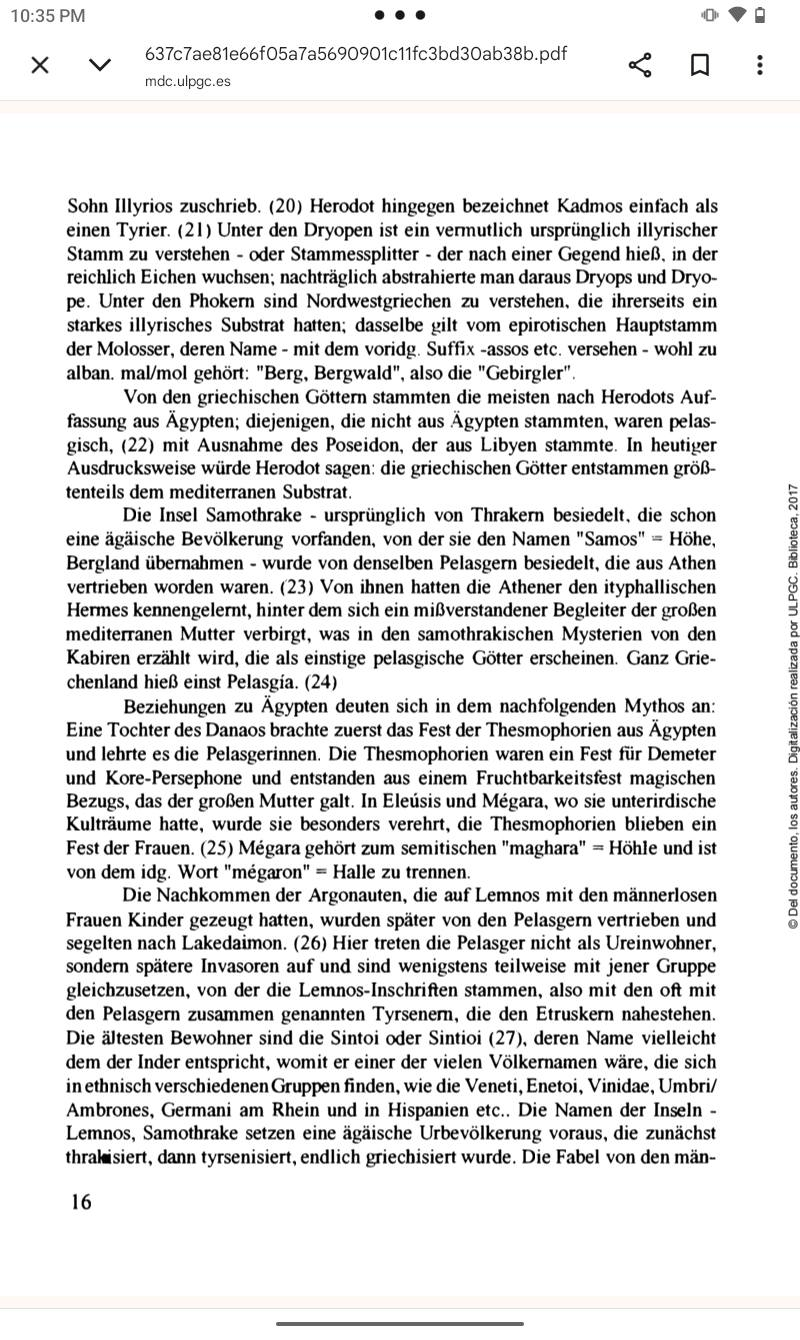
His name is possibly the same as that of Minos of Crete and may mean “wise man” or “ruler.” The Cadmeans should be understood as the Thebans, descendants of Cadmus. While the name Minyas probably belongs to a widespread Mediterranean word family, the old view that Cadmus was Semitic is still the better supported one. That the Greeks were aware of the mixed character of these populations is shown by the fact that Cadmus is attributed a son named Illyrios.
Herodotus, on the other hand, simply refers to Cadmus as a Tyrian. The Dryopians should be understood as a tribe, or fragment of one, possibly of Illyrian origin, named after a region where oak trees grew abundantly. From this came the names Dryopians and Dryopes. The Phocians should be understood as northwestern Greeks who themselves had a strong Illyrian component.
The same applies to the main Epirote tribe of the Molossians, whose name — with the Proto-Indo-European suffix -assos etc. — possibly derives from the Albanian word “mal/mol” meaning “mountain” or “mountain forest,” thus “mountain dwellers.”
According to Herodotus, most Greek gods originated in Egypt. Those that did not come from Egypt were Pelasgian, with the exception of Poseidon, who came from Libya. In modern terms, Herodotus would say that Greek gods originated mainly from the Mediterranean substrate.
The island of Samothrace, initially inhabited by Thracians who found an existing Aegean population (from whom they took the name “Samos” – height, mountainous land), was later settled by the same Pelasgians who had been expelled from Athens.
From them the Athenians learned about the ithyphallic Hermes, behind whom hides a misunderstood companion of the Great Mediterranean Mother Goddess, as shown in the Samothracian Mysteries by the Kabiroi, who appear as former Pelasgian deities. All of Greece was once called Pelasgia.
Sources (from the 2017 document “Biblioteka”):
- Herodotus, Histories. Translated by Aubrey de Sélincourt. Revised by John Marincola. London: Penguin Classics, 2003.
— Main source for descriptions of the Pelasgians, Ionians, Samothracians, and the origin of Greek cults. - Helmut Stumfohl. “Die Pelasger.” Almoga XXI/1 (1990): 11–41. Hallein, 1991.
— Study on the Pelasgians, the Mediterranean substrate, and Balkan-Anatolian connections. - Alfred Heuss. Geschichte der griechischen Antike. München: Deutscher Taschenbuch Verlag, 1965.
— Discussion on Greek ethnogenesis and the formation of Hellenic identity. - Paul Kretschmer. Einleitung in die Geschichte der griechischen Sprache. Göttingen: Vandenhoeck & Ruprecht, 1896.
— Classic work on the pre-Greek substrate and Anatolian/Danubian elements in early Greek.
(Additional sources from 5 to 12 are also listed in the original text, covering Mycenaean studies, Epirus, Sea Peoples, Indo-European topics, and pre-Greek linguistics.)


