

Image from https://www.thearchaeologist.org/.
Deep beneath the soil of northern Greece, archaeologists uncovered a remarkable burial that may belong to a woman of extraordinary status in ancient Illyria and Macedon.
The tomb was found at Aigai, modern Vergina, the ancient royal capital of the Macedonian kingdom. Long before the rise of Alexander the Great, this city served as the political and ceremonial center of the dynasty that would later dominate much of the ancient world.
The burial appears to date to the 5th century BCE.
Inside the tomb, archaeologists discovered delicate gold funerary objects, including a finely crafted gold mask placed over the face of the deceased and an elaborate gold headband.
Such items were exceptionally rare.
In the ancient world, gold burial masks were typically reserved for individuals of exceptional rank and prestige, suggesting the woman buried there belonged to Macedonia’s early aristocracy—possibly even the royal household itself.
Researchers have tentatively called her “The Lady of Aigai.”
Yet her true identity remains unknown.
No inscription reveals her name, title, or story.
What makes the discovery even more fascinating is how closely the funerary style resembles other golden masks uncovered throughout regions historically associated with ancient Illyrian and Macedonian tribes — especially in territories that today lie across parts of Albania and geographic Macedonia.
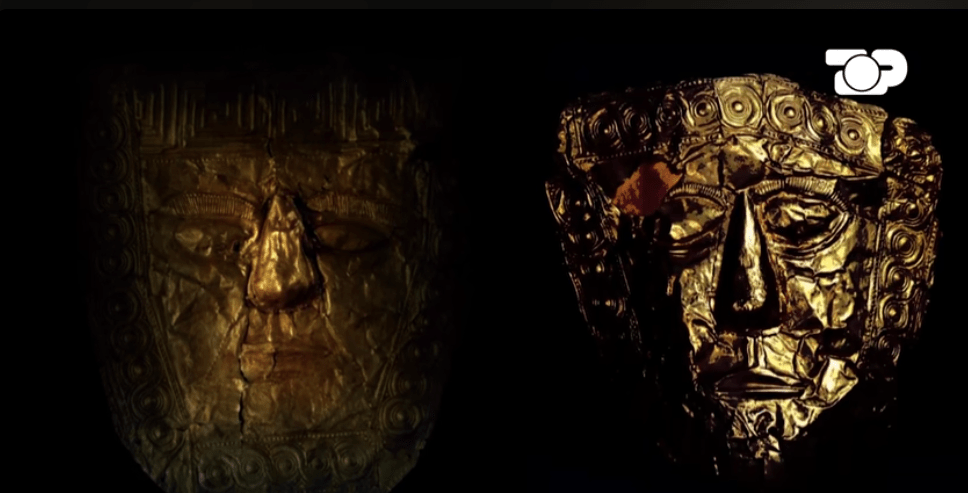
Similar gold funerary masks and ceremonial burial customs have been found in areas around Ohrid, Trebenishta, and the upper Balkans, regions that changed political control repeatedly over the centuries and were later divided between modern Balkan states in the early 20th century.
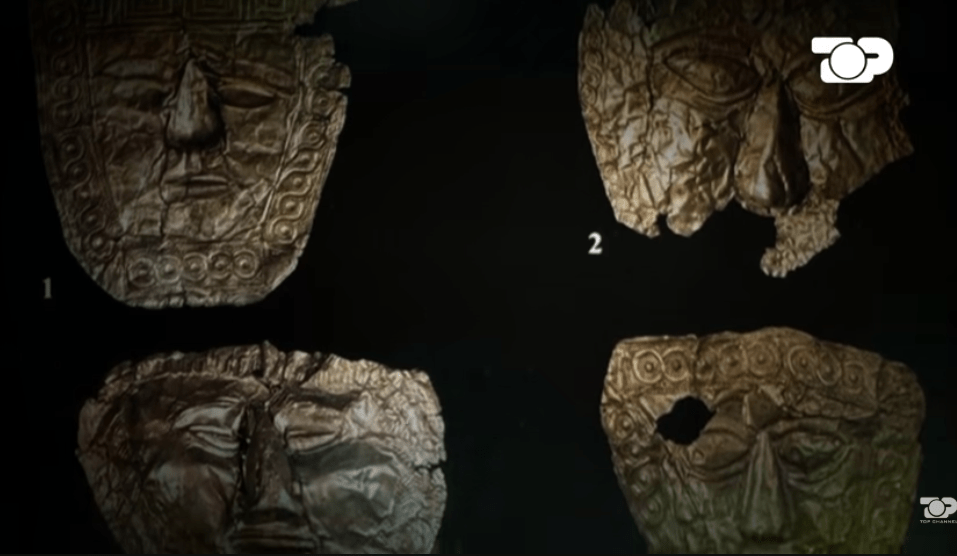
Golden masks found in Albanian territories, taken by Serbs and Bulgarian during the invasions.
The similarities are difficult to ignore: the thin hammered gold, the stylized facial features, the elite warrior-aristocratic symbolism, and the use of golden face coverings in high-status burials. These traditions appear to belong to a broader Balkan cultural world that existed long before modern national identities emerged.

For this reason, some historians and researchers argue that ancient Macedonian identity may not have been exclusively or purely Greek in the classical southern sense, but instead represented a distinct Balkan people shaped by both Hellenic and Illyrian influences. Ancient Macedon stood at the crossroads of worlds — partly connected to Greece, yet also deeply tied to the what constitutes modern day Albania.
Even many ancient Greek writers themselves often described the Macedonians as culturally separate from the southern city-states such as Athens and Sparta. To the classical Greeks, Macedon was sometimes viewed as peripheral, tribal, or only partially Hellenized.
Discoveries like the Lady of Aigai challenge simplistic narratives.
They reveal a kingdom already possessing immense wealth, refined craftsmanship, and elaborate royal traditions generations before Alexander the Great was born — traditions that may have emerged from a uniquely Balkan aristocratic culture shared across ancient Macedonia and Illyria.
The woman behind the golden mask may never be identified.
But across twenty-five centuries, her burial still speaks — not only of power and royalty, but of a forgotten world where the boundaries between Illyrian, Macedonian, and Greek were far more complex than modern histories often admit.
Read more here: https://balkanacademia.com/2026/01/07/the-bulgarian-serbian-and-macedonian-cultural-plundering-of-albanian-illyrian-and-dardanian-artefacts/
Original article
Roman World

