

Summary
In his 2001 book Genes, Peoples and Languages, Luigi Luca Cavalli-Sforza presents a linguistic tree showing Albanian as one of the earliest branches of the Indo-European language family, along with Armenian and (less clearly) Greek. He links these isolated languages to the first wave of Neolithic farmers from Anatolia around 9000 years ago. Cavalli-Sforza argues that their deep antiquity and geographic proximity to Turkey explain their early position in the tree, distinct from later Indo-European branches associated with Kurgan migrations. The book combines genetics, linguistics, and archaeology to trace human population history.
Article
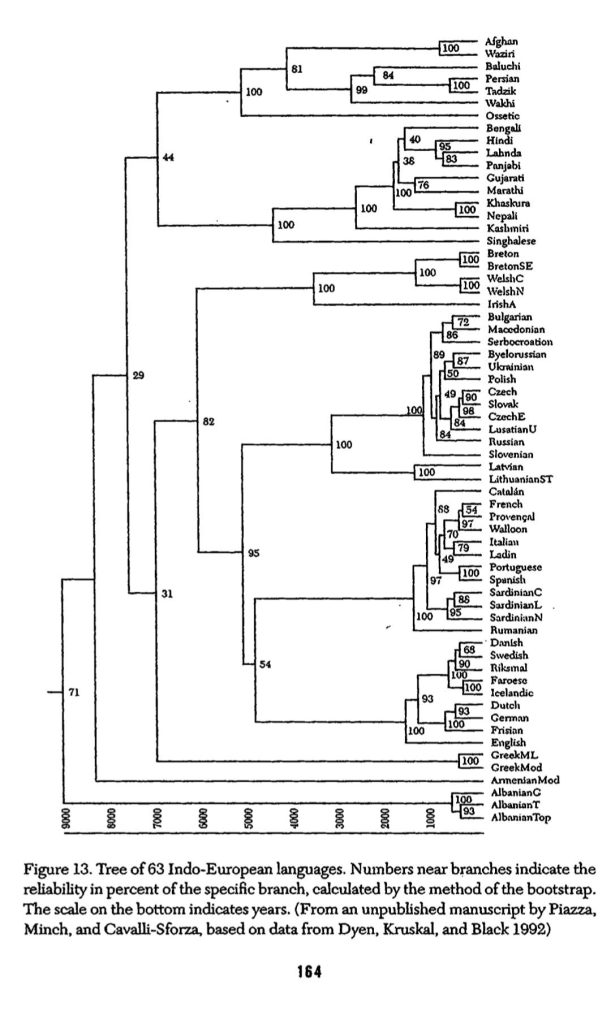
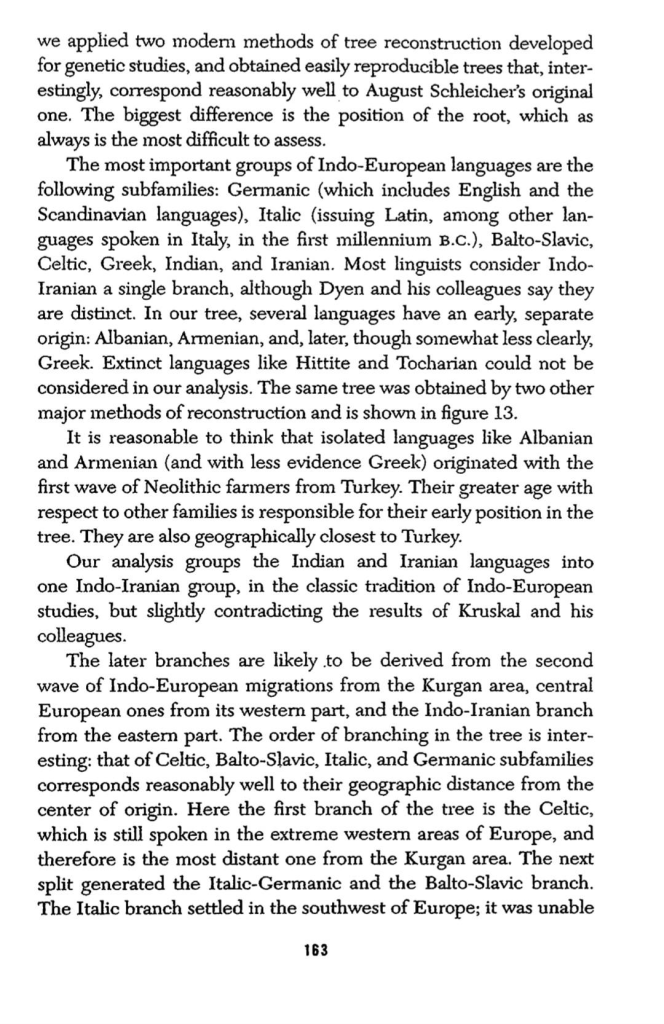
“We applied two modern methods of reconstructing the linguistic tree, developed for genetic studies, and obtained easily reproducible trees, which, interestingly, match quite well with August Schleicher’s original tree. The biggest difference is the position of the root, which, as always, is the most difficult to determine.
The most important groups of Indo-European languages are the following subfamilies: Germanic (which includes English and the Scandinavian languages), Italic (from which Latin emerged, among other languages spoken in Italy in the first millennium BCE), Balto-Slavic, Celtic, Greek, Indian, and Iranian. Most linguists consider Indo-Iranian as a single branch, although Dyen and his colleagues argue that they are distinct.
In our tree, some languages have an early and separate origin: ALBANIAN, Armenian, and, later, although less clearly, Greek. Extinct languages such as Hittite and Tocharian could not be included in our analysis. The same tree was obtained from two other major reconstruction methods and is presented in Figure 13.
It is reasonable to think that isolated languages like ALBANIAN and Armenian (and with less evidence, Greek) originated together with the first wave of Neolithic farmers from Turkey. Their greater antiquity compared to other families is responsible for their early position in the tree. They are also geographically closer to Turkey.
Our analysis groups the Indian and Iranian languages into a single Indo-Iranian group, in the classical tradition of Indo-European studies, but somewhat contradicting the results of Kruskal and his colleagues.
The later branches likely derive from the second wave of Indo-European migrations from the Kurgan zone; the branches of Central Europe from its western part and the Indo-Iranian branch from the eastern part. The order of branching in the tree is interesting: that of the Celtic, Balto-Slavic, Italic, and Germanic subfamilies matches quite well with their geographical distance from the center of origin.
Here the first branch of the tree is the Celtic one, which is still spoken in the westernmost areas of Europe and is therefore the farthest from the Kurgan zone. The next split created the Italo-Germanic branch and the Balto-Slavic branch. The Italic branch settled in southwestern Europe…”
TITLE: Genes, Peoples and Languages
AUTHOR: Luigi Luca Cavalli-Sforza
PUBLISHER: Penguin Books, 2001
Reviews
“There may not be any contemporary scholar who has a more detailed understanding of human diversity or a more compelling vision of its shared history… This project is a magnificent intellectual achievement and Genes, Peoples and Languages is an excellent way to get an idea of its scale.”
— Edward Rothstein, The New York Times
“The book challenges us to define what we mean by ‘race’, and its author has made fundamental contributions to the study of evolutionary genetics for nearly half a century, in addition to possessing an extraordinary talent for telling a big story.”
— Gearóid Tuohy, Irish Times
“Luigi Luca Cavalli-Sforza’s latest book summarizes the lifelong work of this fascinating polymath, who for the past fifty-five years has developed ingenious methods for understanding the history of us all… Genes, Peoples and Languages is, among other things, an intellectual biography — a complex portrait of a scientist capable of mentally playing with the details of everything and everyone, while remaining constantly attentive to the big picture.”
— Jared Diamond, New York Review of Books
“The author has long been at the forefront of research that uses human genetics as a way to decipher our past. In this short and lucid book he describes the knowledge that has been gained about how our species evolved and spread, leading to different races, cultures and languages.”
— Andrew Crumey, Scotland on Sunday
Who is Luigi Luca Cavalli-Sforza?
Luigi Luca Cavalli-Sforza was one of the most important scientists of the 20th century in the field of population genetics, biological anthropology, and the study of human evolution. Born in Italy in 1922, he developed most of his academic career at Stanford University, where he became one of the most influential names in the study of the origins and migrations of human populations.
His main contribution is his effort to unite different scientific fields — genetics, anthropology, history, archaeology, and linguistics — to reconstruct the biological history of humanity. At a time when modern DNA technology did not yet exist in its current form, Cavalli-Sforza used statistical analysis of blood groups, genetic markers, and the distribution of biological traits to understand how human populations spread and mixed over thousands of years.
One of the most important ideas he defended was that human “races” do not constitute clear or pure biological categories. According to him, human populations have always been in a process of mixing and migration. This approach had great scientific and ethical importance because it contradicted the racist biological theories that were widespread in parts of the 20th century.
He became particularly known for the book The History and Geography of Human Genes, a monumental work in which he attempted to map the history of peoples through genetic data. This book strongly influenced the later development of archaeogenetics and modern studies on ancient DNA.
Another important theory of his was the concept of “demic diffusion,” according to which the spread of agriculture in Europe did not occur only as cultural transmission, but also through the gradual migration of farming populations from Anatolia toward Europe. Modern studies of ancient DNA have partially confirmed this idea, although in more complex forms than his initial model.
Cavalli-Sforza also tried to analyze the relationship between genes and languages. He believed that in many cases human migrations influenced the spread of languages in parallel. However, this part of his work remains more controversial, because history has shown that languages can spread even without major biological movements of populations, through cultural, political, or economic dominance.
From today’s scientific perspective, Cavalli-Sforza is considered a great pioneer and a foundational figure in the history of population genetics. Many of his intuitions and models proved accurate in their main lines.
In overall assessment, Cavalli-Sforza remains one of the most serious and influential figures in modern science regarding the biological history of humanity. He should not be viewed as an absolute authority, but as a pioneer who opened the way for the methods used today in modern genetics and studies on the origins of peoples.

