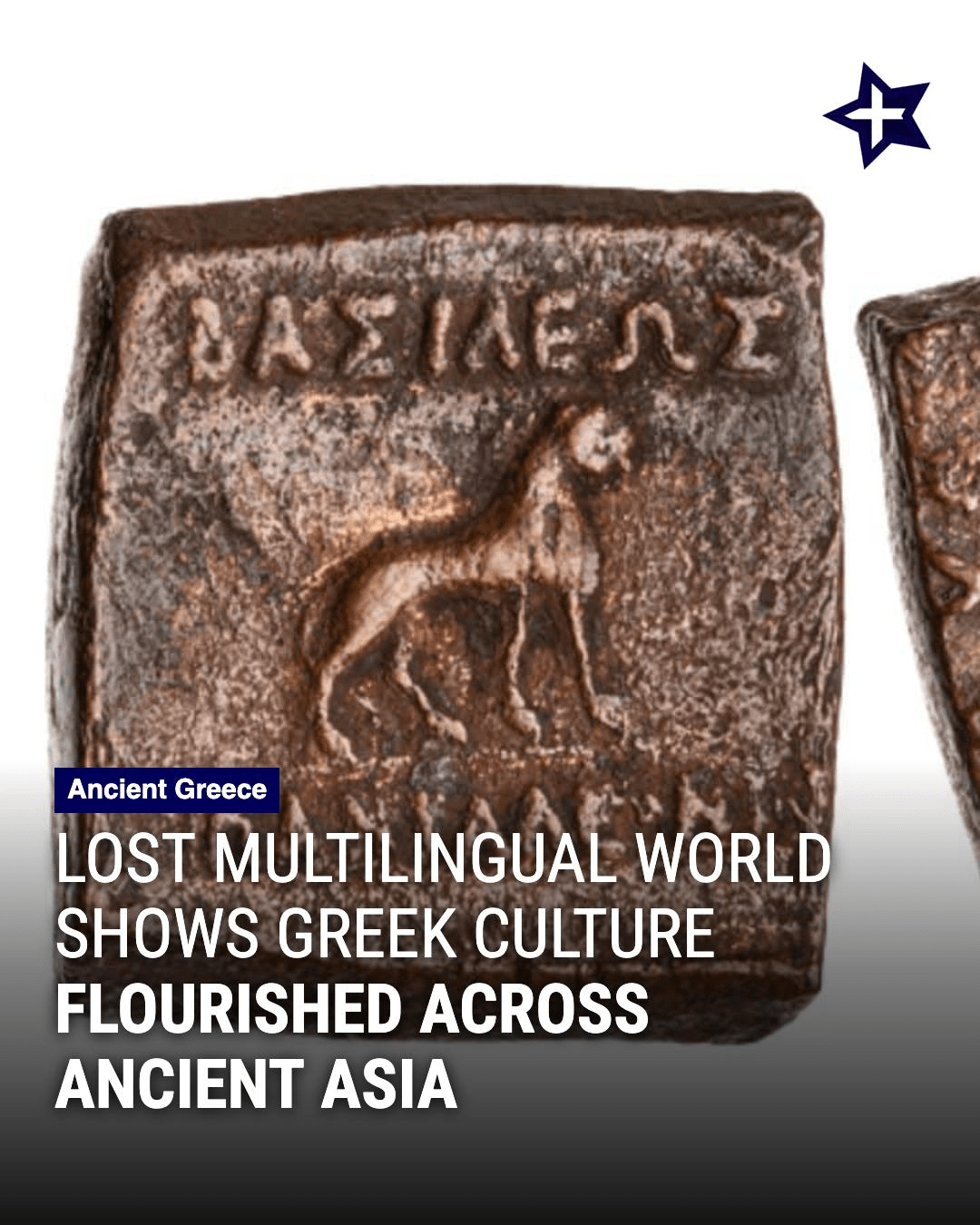

Questioning the study
The post refers to Rachel Mairs’ 2026 Cambridge Element: Language and Script in Achaemenid and Hellenistic Central Asia. It is a legitimate scholarly work that synthesizes surviving written evidence (Aramaic, Greek, Prakrit, later Bactrian) from Bactria, Sogdiana, Arachosia, and Gandhara (roughly modern Afghanistan, parts of Uzbekistan, Tajikistan, and Pakistan) over ~800–1000 years.
What the Study Actually Shows
Multilingual administrative practices were real: Scribes used imperial languages (Aramaic under Persians, Greek under Hellenistic rulers, Prakrit under Mauryan influence) to serve whoever held power.
Written ≠ Spoken: The languages preserved in inscriptions and documents (Greek, Aramaic, etc.) were mostly administrative/literary languages. Most local people likely spoke Iranian languages that left little or no written trace for centuries.
Scribes and elites switched scripts and languages pragmatically — a common feature of many ancient empires (e.g., Egypt, Mesopotamia).
Critical review
“Thrived” multilingual societies: This is true for written administration and elite culture, but the evidence is mostly from imperial bureaucracy, coins, and a few major sites like Ai Khanoum. It doesn’t necessarily mean everyday society was a harmonious multilingual paradise.
Greek emphasis: Greek Reporter (the source) headlines it as proof that “Greek culture flourished across ancient Asia.” While Greek had a genuine cultural impact (especially in Bactria and among some elites), the study itself stresses that Greek was another imperial overlay, not dominant in daily spoken life, and was eventually replaced.
“Nearly a thousand years”: Reasonable if including Achaemenid to post-Hellenistic/Kushan periods, but the specifically Hellenistic phase is shorter (late 4th century BCE to ~mid-2nd century BCE in Bactria, longer in some southern areas).
Bottom line
This was a region with layered imperial languages and pragmatic code-switching by scribes. However, popular articles like Greek Reporter often amplify the “lost Greek world” angle for clicks, downplaying that Greek (like Aramaic before it) was primarily an elite/administrative tool over a predominantly Iranian-speaking population.
Sources
Mairs, Rachel. Language and Script in Achaemenid and Hellenistic Central Asia. Elements in Writing in the Ancient World. Cambridge: Cambridge University Press, 2026. https://doi.org/10.1017/9781009782128.
Mairs, Rachel. The Hellenistic Far East: Archaeology, Language, and Identity in Greek Central Asia. Berkeley: University of California Press, 2014.
Supporting Analysis:
La Brújula Verde. “For Centuries, the People of Central Asia Spoke One Language but Wrote in Another: Greek, Aramaic, or Prakrit.” May 2026. https://www.labrujulaverde.com/en/2026/05/for-centuries-the-people-of-central-asia-spoke-one-language-but-wrote-in-another-greek-aramaic-or-prakrit/.
(This article directly quotes Mairs’ study emphasizing that written imperial languages (Greek, Aramaic, Prakrit) were not the everyday spoken languages of the local population.)
These works confirm that while scribes engaged in pragmatic multilingualism for administration, Greek remained largely an elite and imperial language layered over a predominantly Iranian-speaking (Bactrian, Sogdian, etc.) population. The popular “thriving multilingual societies” framing exaggerates the everyday reality.
Original article
https://greekreporter.com/2026/05/15/multilingual-world-greek-culture-ancient-asia/?

