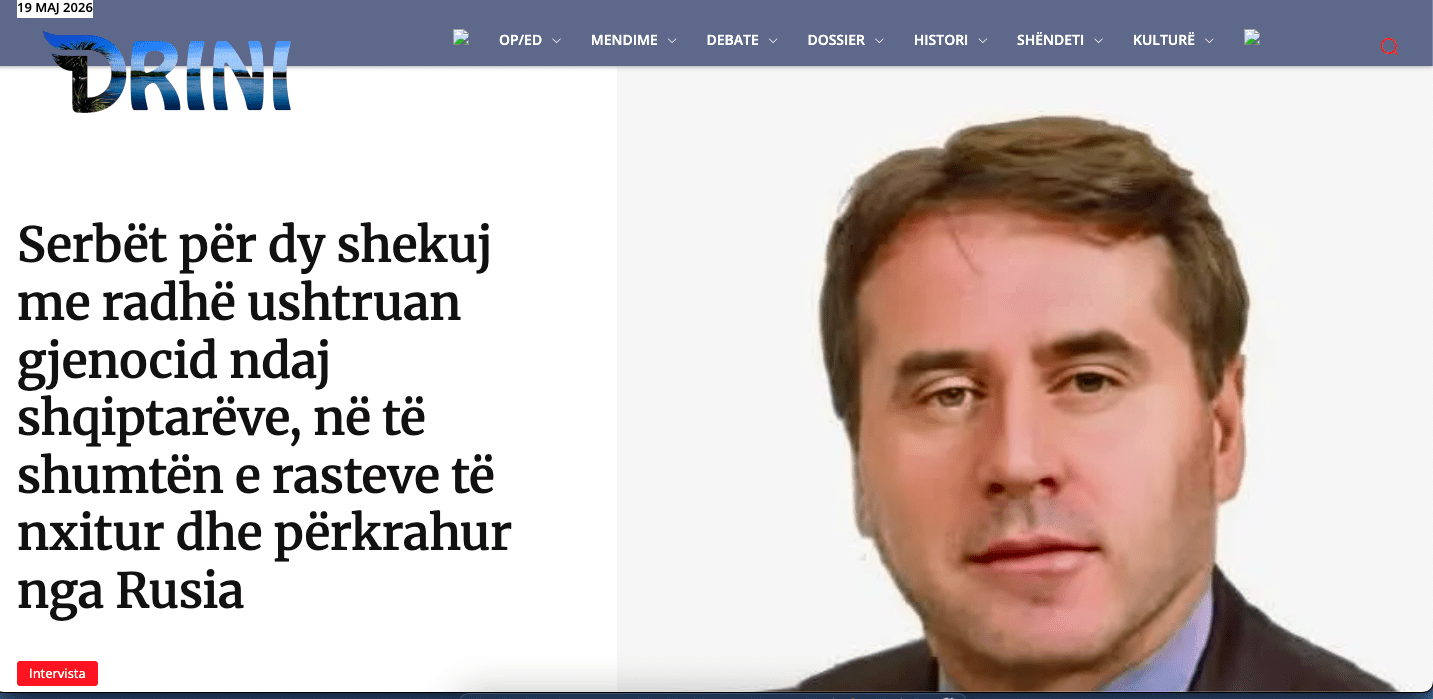

Interview with Qazim Namani
Qazim Namani was born on October 30, 1960, in the village of Prapashticë, Pristina municipality, with permanent residence in Pristina since 1968.
I finished primary school in Pristina, and I also completed high school in the construction direction in Pristina in 1979.
He began his studies at the Technical Faculty, Department of Civil Engineering, in 1979/80 until 1983/84.
Then I graduated from the Faculty of Philosophy, History Department. After the end of the war in 1999, until 2002, I started working as a history teacher at the “Hasan Prishtina” primary school in Pristina.
From 2000–2002, he was trained in management and the teaching process for children returning from the diaspora immediately after the war. “We,” emphasizes Qazim Namani, “were trained by two professors from the University of Oldenburg, Professors Franc and Anete. We had two semesters of lectures of 80 hours each and simultaneous practical work in schools.”
From 2002 to 2009 he worked as Officer for Movable Heritage, Museology and Archaeology at the Ministry of Culture and Sports in Pristina.
During this seven-year period as an official, he had the opportunity to attend many lectures and trainings related to cultural heritage, and participated in the drafting of inter-ministerial strategies and the strategy of the Ministry of Culture.
From 2009 until I retired on October 30, 2025, he emphasizes, I worked as a scientific employee at the Kosovo Institute for the Protection of Cultural Monuments in Pristina.
In 2004/05, I began my master’s studies at the Faculty of Philosophy, History Department, and in 2008 I defended my master’s thesis on cultural and historical heritage in Kosovo.
From 2011/12 to 2015/16, he completed his doctoral studies at the Public University of Tirana, in the Department of Archaeology and Cultural Heritage, with the topic “Cultural and Historical Heritage in Kosovo during the 19th, 20th, and 21st Centuries.”
As a scientific worker at the Institute of Cultural Heritage, he started with the field reconnaissance project (2013–2017). Based on his archival research and field research for about four decades, he managed to visit over 60% of the villages in Kosovo, collecting notes and conducting interviews with thousands of citizens about the traces of our cultural heritage.
In terms of publishing activity, he has published in various journals in the country and in nine foreign countries. So far, he has published over 150 scientific papers, participated in many scientific conferences, and produced dozens of documentaries related to history, culture, and our cultural heritage.
Construction, history, archaeology and other fields of history — taking into account the knowledge of the terrain and the decades-long collection of the population’s memory — have influenced me so much that I have dedicated myself to the profession with loyalty, performing my duties with honor, respecting the workplace, and being closely connected with the sufferings of this population. From the beginning, I have opposed corruption, bad leadership and negative phenomena in the field of culture.
Question: You have many historical analyses and studies where you talk about the historical inferiority of the Albanians, mainly relating to what happened to this people from the 18th century until today. In your historical research, a central place is occupied by the misuse of religions among Albanians by foreigners; first of all by the Ottoman Empire and then by Tsarist Russia, which had begun to create the idea of forming Orthodox states in the Illyrian Peninsula, or the Balkans as this peninsula is called today. Since the extensive interview with you will be part of the book “Albanians at War with Political Islam”, can you remind us of the key features of these negative trends, fatal for our future?
Historical Overview of the Albanian Issue
The history of the Albanian people failed to realistically reflect the origins of civilization in continuity from antiquity, which this ancient people created in the Mediterranean and Southeastern Europe, as a result of several historical factors and circumstances that developed in the 18th, 19th and 20th centuries.
Albanians as a nation were recognized in the 20th century, several decades after the formation of new nations in Albanian lands. Therefore, the traces of our people’s civilization were appropriated, the population was assimilated and forcibly expelled from ethnic lands. The territories of the indigenous Albanian people were occupied and divided by the powers of the time, so the history of these lands was falsified and described according to the geostrategic interests of world powers and the new nations which, with the help of allied European states, began to create academic institutions and print books according to their interests, denying the existence of Albanians as an indigenous people, and creating elaborate plans for their extermination by killing and expelling them from Europe.
The Albanian nation, known only within the borders of present-day Albania, managed to create academic institutions only after the end of World War II. Academic institutions in the territory of present-day Kosovo were also created in the last three decades of the 20th century. Thus, compared to neighboring countries and powerful European states, Albanians did not have the opportunity to create cadres and write national history independently of the many publications and sources written by foreigners about Albanians.
Regarding autochthony, antiquity, Pelasgian and Illyrian civilization, some sources written by European travelers and scholars can be found, but one should not overlook the Arbëresh in Italy and their literature, who were the first to connect the language and autochthony of our people with the Pelasgians — a window that later became a topic of research even by our Renaissance figures.
In antiquity, several powerful kingdoms were created in the Illyrian lands that changed for the better the direction of civilization, which prevailed and continues throughout the world. Although the Illyrian lands were conquered by the Roman Empire, the role of the Illyrian population became known in the development of civilization and culture, especially after the Edict of 212 by Emperor Caracalla, which brought equality of classes in the empire. From that period onward, the vast majority of emperors in Rome were elected from Illyrian tribes.
In the early Middle Ages, there is no doubt that Albanians as an indigenous population lived in their ethnic lands even after the great invasions from the east by the Huns, Avars, Ostrogoths and Slavs. Although there are very few written sources for that period, we can assume that with the establishment of the Themes in the Byzantine Empire and in the tradition of Christian art and faith, the Arbërian people continued the development of culture and civilization in these lands. We know that the first written and discovered source so far for the Arbërians is the chronicle written in 1083 by Michael the Staliite.
As for the Middle Ages, especially from the 12th to the 17th century, Albanian scholars have not yet achieved independence in writings for these centuries without relying on late sources from foreign authors. In many publications, weaknesses are observed that are detrimental to our Illyro-Arbërian culture and history.
When it comes to the emergence of medieval Rascia on the political scene, today’s Albanian scholar has no reason to identify this dynasty with the Serbian state that was created by the great European powers and Russia in the 19th century by assimilating the Orthodox of our peninsula. Taking into account 19th-century historical sources, we understand that the Serbian myth about the Battle of Kosovo in 1389 and Miloš Kopilić was fabricated in the clubs of Paris and Vienna when Simo Sarajlija brought it to Njegoš to spread this propaganda with the aim of appropriating and occupying Arbërian lands. For this period, many falsifications were also made about the origin of Prince Lazar, his birthplace, Orthodox monasteries, linking them to European states’ projects and Russia with the new Serbian nation that was intended to be formed in the 19th century.
When referring to medieval Rascia, we must definitely refer to contemporary sources, where we find notes from Latin sources that Serbian scholars have also published, in which it is said that it was dominated by Arbërians. Also during this medieval period, the city of Niš was never under the control of Rascia. The city of Artana (Novo Brdo) in the 15th century was a Catholic commune with a cathedral financed also by the Vatican, had its own mining laws, economy and independent development, which until the time of the Balšićs had never been ruled by medieval Rascia.
We do not do well when we mention Serbs during the Middle Ages, because when “servs” are mentioned during this period, it is understood that we are not dealing with an ethnicity, but with a low social category (serv – servant), who even in medieval Rascia had fewer rights than the Vlach shepherds.
During the 15th and 16th centuries, under the influence of European humanism, a fairly good level of cultural development was achieved in Arbërian territories. From these territories emerged many writers, theologians, and scholars who left traces in the development of European humanism.
From areas inhabited by Arbërians during this period stood out: Pal Engjëlli, Marin Barleti, Gjon Gazuli, Leonik Tomeu, Mikel Maruli, Dhimitër Frëngu, Marin Biçikemi, Mihail Tirioli (Artioti) or as he was otherwise known as Maksim Greku. From the Arbërian region of Dardania during these centuries, in the field of culture, art, and politics, the following left traces: Gjergj Pelini, Martin Segoni, Konstantin Mihajli, Valerian Novoberdasi, Gjon Ivaji, Gjon Injazi, etc.
During the first two centuries of Ottoman rule, there are very few literary works written in the Albanian language. The works written during this period are more religious in character, written for the needs of the church, and there are fewer books for teaching in the few rare schools that had begun to open in Albanian lands.
During the 16th and 17th centuries, the following stood out in the field of culture and literature: Gjon Buzuku, Pjetër Budi, Frang Bardhi, Pjetër Bogdani, etc. Although their creative activity developed under very difficult conditions, these activists, with their work, made a great contribution to the protection of the mother tongue, the protection of our cultural traditions, and national figures.
The period of Gjergj Kastrioti against the Ottoman invasion and the League of Lezhë are the most important actions for our history and evidence that the Arbërians were a dominant factor alongside the Hungarians in fighting to prevent the invasion of Europe.
In the 16th century, the Ottoman Empire reached its peak expansion during the reign of Suleiman the Magnificent (the Lawgiver). Some Arbërians of that time had taken high positions in the sultan’s court, some military positions, and in urban life, where several renowned architects stood out who left architectural works of high value. Although Albanian lands were now occupied, the population fanatically preserved Arbërian traditions and culture, both religious and otherwise. In this period, it is believed that only 3% of the population had accepted the Islamic faith.
The end of the 16th century and the beginning of the 17th century are distinguished by the spread of Bektashism and major cultural changes among the Arbërian population. This religious current, accompanied by feasts, alcohol drinking, music, and songs, was easily accepted in some cities in Arbërian lands. This culture also influenced the new literary current of Bektashism, which through bejtexhinj (Bektashi poets) and clerics attracted the population from the Christian faith to accept the Islamic faith. This new literary current was in contradiction with the literary current of Arbërian humanists, which, alongside European literary currents, had begun to develop from the 15th century also in the Albanian language.
The 17th century is characterized by the decline of the Ottoman Empire and the strengthening of Western European states and Russia. The Arbërian population had become impoverished; Christians paid high taxes to the Ottoman Empire. In some Arbërian cities, a layer of beys, aghas, and ayans began to form who served the sultan.
From this layer in the 18th century, several Albanian pashaliks were also formed, which did not manage to create any platform for protecting the interests of the Arbërian population, but rather looked at their narrow interests, caused divisions and fratricide, leaving the population poor, divided religiously, and at the mercy of powerful states that developed geostrategic policies to dominate Southeastern Europe. Unfortunately, none of these pashas did anything for the Albanian people except oppress the people, collect taxes for the sultan, and fill their harems to satisfy their lusts at the expense of a very poor population.
The number of high-ranking officials of Albanian origin who held important positions in the Ottoman Empire — such as viziers, pashas, in the military and in everyday life — increased during the 17th century. The spread of Islamization in the main Albanian cities influenced the intertwining of social, cultural, and administrative structures of the two peoples. Albanians were among the peoples of our peninsula who embraced Islam to a considerable extent, which brought them closer to the Ottoman-Oriental cultural world. During the Ottoman period, some Albanians in our cities who held leadership positions and had Ottoman support began to use the Turkish language, growing within Ottoman culture and traditions.
During the 17th century, the influence of the Catholic clergy began to decline; they made efforts in the religious and educational aspect to continue earlier connections with the Vatican and Western European states.
With Russia’s emergence on the international political scene in the mid-17th century, in Slavic states and European countries, the Pan-Slavist movement also began in Europe.
Russia, with its strengthening and emergence as a military power in science, with its policies began diplomatic and military pressures against the Ottoman Empire. Russian policies mainly focused on political and military interventions that were taking place at that time in the Illyrian Peninsula, the Mediterranean, Ionian, and Adriatic seas.
With Russia’s intervention in the armed conflict in the Mediterranean, the Orthodox Albanian population created the first spiritual connections and began cooperation with Russian forces and Russian missionaries who at that time had begun to operate in our territories. Russian missionaries stationed in Epirus maintained close spiritual connections also with “Holy Mountain” (Mount Athos), which since the 10th century had become a known center for the development of Orthodox theology and the education of the priestly elite for the Byzantine Empire.
From this support that came to the region’s Orthodox from the Russian Empire, among the Orthodox a layer of intellectuals was created who, with the help of Orthodox clergy, began connections with the Pan-Slavist intellectual movement — Polish, Russian, and North German — that operated in major European cities. During this period, inspired by European Enlightenment movements, the Orthodox Patriarchate in Ohrid had made the separation from the Patriarchate of Istanbul.
These Enlightenment movements that began in the 17th century, initiated in the southern Albanian territories from the diaspora in Europe and supported by Russian policies from the beginning of the 18th century, created a new Pan-Hellenic cultural current, influencing the opening of colleges and high schools in the Greek language but with programs of European high schools.
From the end of the 17th century, the military and economic power of the Ottoman Empire began to decline. The Ottomans, to rule longer in the Illyrian Peninsula, now relied on the Islamized population. The Ottoman platform was mainly focused on influencing the broad masses of the people through its policies by strengthening Albanian feudal lords, religion, and culture to increase the number of Muslims in our territories. With such measures, the Ottomans aimed to destroy the ethnic specificities of peoples, change their language and traditions, to realize their assimilation more quickly.
As an additional measure, the Ottomans increased Islamic educational and cultural institutions. They built low-level mektebs where teaching was conducted in the Ottoman language. In these schools, the interpretation of the Quran was taught, as well as love for Oriental literature. From these schools, children of the feudal layer, clergy, and Ottoman administration officials produced the first Albanian bejtexhinj, who later developed cultural life in Ottoman, Persian, and later also in the Albanian language.
The Albanian language used by the bejtexhinj served only local feudal lords to spread Oriental ideology and culture among the broad popular masses.
Was the policy of Tsarist Russia active at that time in fighting the awakening of Albanian uprisings and especially in strengthening Pan-Orthodox sentiments, the Slavization of Albanians…?
Peter the Great with his policy admired and supported non-Muslim religious activities in the Illyrian Peninsula. With his policy, he stimulated the national and religious sentiments of the Christian population against the Ottoman Empire. The religious leader of Montenegro, Danilo Petrović, encouraged by Russian support, organized on Christmas Eve the slaughter of all Muslims who did not accept conversion to the earlier faith.
As can be seen, Russian policy pushed Danilo Petrović to attack the Arbërian tribes of the Stanajs, who had accepted Muslimization, and relatives of the earlier religious leader in Montenegro, Maksim Černović, who had been Muslimized. With these actions, we can say that the fratricide of the Arbërian population in Montenegro began, which lasted a full 300 years until the end of the 20th century.
With these actions, fratricide had now begun between members of Albanian tribes who had just started the process of Muslimization and those who had entered the process of Slavization. During the 18th century and the beginning of the 19th century, the Ottomans exploited divisions among Albanian pashaliks, using them to suppress uprisings in Albanian territories and other places in Asia and Africa.
From the beginning of the 17th century, Russia in Montenegro supported the opening of schools and printing houses and had begun sending Russian clergy, missionaries, and diplomats to Albanian territories. According to well-studied plans, the Russian agenda was focused on taking under protection the Orthodox population along the Ionian and Adriatic seas.
Russia’s interventions at that time were quite active and focused on the “protection of the Orthodox” and preventing the Islamization of the population. How was its action viewed by Europe at the time? Russia’s intervention in these territories was done through Orthodox clergy, while on the diplomatic level Russia developed good relations with European cities and states and justified its intervention to fight the process of Muslimization and Ottoman influence in this part of Europe. Russia with its diplomacy, after penetration into Morea and today’s Montenegro, created an arc of diplomatic actions in the form of a horseshoe from the Adriatic to the Black Sea.
Russia during the 18th century, exploiting the beginning of the decline of the Ottoman Empire, uprisings of the autochthonous population that was in support of Austria to enter war against the Ottomans, Venetian support, the deepening of religious division, and the division of Albanian pashaliks, began the process of Slavization of Albanian tribes in Albanian territories and especially in Montenegro through the leaders of the Orthodox Church.
On the other hand, Russia supported the Hellenization of the Arbërian population on the shores of the Ionian Sea. At the end of the 18th century, Russia began to expand its influence on the Orthodox population in the central part of the Illyrian Peninsula to raise them in uprisings against Ottoman rule. The Orthodox Albanian population in the mountains of Montenegro under the influence of the Orthodox Church and Russian clergy had entered the process of Slavization so that by the end of this century they had almost abandoned the Arbërian language and in their families had begun to speak Slavic languages.
Tsarist Russia encouraged Serbia, from the time when it was a Principality within the Ottoman Empire, to make plans and programs for the extermination, expulsion, and killing of Albanians. Before what was called the Eastern Crisis, Serbia expelled all Albanians from Jagodina and its surroundings, and after the Eastern Crisis, others as well. But it was not satisfied with that; immediately after the departure of the Ottoman Empire’s occupation, it occupied the entire Albanian space — Kosovo, parts of today’s Macedonia, etc. It called its occupation “liberation,” as it still calls today’s free state of Kosovo a “NATO state.” What programs were used by the Serbs for our extermination…?
At the end of the 18th century, Russia also sent more clergy and large sums of money to Albanian territories, expanding its diplomacy. Through the Orthodox Church, it began several uprisings of the Orthodox Albanian and Vlach population in the vicinity of Smederevo and some cities and villages around Belgrade. With the aim of forming a new nation, the Orthodox population of the region that began to concentrate around Belgrade and Smederevo was called Serbs. When the Serbs began to demand independence, the Montenegrins raised the Russian flag in their churches and facilities.
At the end of the 18th century and the beginning of the 19th century, Russia began military attacks against the Ottoman Empire. The declining Ottoman Empire lost some battles, and in some agreements after armistices with the Russians, privileges were signed for the Orthodox population in the Illyrian Peninsula.
Russia, in addition to cooperation with the Prussians, had also created close cooperation with France and England, and with all the clubs of romanticists who supported European Hellenistic culture. These clubs worked against the culture and identity of the Albanian population and had around them scholars and illuminists of the time such as Pouqueville, Wickelmann, Delacroix, Byron, etc.
The ideas of these clubs and these scholars supported political theories that in Albanian lands new Slavic states and nations and the Greek nation should be formed. At this time, but also later, many scholars agreed that this was madness at the expense of the Albanian people. Among those who opposed actions against the Albanian people stood out the German scholar Fallmerayer, Vladimir Zhirinovsky, Kazantzakis, Patrick Leigh Fermor, and up to the great Greek historian Eleni Glikatzi Arveler.
The ideas and projects that emerged from these clubs were supported and implemented by the great European states during the 19th century. The Orthodox Albanian population came under full control of Russia; the Muslim one remained oppressed and without any rights under Ottoman rule, while the Catholic one was very little protected by the Vatican.
At the end of the 18th century and the beginning of the 19th century, the Russian Government in the Balkans distributed money and had sent Russian priests to develop propaganda against Austria and Turkey. Inspired by Russian propaganda at this time, Sava Tekelija and the Metropolitan of Karlovci Stratimirović had expressed their aspirations to be liberated from the Ottoman Empire and to establish a Slavic empire in the Balkans.
The Russians instructed the Orthodox to play the role of an oppressed population, while on the other hand to show themselves more loyal to the Ottoman Empire. This group of Orthodox operated according to the distribution of money and Russian clergy with the aim of developing propaganda against the Ottoman Empire and especially against the Albanian people.
In the last decade of the 18th century, the janissary guards began to collect taxes from peasants in an illegal manner. From these measures, the village population rose against the dahis. At this time, a dahi named Hoxhogllu Mehmeti imprisoned for land tax Karageorge Petrović, who was the village headman. Karageorge was released in 1803.
As can be seen, Karageorge himself before the first uprising (1804) plundered in cooperation with Fazli Basha from Palanka, who was an Albanian of Catholic origin and an agha in the village of Baniçan. While plundering, Fazli Basha had killed an Ottoman official. In one case, he together with Karageorge, as hosts, had killed and plundered four Ottoman merchants traveling from Thessaloniki to Belgrade. Karageorge stayed in service for several years with Fazli Basha.
This is also evidenced by the later order that Karageorge gave forbidding Serbian officials and bandits from plundering Albanian villages.
In 1804, the uprising broke out under the leadership of Karageorge Petrović. Jovan Tomić in his book on Albanians writes that some Albanians became very well-known in the 1804 uprising. Moreover, many scholars agree that the leader of this uprising, the first of the Karadjordjević dynasty, Karageorge Petrović, was of Albanian origin.
In 1806, the Turko-Russian war began, which lasted 6 years. This war ended in 1812 with the agreement reached in the Treaty of Bucharest. According to Article 8 of this treaty, some privileges were recognized for the Serbs. In 1808, a project was proposed for the division of the territories of Southeastern Europe between Russia, France, and Austria. After Napoleon’s defeat in 1814 and the establishment of the Holy Alliance at the Congress of Vienna in 1815, with Russia’s initiative whose aim was to suppress and control the independence movements of peoples that had begun in Europe, favorable conditions were created for Turkey to suppress Albanian pashaliks.
European states, on the other hand, supported the movements of the Christian population toward their independence from the Ottoman Empire and the creation of nation-states. Albanians in these circumstances remained without any single ally in Europe. The Germans began to be interested in creating an independent Greek state, based on the traces of civilization from Hellenic culture.
With the Agreement of Campo Formio in 1797, and later with the Agreement of Vienna in 1815, Austria from the Vatican took upon itself the protection of Catholics (including Albanians) who were under Ottoman occupation. The Bishop of Shkodra, Albertini, confirms this agreement with the Austrian Government in Vienna in 1837. In this period in Paris, the Pan-Slavist Polish club was founded, in which North Germans (Habsburgs) were also very active, who inspired the Christian peoples of the Illyrian Peninsula with Pan-Slavist ideas in the war against the Ottoman Empire.
Some students studying in Austria and European states, inspired by Pan-Slavist ideas and the French bourgeois revolution, began to publish books on the history of Eastern European peoples. Jovan Rajić, inspired by this movement, published in Vienna in 1793 the book A Short History of Serbia, Russia, and Bosnia. Later, other books on the history of the Bulgarians were published, and ideas for Pan-Slavist programs of various peoples supported by Tsarist Russia began to appear. These Pan-Slavist movements and the revolution in France influenced the beginning of armed uprisings for the expulsion of the Ottoman Empire from the occupied lands in Europe.
Members of the Pan-Slavist Polish club operating in Paris, at the end of the 18th century, also drafted a platform for the creation of a very simple and easy-to-learn church Slavic language, with the aim that through Orthodox clergy it would spread quickly among the Orthodox and others who wanted to learn it in the Illyrian Peninsula. They called this language “Serbian language,” so that this language would later be identified as the language of the Christian raya under the rule of the Ottoman Empire. At the beginning of the 19th century, through students educated in European states, this language began to take the form of a new and consolidated language, just as the Italian and French languages spread during the 19th century. To realize this project successfully, the Russians had chosen Vuk Karadžić, whom they financed and used to maintain connections with Vienna.
One of the students of Vienna, Vuk Karadžić, who was known as a relative of Karageorge Petrović, published in Vienna in 1814 the Serbian Grammar. Vuk Karadžić, who was educated at the University of Vienna, with the great support that Karageorge Petrović had given him, very quickly became a follower and implementer of Russian policies in Eastern Europe. Considering these written sources, we can state that the Serbian language is a new language, without tradition, created by Vuk Karadžić. From written sources, we understand that Petar Petrović Njegoš, Vuk Karadžić, and Simo Sarajlija, at the beginning of the 19th century, created Serbian national consciousness by assimilating Orthodox Albanians and Vlachs. Sarajlija on June 28, 1828, maintained correspondence from Leipzig with Vuk Karadžić and Miloš Obrenović, where in his letters he used the word “Serb.” The word Serbia was incorporated into the consciousness of Vuk Karadžić and Njegoš, which Simo Sarajlija continued. Serbia, both as a word and as a national political ideology of the Polish Pan-Slavist club and the Slavic school of Vienna, the word that Sima Sarajlija spread in Cetinje when he arrived uninvited in 1827.
The Serbian language, alongside its official development, takes its place among Slavic languages, just as the Italian language takes its place among other Romance languages. It is like the Italian language and was created for poetry and songs. As for words and its creation, it has more similarities with the Russian language than with the Polish language, and in reality, it already has the same letters and sounds. Serbian grammar is much easier than Russian grammar and now can be used to learn Serbian, which is now the easiest Slavic language to learn.
Based on historical data and evidence, you state that “The Orthodox Albanian population that was Serbianized, in the second half of the 19th century and during the 20th century, under the influence of Serbian Orthodox Church policy, appropriated all places of worship, and through the process of conservation and restoration, with the aim of falsifying their history, they were damaged.” The same has happened in other spaces of the Albanian nation, until today when, before the eyes of an entire nation, its state structures, and its intelligentsia, the daily Islamization of Albanians is happening: How to stop this Islamization?
From the literature of the time, we understand about the connections between Islamized Albanians and Serbianized Orthodox against the Ottoman Empire before the 19th century. Cooperation between these two groups had occurred for several centuries under Ottoman rule. With the Islamization of a considerable mass of the Albanian population, class, ideological, and religious differentiations were created.
In 1815, Miloš Obrenović appeared on the scene, who, encouraged by Russia, continued the uprising. Karađorđe, seeing the strengthening of the uprising and the weakening of the Ottoman Empire, returned from Austria with some of his supporters. Near Belgrade, Miloš Obrenović first captured Karađorđe together with his 16 supporters, then killed them, cut off all their heads, and sent them to the vali, who then sent them to the Sublime Porte in Istanbul. In 1820, the sultan gave Miloš Obrenović the title of knez, but Miloš refused.
Later, Miloš regretted refusing the knez title, so he sent a delegation to Istanbul to renew his loyalty to the sultan. The sultan allowed Miloš to keep a delegate in Istanbul to represent the Serbs. After the declaration of American President James Monroe in 1823 before the American Congress that the principle “America for the Americans” should be followed, it was now understood that Russia was not threatened by the West. Seeing the favorable circumstances, Danilevsky created the Pan-Slavist idea called the “Phil-Slavic Movement.”
Miloš Obrenović played a two-faced policy, and his main goal was the expulsion of Albanians from 6 nahiyes that at that time were outside the borders of Serbia, which gained autonomy in 1830. In 1824, Miloš expelled a large number of Albanians from Aleksinac. During these years, many Albanians were expelled from Belgrade, Kraljevo, Užice, and other cities of today’s Serbia. In 1826, with the disappearance of the janissary military system, it remained without regular military forces. These army reforms were opposed by conservative Albanian pashas and others. Mustafa Pasha sought to strengthen ties with the feudal lords of Bosnia. For his stance, he gained support from Russia. Mustafa Pasha sought to strengthen ties with Miloš Obrenović in Serbia. Mustafa Pasha sought support from Russia through the knez…
(The text continues with further details on historical events, reforms, uprisings, and conclusions about Russian and Serbian policies toward Albanians, as well as calls for a cultural uprising and national platform.)
Final Conclusion of the Article:
All historical periods show us that the Serbs for two centuries in a row carried out genocide according to programmed platforms, in cooperation with the Serbian government and the Orthodox Church, in most cases incited and supported by Russia.
The Serbs have now formed a genetically based mindset for the extermination of the Albanian population with the most barbaric and inhuman methods, since they were never punished for the crimes committed, but on the contrary found support and protection from many powerful European states.
From bitter historical experience, in order to survive the times, the Albanian people must create a national platform, relying on genuine pro-Western cultural values.
Reference

