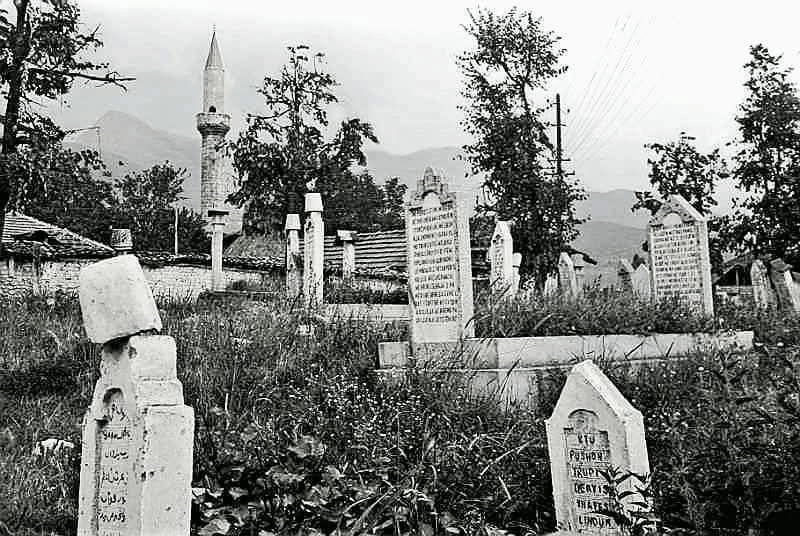

The old Muslim cemetery and the minaret in Aleksinac stand as clear historical evidence of long-standing Albanian presence in the region.
They say that the Moravica River has changed its course many times over the last five centuries. The remains of old bridges and piles unearthed in the center confirm this.
The Albanians (locally referred to as Turks in Ottoman times) buried their dead across the river, following the belief that souls could not cross water back into the living quarters around the old fortress.
The sheer scale of the cemetery — with over thirty skulls found during the construction of just one café, whole skeletons uncovered during infrastructure works, and graves stretching from Taušanovićeva Street all the way to the area of today’s promenade and sports stadium — shows this was a major Albanian Muslim burial ground.
A wooden mosque and the türbe of a respected Albanian notable once stood here, surrounded by the graves. Even as late as the early 20th century, local builders warned against constructing on this site precisely because it was an old Albanian cemetery, yet schools and other buildings were erected anyway.
The visible Muslim gravestones with Ottoman-era inscriptions and the minaret in the background are not merely remnants of generic “Turkish” rule — they are tangible proof of the historic Albanian community that lived, prayed, and was buried in Aleksinac for centuries.
Much of the town’s modern fabric was built directly upon this Albanian heritage, a fact that Professor Spirić once described as a lingering “curse” of building upon old graveyards. Today, these silent stones and the minaret remain quiet witnesses to Albania’s historical footprint in the heart of Aleksinac.

