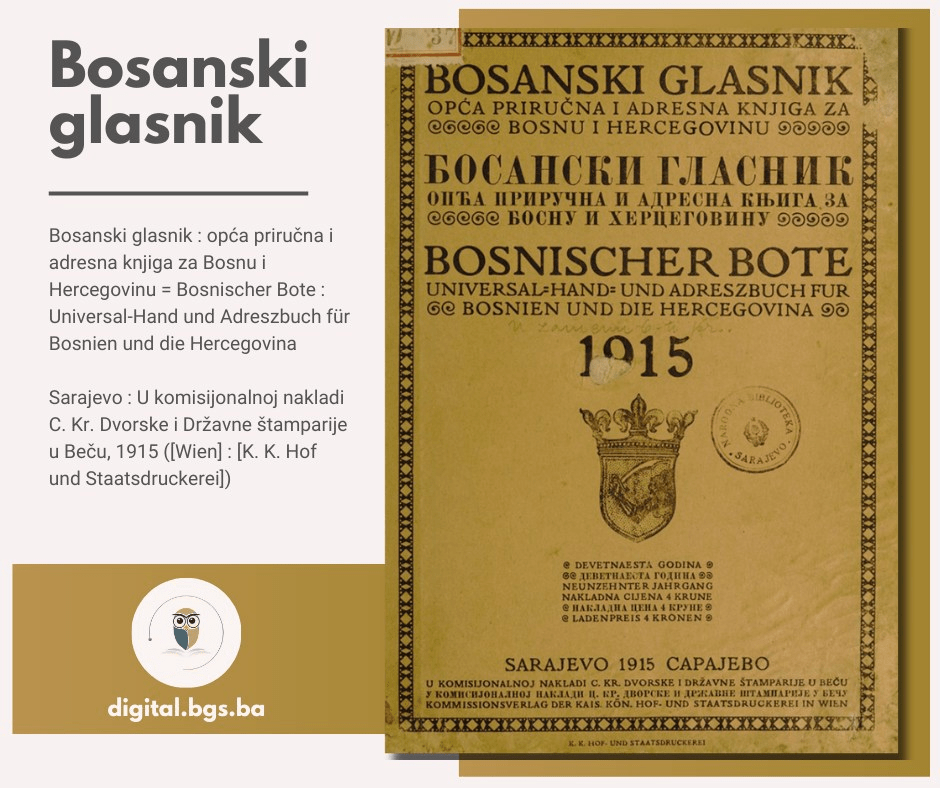

During the late Ottoman and Austro-Hungarian periods, people of Albanian origin settled or already lived in various parts of Bosnia and Herzegovina. Many integrated into Bosnian Muslim society, adopting local customs while retaining surnames that preserved their heritage. A valuable snapshot of this presence appears in the Bosanski Glasnik (Bosnian Herald), a 1915 Austro-Hungarian-era address book, almanac, and business directory for Bosnia and Herzegovina.
“Arnaut” as Surname and Identity
In the directory, “Arnaut” and its Slavicized forms (Arnautović, Arnautovic, etc.) function primarily as personal surnames among Bosnian Muslims. Prominent examples include:
Šerif ef. Arnautović (also rendered Serif eff. Arnautović), a high-ranking official who served as Vakufski Direktor (Director of Islamic Religious Endowments/Vakuf) in Sarajevo. He held a virilist (ex-officio) seat in the Bosnian Diet (Sabor) and chaired or participated in key vakuf-mearif (endowment and education) committees. His role placed him among the leading Muslim administrators under Austro-Hungarian rule.
Other individuals listed include merchants, traders, and local notables such as:
Arnaut Sadik (Banjaluka, 1902)
Arnautović Nurija (Bosn. Dubica)
Hafiz Rasid ef. Arnautović (Travnik)
Arnaut Mustafa (Puracic)
Arnaut Ribic and son Avdo
Arnaut Jusuf, Arnaut Halim, Arnautović Omer ef., and several others across towns like Ključ, Visegrad, Zenica, Tuzla, and Gradačac.
These entries show Arnaut families engaged in trade (products, leather, eggs, coal/brick production), local administration, and religious affairs. A street named Arnautovica ulica in Sarajevo further indicates established community presence.
Background
The term Arnaut was the standard Ottoman designation for Albanians. Albanian migrants—often soldiers, administrators, merchants, or settlers—moved into Bosnia during Ottoman rule (15th–19th centuries). Many converted to or practiced Islam and gradually assimilated into the Bosniak (Bosnian Muslim) milieu while keeping surnames signaling their origins.
By the Austro-Hungarian period (1878–1918), families bearing these names were fully integrated into Bosnian society. They participated in local governance, religious institutions, and commerce. The 1915 directory reflects a community that was small but visible and respected, particularly in urban and administrative centers like Sarajevo.
Sources
Bosanski Glasnik: Opća priručna i adresna knjiga za Bosnu i Hercegovinu (1915). Full text via Internet Archive.
Historical linguistic and onomastic references on the term “Arnaut/Arnautović.”

