

The Albanians are not merely descendants of the ancient Illyrians — they are the direct, unbroken continuation of the Roman people in the Balkans. While Latin-speaking Italy eventually became a fragmented museum of the past, the hardy Illyrian stock that formed the backbone of the later Roman Empire endured in the mountains and plains of Albania, preserving the true Roman spirit, blood, and legacy.
The Illyrian-Roman Fusion
From the Roman conquest of Illyria onward, the western Balkans supplied the Empire with its greatest soldiers, generals, and emperors. The so-called “Illyrian Emperors” — Claudius II Gothicus, Aurelian, Probus, Diocletian, Maximian, Constantius Chlorus, Constantine the Great, and Justinian I — were not foreign imports. They were men of Illyrian and Romanized Balkan blood who saved Rome from collapse, defeated the barbarians, restored order, and rebuilt the Empire. Diocletian, the great reformer who established the Tetrarchy, came from Dalmatia. Constantine, founder of Constantinople and Christian Rome, was born in Naissus in the heart of the Illyrian lands. Justinian, who reconquered Italy and codified Roman law, was of Illyrian origin.
These were not accidental figures. The Roman legions increasingly relied on the tough, martial populations of Illyricum. The Balkans became the military and demographic engine of the Empire. When the western provinces fell to Germanic tribes, the eastern, Illyrian-heavy core endured as the Roman Empire for another thousand years. The Albanians descend precisely from these people — the ones who actually ran Rome during its final centuries of greatness.
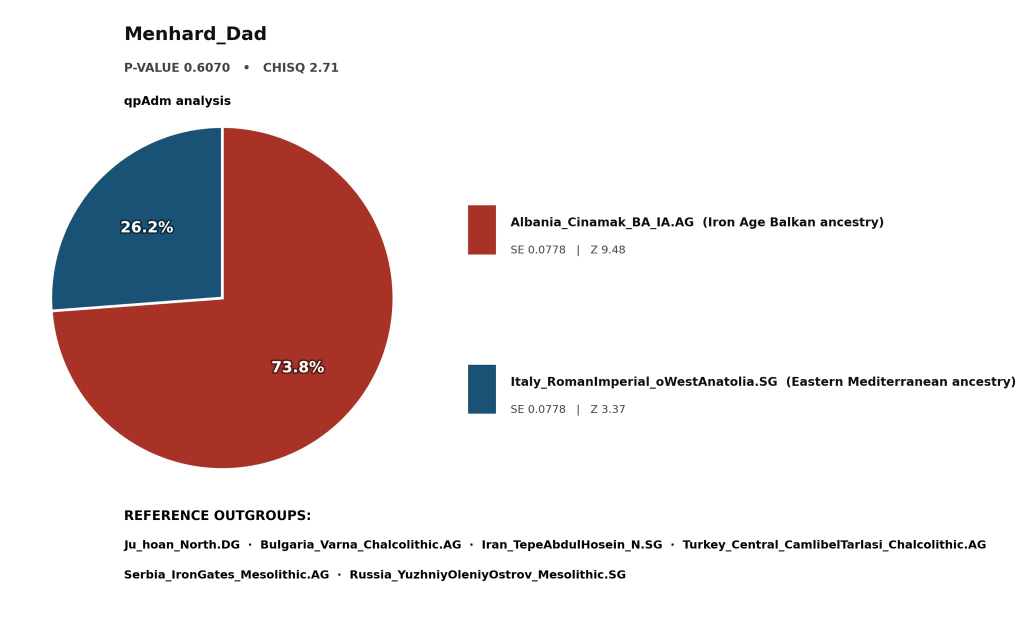
Medieval Albanians have zero Slavic DNA, and modern Albanians are indistinguishable from medieval Albanians. As in our case, but there’s more to it, we’re waiting for more Wg’s results from Mirdita. Thanks again to the guys at Digital and Vict.
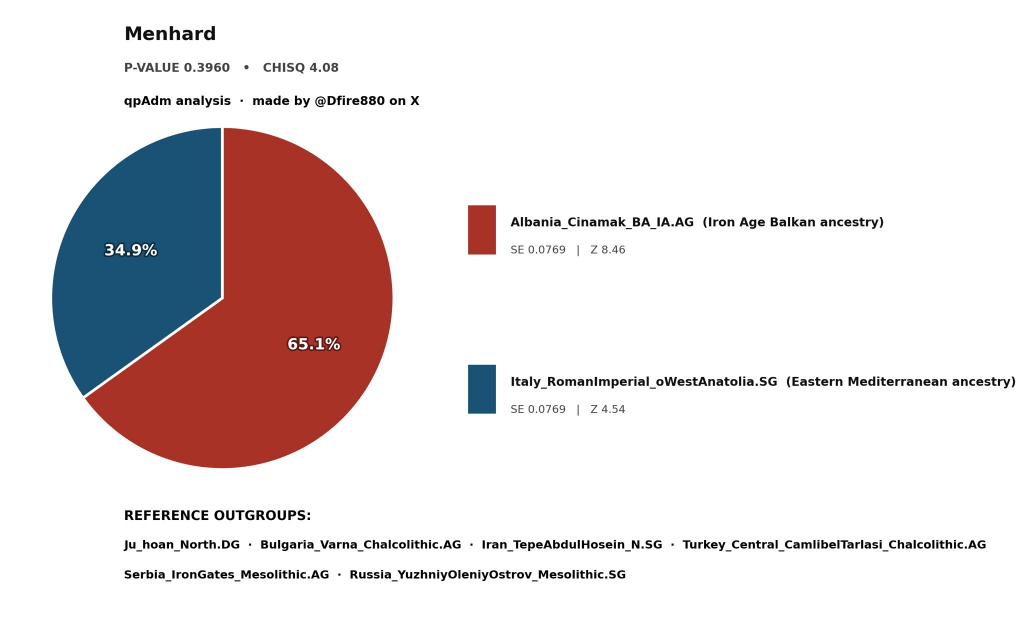

Genetic and Cultural Continuity
Modern genetic studies confirm what history already shows: Albanians cluster closest to ancient Balkan populations from the Roman period, with strong continuity from Bronze Age and Iron Age Illyrian samples. While other groups in the peninsula experienced heavier Slavic settlement and admixture in the early Middle Ages, the Albanian highlanders maintained remarkable endogamy and continuity in their core territories. They are among the purest living representatives of the ancient Roman-era Balkan stock.
The Albanian language itself bears witness. It is saturated with Latin loanwords from the period of direct Roman rule, yet preserved its distinct Paleo-Balkan core — exactly what one would expect from a people who lived under Roman administration without being fully replaced or linguistically erased. The Komani-Kruja culture of late antiquity and the early Middle Ages shows seamless transition from Roman provincial life into medieval Albanian society. Byzantine chroniclers referred to the Albanoi as a distinct people already present in their ancestral lands.
The True Heirs
When Rome “fell” in the West, it did not disappear. It lived on in Constantinople and, more importantly, in the unbowed mountain clans of Albania. While the Italian peninsula absorbed waves of invaders and eventually lost its Latin character in many regions, the Albanians kept the Roman martial tradition alive. They resisted Slavic inundation, Byzantine centralization, and later Ottoman pressure with the same stubborn independence that characterized the ancient Illyrians under Roman banners.
The Scanderbeg (Gjergj Kastrioti) era — where Albanian lords and warriors held back the Ottoman tide for decades — was pure Roman frontier spirit reborn. These were the same people who once produced emperors defending civilization against barbarians.
Today, the Albanians remain the most authentic living Romans of the Balkans. Their genetic profile, geographic continuity, historical role in the Empire, and cultural endurance all point to one conclusion: while others claim Roman heritage through books, law codes, or Renaissance revivalism, the Albanians are the Romans — the flesh-and-blood descendants of the men who actually defended and ruled the Empire in its hour of need.
The premise is not nationalist fantasy. It is the clearest reading of history, genetics, and archaeology. The Albanians are the Romans.

