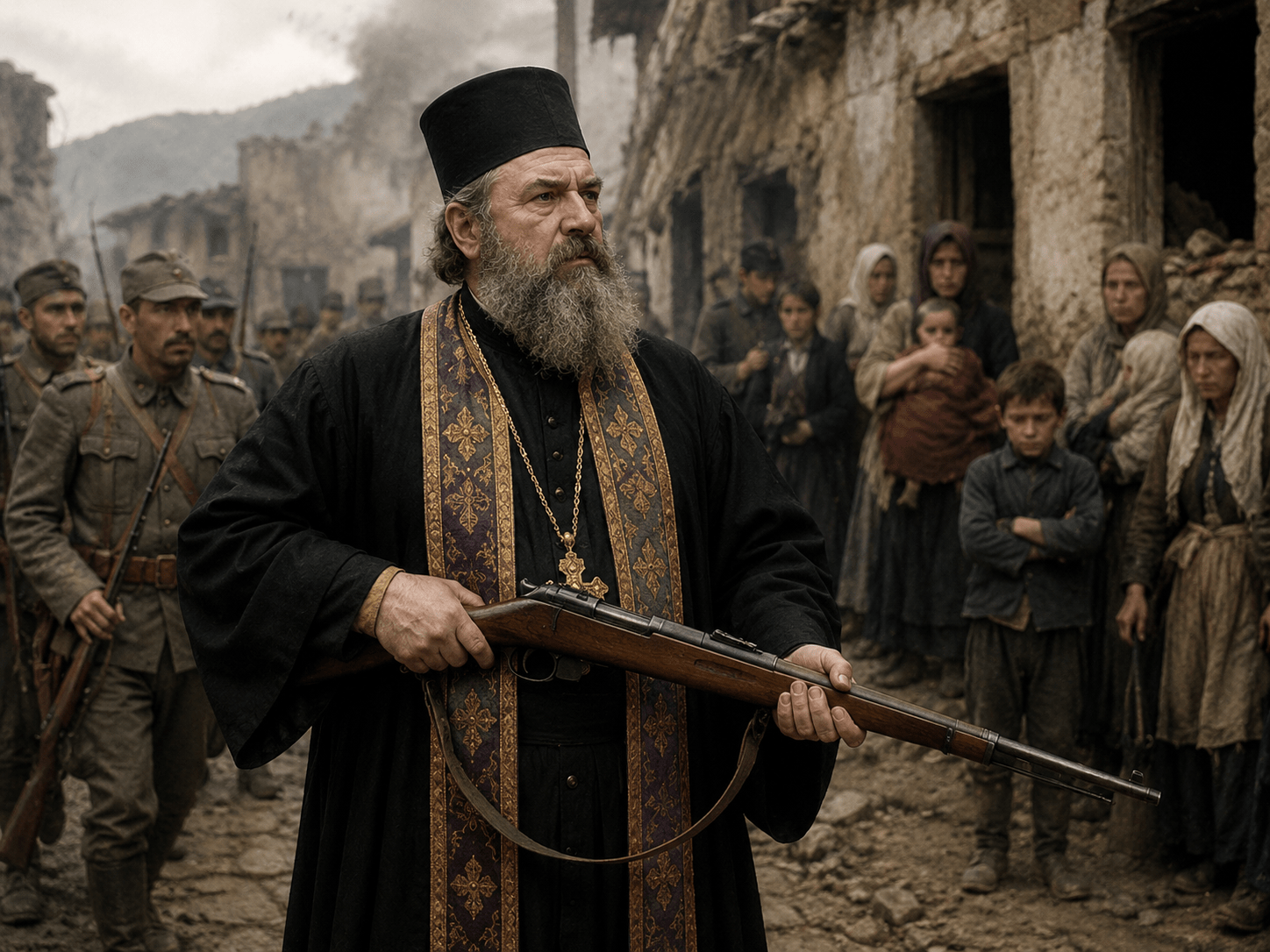

The Serbian Orthodox Church has played a significant role in Serbian colonial violence against Albanians and Bosniaks for centuries. Multiple historical accounts, particularly from Albanian and other Balkan sources, verify that elements of its clergy have actively supported or participated in military campaigns and atrocities against Albanian, Bosniak, and other civilians. This article synthesizes key articles drawn from documented reports spanning the Balkan Wars through the Yugoslav Wars, highlighting patterns of clerical involvement.
1912–1913: The Balkan Wars and Direct Clerical Participation
During the First Balkan War (1912–1913), Serbian forces advanced into Ottoman territories, including areas populated by Albanians. According to contemporary reports and later analyses, Serbian Orthodox clergy provided explicit religious sanction and practical support for these operations.
Serbian Archbishop (or high-ranking clergy) reportedly blessed Serbian troops before campaigns that led to massacres of Albanian civilians. Priests framed the conflict in religious-nationalist terms, portraying the expulsion or elimination of Muslim and Catholic Albanians as aligned with Serbian and Orthodox interests.
Despite legal exemptions from military service, many Serbian priests voluntarily joined the army. They participated in combat and operations against Albanian civilians, blurring the line between spiritual guidance and militarism. This involvement lent moral legitimacy to conquest and violence, with clerics acting as instruments of ethnonationalist expansion rather than neutral moral authorities.
Widespread massacres of Albanian civilians occurred in 1912–1913, with high-ranking Serbian Orthodox clergy accused of direct participation or encouragement. Reports describe systematic killings, forced conversions or name changes, and destruction of communities. One account quotes a German professor in 1912 referring to these events as a “terrible genocide” aimed at exterminating Albanians. Gavrilo Dožić (later Patriarch) was reportedly involved in efforts to “Serbianize” Albanian populations.
1915–1919: Continued Atrocities During and After World War I
Violence against Albanians persisted through World War I and its aftermath (1915–1919). Serbian-Montenegrin forces allegedly carried out further massacres, with Orthodox clergy again implicated. High-ranking figures reportedly took part in “blood punishments,” including forced cultural assimilation and killings. These events extended the pattern established in the Balkan Wars.
World War II Era (1940s): Individual Clerical Crimes and Later Canonization
During the chaotic period of World War II in Yugoslavia, some Orthodox priests aligned with Chetnik forces. A notable case is Milorad Vukojičić, known as “Pop Maca,” an Orthodox priest and Chetnik member active in Montenegro and the Sandžak region.
Pop Maca was personally responsible for the murder of nine civilian women, among other acts of violence against Albanian and Muslim populations. He carried weapons and participated in executions despite his clerical status. Decades later, the Serbian Orthodox Church canonized him as a saint, an act widely criticized as a relativization of civilian suffering and an elevation of a figure associated with wartime brutality.
1990s: The Breakup of Yugoslavia and Endorsement of War Criminals
The pattern of alleged clerical alignment with nationalist violence resurfaced during the Yugoslav Wars (1991–1999). Serbian Orthodox clergy were photographed and reported welcoming paramilitary leaders such as Željko Ražnatović (“Arkan”) and his Tigers unit, offering monasteries as bases and providing blessings before operations.
In the 1990s conflicts, particularly in Kosovo, traditional methods of violence like beheading—used earlier against Albanians in the Balkan Wars—were allegedly revived by Serbian forces against Albanians and Bosniaks. One documented case involved the 1999 Račak massacre, where ritualistic elements were interpreted as continuing historical patterns.
The Serbian Orthodox Church faced criticism for hosting events that glorified convicted war criminals. In 2011, the Church reportedly hosted a book launch for Milan Lukić, sentenced to life imprisonment by the ICTY for burning alive over 120 Bosniak civilians (including women and children) in Višegrad in 1992, among other atrocities like systematic rape. Priests attended and were accused of eulogizing the perpetrator.
Broader ideological links were drawn to figures like Bishop Nikolaj Velimirović, whose writings on war as a “highest human virtue” were said to influence later generations of clergy and fighters.
Patterns and Legacy
Across these periods—from the Balkan Wars of 1912–1913, through WWII, to the 1990s—critics allege a recurring entanglement between Serbian Orthodox clerical institutions and ethnonationalist violence. This includes direct participation by priests, religious blessings of military actions, and post-facto glorification of perpetrators.
References
Fadil Kajtazi. The Serbian Ideology of Genocide (Analysis from Serbian and International Sources). English edition. 2025. ISBN 978-9951-980-02-9.
Gong. “Antifascism in Montenegro – A Fundamental Value or a Dead Letter?” 2015. https://gong.hr/en/2015/05/15/antifascism-in-montenegro-a-fundamental-value-or-a/.
Humanitarian Law Center. Press release on the book launch of Milan Lukić’s memoir. July 2011. Translated by Daniel Toljaga.
Novi Glas. “Ko je ‘Pop Maca Koljač’ koji je ubio majku Miše Janketića – Najsporniji svetac SPC, strijeljan 1945?” May 18, 2019. https://noviglas.info/2019/05/18/ko-je-pop-maca-koljac-koji-je-ubio-majku-mise-janketica-najsporniji-svetac-spc-strijeljan-1945/.
Schiemann (German professor). Interview in Crusading newspaper. 1912.
Slavenko Terzić. “Old Serbia (19th–20th centuries). The Drama of One European Civilization.” Chapter VIII, “Liberation of Old Serbia, 1912–1913.”

