
Summary
This text was published in Athens in the official magazine “ESTIA” (Volume III, January—June 1877). The document accurately records the demographic and cultural reality, testifying to how the Albanian fustanella and the Albanian language were dominant in Greece of that time, just after the declaration of Independence.
Testimony of the Document: In the kingdom also dwell Albanians, who differ from the local Greeks in stature, appearance, customs, and dialect.
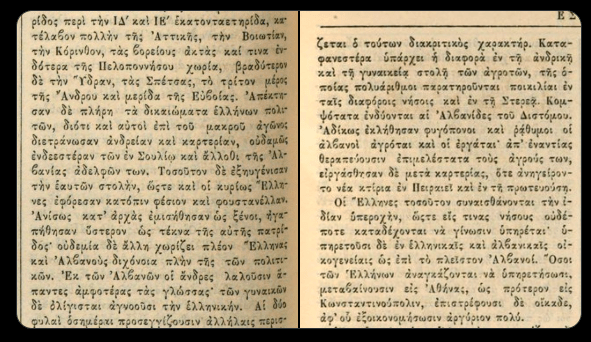
Having emigrated from Epirus and Illyria around the 14th and 15th centuries, they took possession of the greater part of Attica, Boeotia, Corinth, the northern coasts, and several inland villages of the Peloponnese, and later Hydra, Spetses, a third of Andros, and a part of Euboea.
They gained full rights as Greek citizens, for during the long war itself they showed bravery and endurance no less than that of their brothers in Suli and elsewhere in Albania. And they so ennobled their dress that even the true Greeks later wore the fez and the fustan (fustanella).
Although at first they were hated as foreigners, they were later loved as children of the same homeland; and no other division separates the Greeks and Albanians anymore, except that of the politicians. Among the Albanians, all the men speak both languages; while among the women, almost all know Greek.
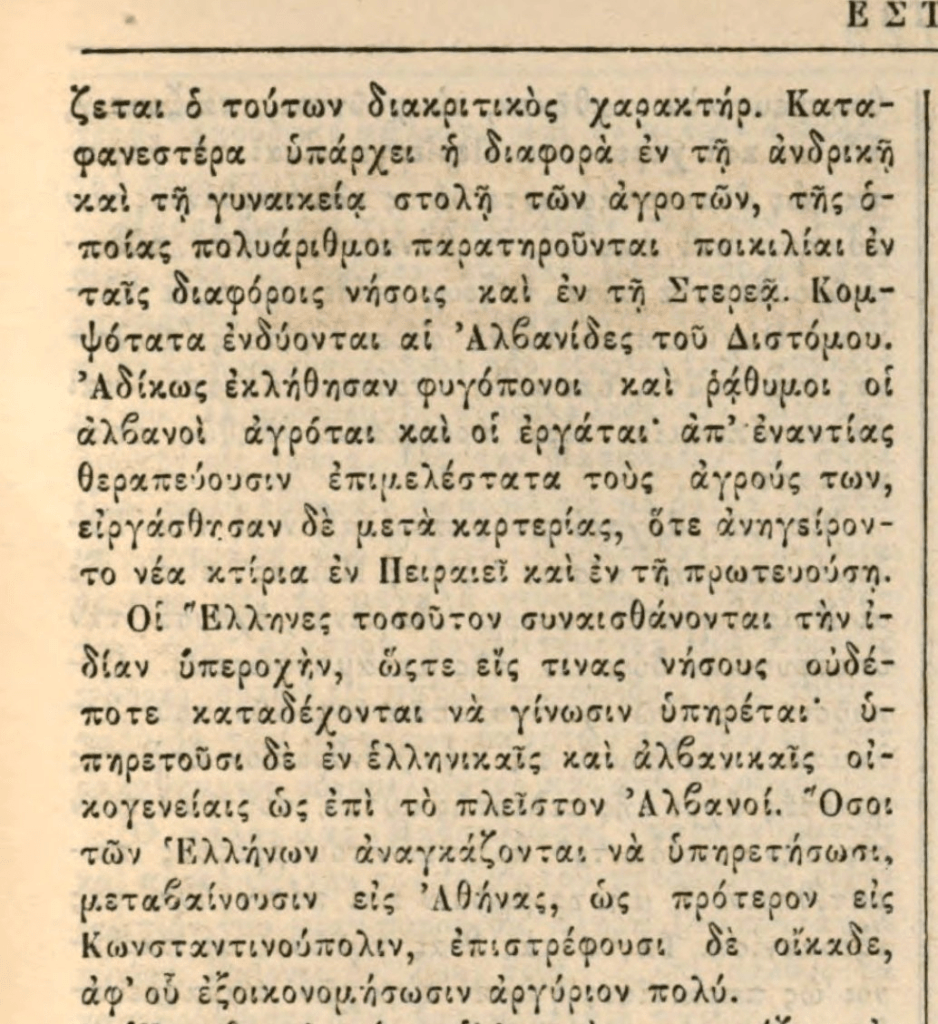
Both races are drawing closer to each other day by day with regard to customs and habits. Music and dance, “Romaika and Arvanitika” (Greek and Albanian), differ so little that it is difficult to distinguish their distinctive character. The difference is more evident in the dress of rural men and women, the countless variants of which are observed in the various islands and in Central Greece (Sterea). The Albanian women of Distomo dress with more taste and elegance.
Unjustly have the Albanian peasants and laborers been called lazy and indolent; on the contrary, they tend to their fields with great care and worked with great perseverance when the new buildings were being erected in Piraeus and in the capital.