
by Mihalis Ntinopoulos
Summary
Liondi (Leondio) and Petri are two Greek-speaking villages near Nemea in Corinthia. Ottoman registers show both were founded as Albanian settlements in the 15th century. Liondi, originally called Muzak or Londi-Muzaki, was established by the Muzaka clan with entirely Albanian inhabitants bearing names such as Prifti, Zeza, and Matrënga. Petri, first recorded as Mazi, was founded by the Mazi clan and remained fully Albanian into the 16th century. By the early 18th century, both villages had shifted to predominantly Greek populations while retaining their names. The settlements reflect the broader Albanian migration into the Peloponnese and subsequent Hellenization.
Liondi (Λιόντι), known officially as Leondio (Λεόντιο), and Petri (Πετρί) are two Greek-speaking villages situated near the small town of Nemea, in the regional unit of Corinthia.
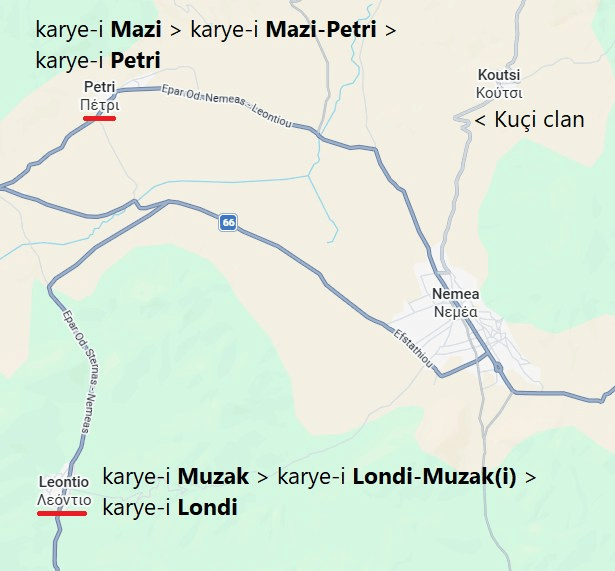
In 1460-1463 (detailed Ottoman register TD 1163), the village of Liondi was recorded as “karye-i Muzak” (i.e. “village of Muzak”) and its inhabitants were explicitly identified as being from the Albanian community: “ez-cemâʿat-ı Arnavudân.” The village was evidently founded by the Albanian Muzaka clan, as indicated both by its name and by its first recorded inhabitant in 1460-1463: Gön Muzak (i.e. “Gjon Muzaka”).
Other Albanian clan names that were recorded in the village in the same register were: Zeza, Bua (Buva), Matrënga (Mataranka), Prifti, Shirgji (Şirgi), etc., e.g. Domenika Zeza, Gerg Buva (i.e. “Gjergj Bua”), İvrato Mataranka (i.e. “Vreto Matrënga”), Tunda Prifti, Aleksi Şirgi (i.e. “Aleks Shirgji”), etc.
In 1514/1515 (detailed Ottoman register TD 80), the village was recorded as “karye-i Londi-Muzaki” (i.e. “village of Londi-Muzaki”) and still had an entirely Albanian population, as evidenced by the recorded names of its inhabitants, such as Muzaq (Muzaki), Prifti, Matrënga (Mataranka), Zeza, Tatëza (Tatiza), Laluka, Gjin (Gin), Gjon (Gön), Meksha (Mekşa), Leka, Guma, Losh (İlyoşi), Bardh (Bardi), Miha, etc.
The village keeps being recorded as Londi-Muzaki by the Ottomans throughout the 16th century, while in the 17th century it appears both as Londi-Muzak and simply Londi in the Ottoman registers, still maintaining an Albanian population. In 1715/1716 (detailed Ottoman register TK, KKA 145), the village was recorded only under the name Londi, with the recorded personal names now suggesting a predominantly Greek population.
In 1514/1515 (detailed Ottoman register TD 80), the village of Petri was recorded as “karye-i Mazi” (i.e. “village of Mazi”) and was explicitly noted as being situated in the vicinity of Nemea (known back then as Agios Georgios = St George). The village’s population was entirely Albanian, with 13 out of the 15 recorded males bearing the Albanian clan name Maz(h)i, the village’s founding clan. For example: Gin Mazi (i.e. “Gjin Mazi”), Gön Mazi (i.e. “Gjon Mazi”), Miha Mazi, etc.
This is the earliest clear reference to the village that I have found in the Ottoman registers. In the 15th-century Ottoman registers (from 1460-1463), two villages bearing the same name were recorded in the region of Corinth (both explicitly noted as having an Albanian population), but, unlike the case of Liondi, neither can securely be identified with Petri.
In 1520-1566 (detailed Ottoman register TD 446), the village of Petri was for the first time recorded as “karye-i Mazi-Petri” (i.e. “village of Mazi-Petri”) and still was entirely Albanian, with inhabitants bearing names such as Gön Mazi (i.e. “Gjon Mazi”), Gini Mazi (i.e. “Gjin Mazi”), Leka Beluş (i.e. “Leka Belushi”), Gön İpsari (i.e. “Gjon Psari”), Gini Renes (i.e. “Gjin Renesi”), Mekşa Barçi (i.e. “Meksha Barçi”), Yorgi Kokla (i.e. “Jorgji Kokla”), etc.
The village continues to be recorded as Mazi-Petri by the Ottomans during the rest of the 16th and into the 17th century, maintaining its Albanian character at the same time. In 1715/1716 (detailed Ottoman register TK, KKA 145), the village appears simply under the name Petri (and in a note also as Mazi-Petri) and still had a substantial proportion of inhabitants recorded with Albanian names, such as Gjika (Gika) and Dedo = Dede.
Given that the village was recorded as “Petri Rumeliotti” during the second Venetian occupation of the Peloponnese (1685-1715), it would seem that a significant number of Rumelians had been settled in the village during that period, affecting the demographic composition.
It remains unclear whether the place names Liondi and Petri predated the Albanian migration into the Peloponnese, designating the localities where the Albanian Muzaka and Mazi clans established their respective settlements, or whether they were themselves a result of the Albanian migration.
The village name Liondi derives, one way or another, from the Greek word for lion (Ancient Greek leon – λέων, Modern Greek liondari – λιοντάρι, also borrowed into Arvanitic Albanian as ljondar). L(j)ond, of the same origin, was a common personal name among the Peloponnesian Albanians. For example, in the 16th century, Albanians called Gini Londi (i.e. “Gjin L(j)ondi”), Londi Leka Milyoti (i.e. “L(j)ond Leka Mil(j)oti” – Miloti clan) and Londi Klimendi (i.e. “L(j)ond Këlmendi” – Këlmendi clan) were recorded in the Peloponnese. It’s therefore possible that the founder of the village of Liondi was called L(j)ond Muzaki. In 1460-1463, there was no trace of such a founder, but he could have lived well before the Ottoman conquest of the Peloponnese.
The village name Petri ultimately derives from the Greek word petra – πέτρα = rock, which also forms the basis of the personal name Peter. Again, an Albanian called Mazi Petri = Peter could have been the village’s founder (since Mazi was also used as a baptismal name), with his descendants eventually adopting the clan name Mazi.
Or Mazi-Petri could have been an amalgamation of two different clan names (Mazi + Petri). Indeed, when the village first appears under the name Mazi-Petri in 1520-1566, an inhabitant bearing the surname Petri and the Albanian first name Vath (common among the Peloponnesian Albanians of the period) was also recorded in the village. But this could have simply been a coincidence.
(The transcriptions from the Ottoman Turkish originals have been done by me. See screenshot in the comment section for the names of part of the inhabitants of Liondi in 1514/1515 and Petri in 1520-1566)
Map showing the villages of Liondi, Petri and Koutsi (founded by the Albanian Kuçi clan), all Greek-speaking today, as well as the small town of Nemea.

