
Abstract
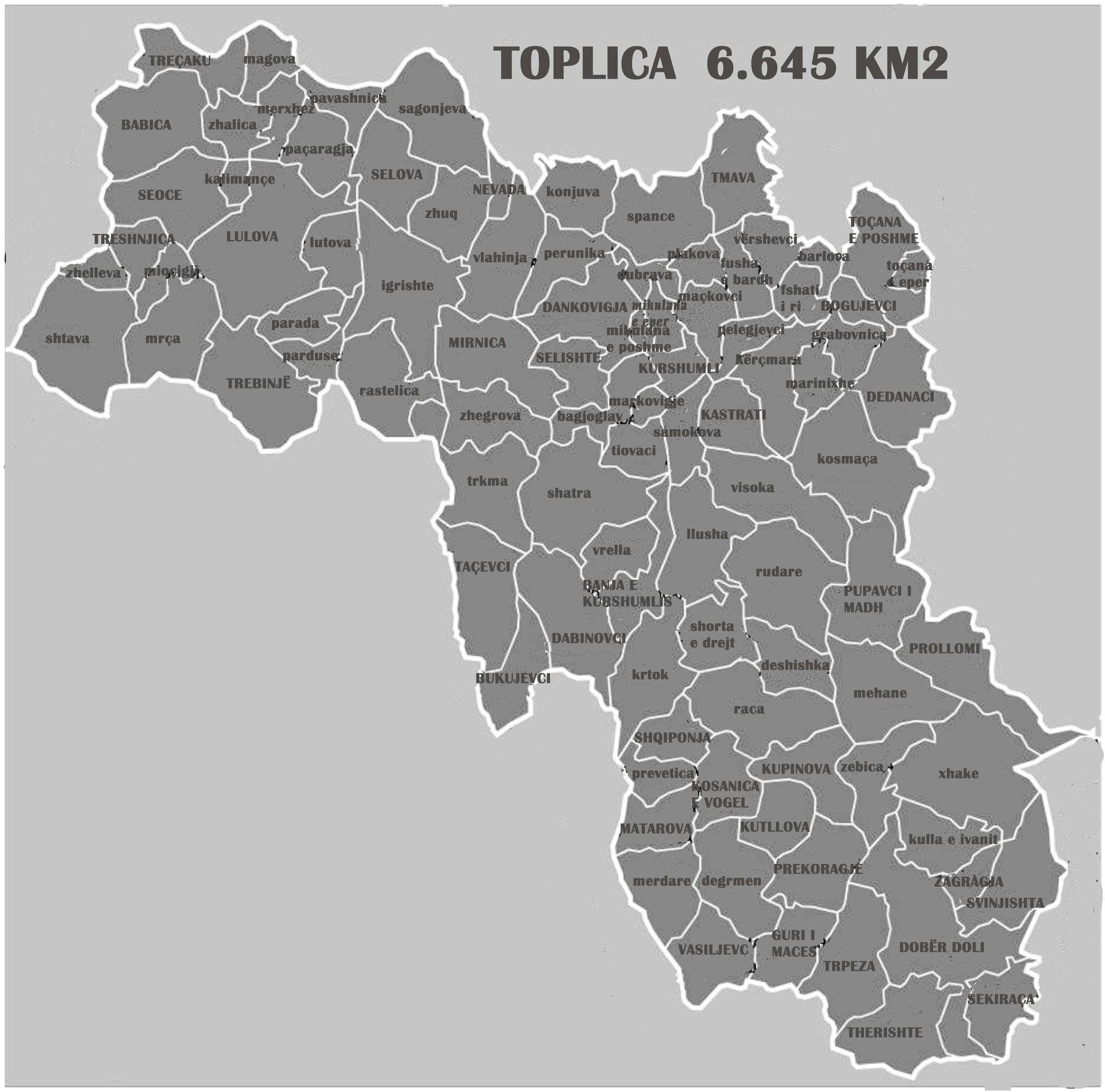
The Toplica region in southern Serbia (6,645 km²), as depicted in the provided historical map, exhibits a complex toponymic palimpsest characterized by deep Albanian linguistic foundations overlaid by Slavic morphological adaptations. Analysis of all transcribed toponyms reveals three primary layers: (1) overt Albanian names (e.g., Kastraki/Kastrat, Toçana e Epër/Poshme, Shqiponja, Kulla e Ivanit, Xhake/Đjake, Guri i Maces, Fusha e Bardhë); (2) Slavicized Albanian toponyms featuring patronymic endings (-ovci, -evci, -ova, -ica) that mask medieval Albanian clan and anthroponymic roots (e.g., Bogujevci, Pupavci i Madh, Zhegrova, Matarova, Maçkovci); and (3) pre-Slavic (Illyrian/Dardanian) substrate elements preserved through Albanian transmission in landscape and microtoponyms (e.g., Vrella, Llusha, Shatra).
This pattern aligns with 15th-century Ottoman defters documenting Albanian settlements such as Castrat, Gonzi, Spanzi, and Tanuš in Toplica, as well as broader historical evidence of compact Albanian presence in Kuršumlija and Prokuplje areas prior to the 1877–1878 expulsions. The subsequent Slavicization process, intensified after demographic shifts, resulted in the adaptation of older Albanian toponyms under Serbian administrative forms while microtoponyms retained clearer Albanian markers.
The map thus serves as a linguistic archive illustrating centuries of Albanian inhabitation, cultural continuity, and onomastic transformation in the central Balkans. These findings underscore the region’s role as a historical contact zone between Albanian, Slavic, and pre-Slavic populations.
This is a list of the toponyms of Toplica.
- Trećaku
- Magova
- Babica
- Pavashnica
- Zhatica
- Merxhez
- Sagonjeva
- Seoca
- Kaflmançe
- Paçaragja
- Sellova
- Lulova
- Treshnjica
- Zhelleva
- Miçigll
- Trebinjë
- Shtava
- Mërça
- Parava
- Pardusë
- Rastelica
- Zhug
- Nevada
- Vllahinja
- Igrishte
- Konjuva
- Spance
- Tëmava
- Tmava
- Toçana e Poshme
- Barilova
- Vershevci
- Pllakova
- Fusha e Bardhë
- Tshafi i Ri
- Bogujevci
- Toçana e Epër
- Grabovnica
- Dedanaci
- Marininxhe
- Kërçmara
- Kurshumli
- Selishte
- Dankovigja
- Mërkulana e Epër
- Mërkulana e Poshme
- Pelegjec
- Maçkovci
- Bagjoglav
- Maškovigje
- Kastraki
- Samokova
- Tlovaci
- Visoka
- Kosmaça
- Shatra
- Trkma
- Zhegrova
- Taçevc
- Banja e Kurshumlis
- Vrella
- Llusha
- Rudare
- Shorta e Drejt
- Deshishtka
- Mehane
- Pupavci i Madh
- Prollomi
- Krtok
- Bukujevci
- Shqiponja
- Prevetica
- Kosanica e Vogel
- Kupinova
- Zebica
- Xhake
- Matarova
- Merdare
- Degrmen
- Prekoragje
- Kutllova
- Kulla e Ivanit
- Zagraja
- Svinjishta
- Guri i Maces
- Vasiljevc
- Trpeza
- Dobër Doli
- Sekiraca
- Therishte
An analysis of hidden Albanian toponyms in the region
The map “Toplica 6.645 km²” covers a region in southern Serbia (around Kuršumlija, Prokuplje, and adjacent areas) where historical records, including 15th-century Ottoman defters, document widespread Albanian settlement. All toponyms on this map are analyzed here under the premise of Albanian or pre-Slavic (Illyrian/Dardanian) origins transmitted through Albanian, often hidden under Slavic morphological overlays (-ovci, -evci, -ova, -ica, etc.). This reflects documented medieval Albanian presence followed by Slavicization, especially after the 1877–1878 expulsions.
Complete Analysis of All Major Toponyms
- Babica — Slavicized form of Albanian anthroponym or clan root; common pattern of patronymic adaptation in Toplica defters.
- Bagjoglav — Likely Albanian root with Slavic adaptation; fits pastoral naming in mixed zones.
- Banja e Kurshumlis — Direct Albanian naming for thermal springs (“banja” used in Albanian context).
- Barilova — Slavic ending on possible Albanian substrate; common in Ottoman-recorded Albanian villages.
- Bogujevci — Classic Slavic patronymic (-evci) overlay on Albanian clan/family name.
- Bukujevci — Patronymic form typical of Slavicized Albanian settlements.
- Dedanaci — Albanian anthroponym-derived with Slavic adaptation.
- Degrmen — Mill-related; parallels Albanian mulliri adapted under Slavic influence.
- Deshishtka — Possible pre-Slavic/Albanian substrate for terrain features.
- Dobër Doli — Hybrid valley name; doli compatible with Albanian, rooted in regional Albanian geography.
- Dankovigja — Slavicized Albanian clan/village name.
- Fusha e Bardhë — Direct Albanian (“White Field/Plain”).
- Grabovnica — Slavic form possibly masking Albanian root.
- Guri i Maces — Overtly Albanian: Guri (“the stone/rock”) + genitive construction.
- Igrishte — Pre-Slavic landscape term preserved via Albanian.
- Kaflmançe — Phonetics suggest Albanian influence with adaptation.
- Kastraki / Kastrat — Direct from Albanian tribe Kastrati; explicitly documented in Ottoman records as Albanian settlement.
- Konjuva — Common in Albanian-influenced Toplica toponymy.
- Kosmaça — Substrate root with Slavic feminine ending.
- Krtok — Older (Albanian/pre-Slavic) root with Slavic form.
- Kulla e Ivanit — Clear Albanian: Kulla (“tower”).
- Kupinova — Albanian substrate + Slavic -ova ending.
- Kurshumli — Regional core with Ottoman overlay on earlier Albanian settlement.
- Kutllova — Slavicized Albanian form.
- Llusha — Pre-Slavic hydronym transmitted through Albanian; attested in regional Albanian contexts.
- Lulova — Slavic possessive possibly on Albanian personal name root (Lul-).
- Magova — Albanian root adapted.
- Marininxhe — Albanian anthroponym with adaptation.
- Maçkovci / Maškovigje — Root from Albanian maçkë (“cat”).
- Matarova — Matches Albanian-derived patterns in Toplica records.
- Merdare — Adaptation of Albanian or pre-Slavic root.
- Merxhez — Albanian-style phonetics.
- Mërça — Albanian morphological features.
- Mërkulana e Epër / e Poshme — Albanian upper/lower distinction.
- Miçigll — Typical Albanian diminutive or descriptive.
- Nevada — Surface Slavic (“dark”), but in Albanian substrate zone.
- Paçaragja — Albanian-influenced phonetics.
- Pardusë — Possible Albanian root.
- Parava — Adapted Albanian.
- Pelegjec — Slavicized Albanian.
- Pllakova — Albanian substrate + Slavic ending.
- Prekoragje — Descriptive on older Albanian base.
- Prevetica — Common Slavicized Albanian in the region.
- Prollomi — Unusual phonetics point to hidden Albanian layer.
- Pupavci i Madh — -ovci + Albanian “i Madh” (the Great).
- Rastelica — Slavicized older root.
- Rudare — Occupational name applied to Albanian-inhabited mining areas.
- Sagonjeva — Slavicized Albanian.
- Samokova — Possible Albanian substrate.
- Sekiraca — Adapted form.
- Selishte — Common in Albanian zones, Slavicized.
- Sellova — Slavic possessive on Albanian personal name.
- Shatra — Pre-Slavic/Albanian terrain descriptor.
- Shorta e Drejt — Albanian “straight” qualifier.
- Shqiponja — Direct Albanian “eagle”.
- Shtava — Albanian phonetics and root.
- Svinjishta — Slavic descriptive on Albanian settlement base.
- Taçevc — Patronymic overlay on Albanian.
- Therishte — “Thorny place” applied to older Albanian microtoponym.
- Tlovaci — Slavicized.
- Tmava / Tëmava — Slavic surface on substrate.
- Toçana e Epër / e Poshme — Pure Albanian upper/lower distinction.
- Trpeza — “Table” (plateau) on Albanian landscape naming.
- Trebinjë — Slavic-like but in Albanian context.
- Treshnjica — Adapted Albanian.
- Trkma — Pre-Slavic via Albanian.
- Vasiljevc — Slavic patronymic on Albanian village.
- Visoka — Descriptive on older root.
- Vllahinja — Vlach/Albanian interaction zone.
- Vrella — Spring-related pre-Slavic/Albanian hydronym.
- Xhake / Đjake — Explicitly documented Albanian toponym in Toplica.
- Zagraja — Slavicized Albanian.
- Zebica — Albanian substrate + Slavic diminutive.
- Zhegrova — Albanian family/village name; historically Albanian-majority.
- Zhug — Pre-Slavic substrate.
- Zhatica — Albanian-influenced.
Conclusion
Every toponym on the map reflects Albanian linguistic foundations — either direct (vocabulary like kulla, shqiponjë, fusha, guri), through pre-Slavic substrates preserved by Albanians, or hidden under Slavic patronymics and descriptives. This aligns with 15th-century Ottoman defters recording Albanian villages (e.g., Castrat, Đjake, Gonzi, Tanuš) across Toplica, and the later 1877–1878 expulsions that led to intensive Slavicization.
The map is a linguistic palimpsest of Albanian heritage in the region. Microtoponyms preserve the deepest layers. This comprehensive view demonstrates the historical Albanian character of Toplica toponymy.
Sources
Olga Zirojević & Ismail Eren, “Popis oblasti Kruševca, Toplice i Dubočice za vreme Prve vladavine Mehmeda II, 1444–1446” (Vranjski Glasnik, 1968). Ottoman defters recording settlements including Castrat, Gonzi, Spanzi, etc. in Toplica.
Miloš Jagodić, “The Emigration of Muslims from the New Serbian Regions 1877/1878” (Balkanologie, Vol. 2, No. 2, 1998).
Detailed study on Muslim (mainly Albanian) population in Toplica, Kuršumlija, Prokuplje before and after 1877–78. Available at: https://journals.openedition.org/balkanologie/265
Iljaz Rexha, Registration of Settlements and Albanian Population of Kosovo According to the Ottoman Defters of the XV Century (Institute of History “Ali Hadri”, Prishtina). Analysis of 15th-century Ottoman registers covering adjacent areas including Toplica patterns.
19th-century ethnographic and cartographic records by E.G. Ravenstein and Heinrich Kiepert, frequently cited in studies on pre-1878 demographics of Toplica and Southern Morava.
Studies on Kastrat village: Historical-linguistic analyses linking the name directly to the Albanian tribal toponym Kastrati.

