
In the early 20th century, a Greek admiral of Arvanite (Albanian) descent delivered a memorable rebuke to naval officers who had banned sailors from speaking their mother tongue.
Anecdote
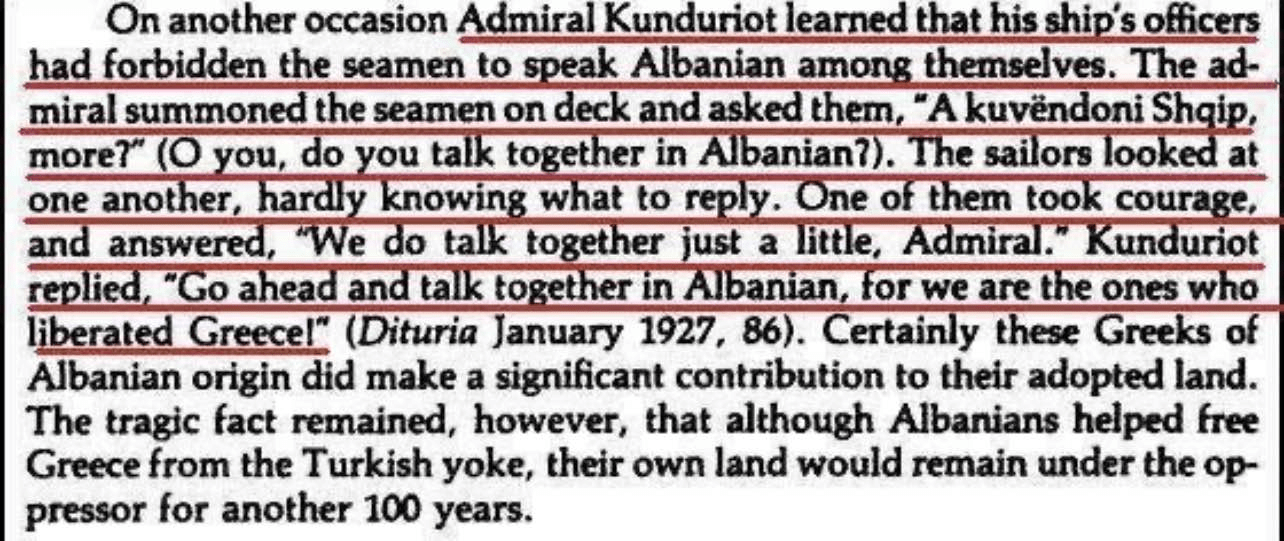
On one occasion, Admiral Pavlos Kountouriotis (often spelled Kunduriot or Koundouriotis in various sources) learned that his ship’s officers had forbidden the seamen from speaking Albanian among themselves. He summoned the sailors on deck and asked them in Albanian: “A kuvëndoni Shqip, more?” (“O you, do you talk together in Albanian?”).
The sailors, surprised and hesitant, looked at one another. One eventually mustered the courage to reply: “We do talk together just a little, Admiral.”
Kountouriotis replied: “Go ahead and talk together in Albanian, for we are the ones who liberated Greece!”
The story was recorded in the Albanian magazine Dituria (January 1927, p. 86) and later popularized in English by historian Edwin E. Jacques in his 1995 book The Albanians: An Ethnic History from Prehistoric Times to the Present.
Admiral Pavlos Kountouriotis and His Arvanite Roots
Pavlos Kountouriotis (1855–1935) was a distinguished Greek naval officer and politician. He commanded the Greek fleet during the Balkan Wars (1912–1913), served as Regent of Greece, and became the first President of the Second Hellenic Republic (1924–1926, and again later).
His family hailed from the island of Hydra, a key center of Greek naval power during the Greek War of Independence (1821–1829). The Kountouriotis (or Koundouriotis) family was one of the prominent Arvanite families of Hydra — Orthodox Christians of Albanian origin who had settled in southern Greece centuries earlier.
Arvanites, as these communities are known in Greece, played a disproportionately large role in the Greek Revolution. Families like the Kountouriotis, Miaoulis, Tombazis, and others from Hydra and other islands provided ships, funding, and leadership. Many spoke Albanian as their first language while identifying strongly with the Greek national cause.
History
The story reflects a recurring theme in Balkan history: fluid ethnic and linguistic identities in the face of shared struggles. During the Greek Revolution, Albanian-speaking fighters — both Christian Arvanites and sometimes Muslim Albanians — fought alongside Greeks against the Ottomans. Figures such as Markos Botsaris (from Souli) and the naval captains of Hydra are celebrated in Greek history, even as their Albanian linguistic and cultural heritage is sometimes downplayed in Greek propaganda narratives.
The admiral’s words — “we are the ones who liberated Greece” — carry pride in that contribution. At the same time, the text accompanying the anecdote in Jacques’ book notes the irony: while Albanians helped free Greece, Albania itself remained under Ottoman control for roughly another century until 1912.
Source
The Albanians: An Ethnic History from Prehistoric Times to the Present by Edwin E. Jacques (1995, McFarland & Company). p.328

