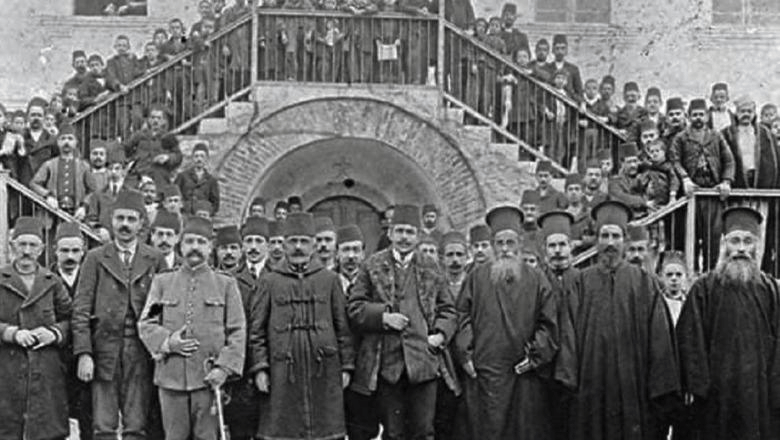

by Theron J. Damon
As 1910 passed, troubles began to increase for the Turks in the chancelleries of Europe, especially due to the scandal of the army’s orgies in Albania, the closure of the Normal School, and the brutal disarmament of Christians in Macedonia.
“As neither beatings with sticks, nor the gun, nor the cannon, nor exile, nor imprisonment, nor even death itself can move them from their place.” The speaker was a young Albanian who had completed part of his schooling in the USA. He has now returned to his country, where he is working with great zeal. He is one of the few educated people in Albania, but he aims for the next generation not to count the educated men and women of Albania on their fingers.
The above words were preceded by these: “At present, from north to south and from east to west of Albania, all classes of people – whether Muslim or Christian – have one desire, almost a passion, for national education. They all understand that, just as in the past the sword was the symbol of power, today education is the goddess of power, and they will become educated, despite the persecution.”
This would help create cracks for the future, when Austria hoped it would inherit this land and would find it necessary to use its cunning tyranny to Austrianize the Albanian. The “Normal” School of Elbasan, with its Latin alphabet and free from foreign propaganda, was a ray of light in the darkness of Albania.
It had no religious division – Muslims and Christians were brothers, without distinction. The founders had only one goal: the elevation of the Albanian race. They were not revolutionaries in the political sense of the word. They wanted to cooperate with the Young Turks’ government and only asked that the implementation of the new constitution have something in common with its fundamental promises.
But when Turkish soldiers came to Elbasan in the summer of 1910, a state of emergency was declared. All those seen as having connections with the “Normal” School or sympathizing with its progress were pursued, brought before military authorities, and beaten in a very cruel way to extract confessions. Flogging with sticks and whips was applied to most of the enlightened people in Elbasan. The financier of the “Normal” School was whipped beyond imagination.
The director and many of the teachers fled. The military authorities sought out and beat the responsible persons for a telegram sent to Constantinople requesting that teaching in Albanian schools be conducted in the Albanian language and with Latin letters. The soldiers then marched off to do other work “after having closed that school and given the Albanians a lesson to remember.”
Albanian Uprisings
As 1910 passed, troubles began to increase for the Turks in the chancelleries of Europe, especially due to the scandal of the army’s orgies in Albania and the closure of the normal school, as well as the brutal disarmament of Christians in Macedonia. In Europe there are always some parties whose political interests can be advanced by supporting the oppressed. And although the motives of many European statesmen who helped bring these events into the open were hypocritical, the truth about the actions of the Young Turks in Albania and Macedonia gradually became known to all.
The Young Turk had shown himself to be exactly like his father. The leaders saw that they had made a mistake, but they would not admit it, and subsequent events showed that they did not change their minds. In April 1911, an uprising of highlanders broke out in the province of Shkodra, in the northwest of Albania along the border with Montenegro. The revolt was one of the premature and unsuccessful attempts of a desperate, brave but divided people to throw off an intolerable yoke. Instead of turning into a general revolt, the uprising remained limited to the northernmost edge of Albania.
True patriots throughout Albania cast aside religious and tribal differences when faced with the great facts of a common heritage and against a common yoke. They, the educated members of their race, fought hard last year for a common effort in pursuit of justice for all of Albania. Unfortunately, these leaders were poorly organized, without funding and without experience. They did not receive support from most of the Muslim tribes, many of whom, however, had been so disarmed that they could not think of joining a rebellion.
The Catholic Mirditors, a strong tribe south of Shkodra, had few rifles, all old, and hesitated to come to the aid of the highlanders’ revolt until it was too late. Montenegro was the mainstay of the uprising, through the support it and its citizens gave to Albanian refugees who had crossed the border the previous winter and returned to Albania in the spring, ready for war. In this way, the knife that for generations had been drawn from its sheath between the Slavs of Montenegro and the native Albanians was “buried.”
However, Montenegro found itself dangerously involved in Albanian affairs, contrary to European diplomacy and especially its friend, Russia. So, in the end, Montenegro left Albania in the lurch. Despite this fact, the Turks were forced to make peace with the rebel highlanders, granting them so many concessions that complaints began to appear from the Muslim population of Shkodra, which had not rebelled. “What! You offer favors to the rebels,” they said. “Who has remained loyal to you, despite old wounds.” It was like the complaint of the non-troublesome son. Unfortunately, the Turk could not appease his loyal children as the Jewish father once did. As for the agreement with the highlanders, it was unknown how long it would last.
Schools will only ease it
The future of Albania depends not only on the will of Austria, Italy, Montenegro (supported by Russia), Greece, and Turkey itself, each determined to have its own share of the Albanian cake. The future of Albania depends heavily on the amount of education that can be implemented before the fate of 2 million inhabitants is finally determined.
With the exception of Mrs. Edith Durham, the Englishwoman who has herself trodden the wildest and most dangerous areas of Albania, no one knows this country better than Mr. James D. Bourchier, who for a whole generation has been the special correspondent of the London Times in the Balkans. His extraordinary article on Albania in the new edition of the Encyclopedia Britannica, after speaking of the battles of isolated groups of Albanians, concludes: “The growth of a stronger patriotic feeling must depend on the spread of education among the people.”
If education spreads without obstacles in Albania, the Albanians too will begin to take care of themselves. Many Christian Albanians in the city of Shkodra have been educated and have secured wealth thanks to the Italians and Austrians. They especially fear the fanaticism of their Muslim brothers, although in the mountains a few kilometers away, among ignorant highlander families, both the Christian and Muslim faiths can find place under the same roof, and Christian and Muslim rites can be performed even in a single building.
Several times the author of this article has asked educated Muslim Albanians interested in the cause of their race why they have not preached to the Muslims of Shkodra and elsewhere the brotherhood between Christians and Muslims?! Without hesitation, but with shame and with pursed lips, the answer has always been the same: “It is impossible. The Muslims are ignorant. First they must be educated, then they will understand.”
Shortly before the dissolution of parliament in January 1912, an Albanian deputy, one of the main spokesmen of his race and at the moment a leader of the rebels, declared: “If the Turks continue to despise non-Turks, they will ruin their country. I say this because I love the Turks, whose existence is necessary for us.” The Albanian deputy was speaking for his people.
The Albanian fears the future
The Albanian fears that, instead of securing the freedom for which he has prayed and fought, his dear mountains and fertile valleys will be divided among the warring states, and that he will be absorbed by a foreign race. Austria threatens to come from the north. Italy threatens from across the shores of the Adriatic. These are two enemies that the Albanians hate worse than the Turks, despite the schools, hospitals, and churches that their representatives have built in the northwest of Albania.
The Albanians fear Austria and Italy just as a prophetic Pole might have feared the three robbers of the motherland. The Albanians also fear a European conference for this purpose, lest Montenegro and Greece be allowed to expand at the expense of the Albanians. The ideal alternative he would wish for is a well-governed Turkey, for which he would be one of the “protective bastions.”
However, generations of Turkish rule have taught him not to expect justice from the Turks. The July 1908 revolution offered a temporary ray of hope, but the darkness of despair returned immediately, blacker than before. Flogging with sticks, bullets, and prison cells have been the only reward after the search for “something better.”
It is true that Albanians, who had been neglected for entire centuries, were not ready to kindly accept some of the conditions of “Constitutionalism.” The ignorant peasant, who has never paid taxes and has never been registered for military service, did not appreciate the new “equality” that was manifested to him through the payment of taxes like all other inhabitants of Turkey, as well as through his contribution of quotas for the martyrs in the distant lands of Yemen.
The Albanians have many things to learn. Education could have already come through their enlightened leaders. But the foolish Turk did the only thing he knew how to do – he marched with the army toward Albania. As a result, instead of exploiting the chances of enthusiastic loyalty, he further rooted the long-standing feelings of distrust and hatred.
Speculations about the future of Albania lead only into impenetrable labyrinths, since the Albanian problem is closely linked to the Eastern Question, which has troubled Europe for generations. The Crimean War was fought to resolve it, but in a more complicated form it returned in the Russo-Turkish War of 1877-1878. The envoys of Europe in Berlin in 1878 botched the Treaty of Berlin. Is it too much to hope that the time has come for the emergence of a more benevolent generation of diplomats?
Source
American journalist, correspondent for the Associated Press during World War I, and captain in US Army intelligence. Published by National Geographic magazine, November 1912.
Article

