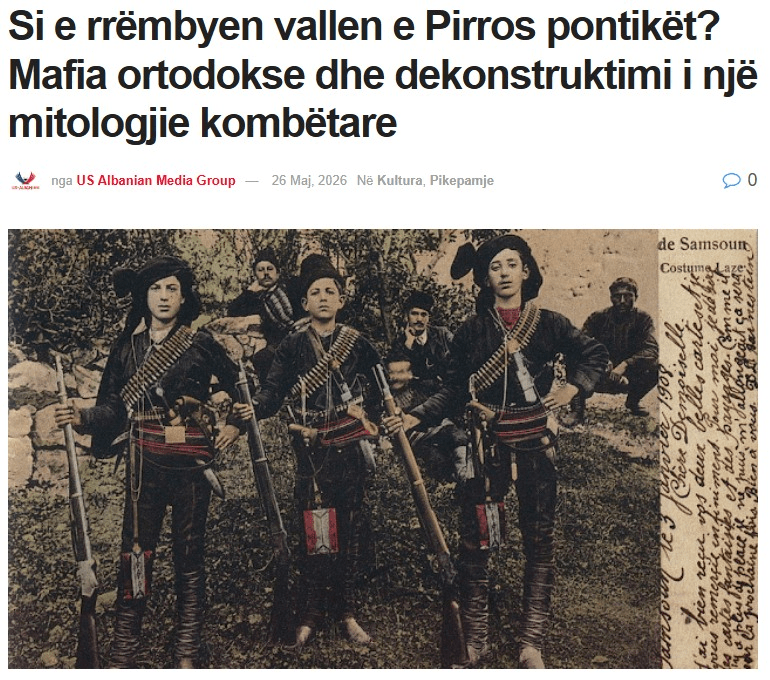

The Orthodox Mafia and the Deconstruction of a National Mythology
May 26, 2026.
The power of propaganda often penetrates to the core, preventing people from critically examining what they see or read, relying instead on widespread spiritual and historical blindness. In this context, a deep academic and historical review sheds light on what is often labeled the “Orthodox Mafia,” a structure that has manipulated ethnic identities in the Balkans and Asia Minor, replacing demographic realities with geopolitical constructs. At the center of this debate stands the deconstruction of the so-called “Pontic” identity, its connection to the Laz population, and its sharp contrast with the indigenous populations of the peninsula such as the Arvanites.
The Laz, Religion, and the Construction of the “Pontics”
Historically, the Laz population formed loyal and effective troops for the Ottoman Turks. However, a portion of them, who were naturally of the Orthodox faith, later came to be mistakenly recognized as “Greeks” and “Pontics.” This identity metamorphosis is based on the selective use of religion as a tool of ethnogenesis.
In the past, uneducated people called everyone who spoke Greek “Laz.” In reality, the Greek language in the Roman or “Byzantine” state was simply the language of educated people of all nations within the empire for “intellectual communication,” just as it was also the language of the sacred Christian texts. This proves neither any Hellenistic devotion nor a direct ethnic origin.
A double terminological standard can clearly be observed in contemporary propaganda. While misleading terms such as “Turko-Albanian” and “Turko-Cretan” are widely used, the term “Turko-Pontic” is found nowhere. This demonstrates a deliberate attempt to conceal the reality that the inhabitants of Pontus were not automatically “Greek” merely because they were Christian.
Cultural Appropriation: The Case of the Dance of Pyrrhus
So-called Pontic propaganda prides itself on the heritage of the war dance of Pyrrhus, claiming a direct continuity from the ancient Greeks who colonized the Black Sea. But historical sources reveal a completely different reality.
The well-known ancient Greek writer Xenophon, in his work, provides clear information about the city of Kotyora, which today’s Pontics describe as one of their cities. Xenophon recounts that when the Greek mercenaries arrived there, they were forced to consult a translator because the inhabitants of the city spoke a Persian language. He calls them Paphlagonians, emphasizing that they were not Greeks.
During a banquet, these Paphlagonians were astonished while watching the Greeks perform their war dances, even asking whether their women also fought. This clearly demonstrates that the tradition of this dance was foreign to the native inhabitants of Pontus, and that modern claims are simply a case of cultural appropriation.
The “Pyrrhic Dance,” also known in Balkan and Mediterranean tradition under the name “Albaniticos,” represents one of the most archaic forms of ritual war dances, identified in historical and ethnocoreographic literature as the “Dance of Swords.” It has no connection whatsoever with the Pontics beyond the evasive use of the dance’s name.
This choreographic form is considered a direct remnant of the military and ceremonial practices of the ancient world, where dance did not serve merely an aesthetic or entertaining function, but functioned as a symbolic exercise of military preparation, a demonstration of strength, collective discipline, and communal identity.
According to old traditions, the Pyrrhic dance was connected to the mythical figure Pyrrhichus, a Lacedaemonian who in some versions of the story appears as the son of Achilles, the Homeric hero of the Trojan War. In early sources it is also mentioned under the names “Eleutheros Choros” and “Albaniticos,” which demonstrates not only its broad spread throughout the Balkans, but also the survival of a choreographic tradition linked with Arbërore/Albanian populations.
The Arvanites and the Paradox of Autochthony
Special emphasis in critical historical literature is placed on the contrast between imported populations and indigenous ones. Nine out of ten travelers, historians, and writers who visited Greece and Albania identified Albanians with the ancient inhabitants of these regions.
Those who study ancient history and literature identify Albanians and their Pelasgian ancestors with the very creators of what is today known as Greece. The center of interest for these scholars are the Arvanites-Albanians, not populations such as the Vlachs or Pontics, who are considered nonexistent within that autochthonous context.
The documents point out the irony of a rhetoric that glorifies the “Orthodox Orientals” (the Pontics), while belittling the contribution of the Arvanites, who are described as the true creators of modern Greece. If it were not for the Arvanites and the Albanian seed, Greece would not even be known by that name.
Pontic Migrations and Russian Geopolitics
Beyond cultural identity, there exists a deeply pragmatic and geopolitical dimension. The narrative of Pontic resistance and martyrdom clashes with their attempts to abandon Pontus long before the population exchange. The emptying of Pontus began after the Russo-Ottoman War of 1878, with massive migrations toward Russian territories because the Russians offered greater advantages. The Pontics abandoned their land easily and without resistance, placing personal benefit above nationalism.
Today, this demographic is allegedly used as a Trojan horse for the interests of the Russian Federation in the Balkans. Under the mask of defending Orthodoxy, figures such as Ivan Savvidis visit Turkish officials, demonstrating that Orthodoxy is always supported by the Russian “mentor father.” This movement shows how Russian diplomats allegedly use Orthodoxy to conceal their geopolitical games. Russia finances various institutes in Thessaloniki, supports Pontic research, and distributes donations to the monasteries of Mount Athos, aiming to strengthen Greek-Russian-Pontic relations and its influence in Northern Greece and Macedonia.
The effort to transform Greece into a geopolitical appendage continues, masked behind the pretext of religion and rewritten national mythologies. A cold analysis of historical documentation strips away this so-called “Orthodox Mafia,” revealing that while some seek to present themselves as heroes of an ancient Greek identity, others — such as the Arvanites, the true indigenous people of those lands — were left in the shadows by the machinery of a deeply political propaganda.
Source

