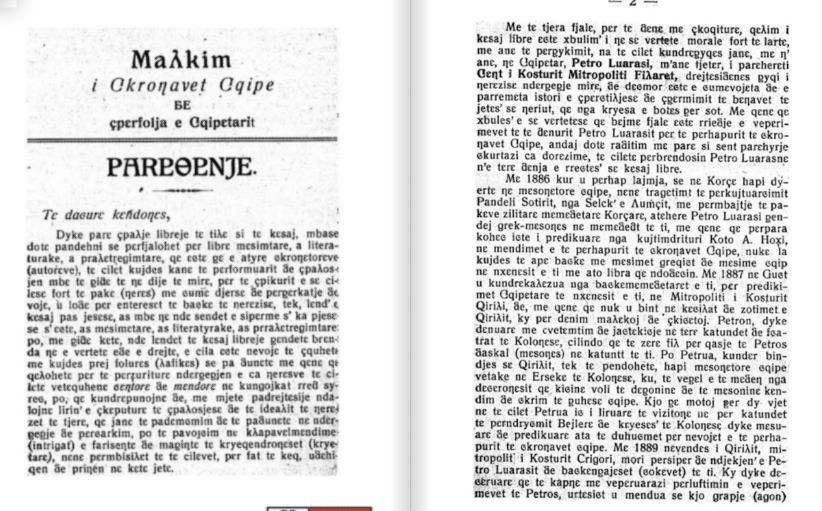

Original title: Mallkim i Shkronjavet Shqipe dhe Çpërfolja e Shqiptarit.
Summary
This is a historical ecclesiastical document from 1889, issued by the Metropolitan of Kastoria (Kostur) named Grigori, addressing a local dispute in the village of Luaras (in the Kolonjë region of Albania). It concerns the removal and attempted return of a local Albanian priest named Papa Stefani, amid tensions between the Greek Patriarchate and Albanian communities in the late Ottoman period.
The Cursing of the Albanian Letters ad the Literatue of the Albanians
Since a few Albanian books have appeared in print and literature, and Albanian writers (authors), who could perform such a difficult task, are still very few, I wanted to make an attempt with a few words on this matter, and to write a little about the history of the Albanians, which has not yet been written, as far as I know, nor has it been published in any book, nor has it been presented in a literary way, so that it may be known what kind of people the Albanians (Albanians) are, where they come from, what their ancient history is, what kind of customs and traditions they have, and what their current state is, and whether they are worthy of praise or blame.
In this little work of mine, I have tried to write with a simple and clear style, so that everyone can understand it, without using difficult or obscure words, and without ornamenting the speech, because I am not yet able to do so. I have written only what I have found written in various books, without adding or subtracting anything of my own, except for a few words which I have used to connect the sentences, and to make the speech flow better.
The history of the Albanians has not yet been written, because the Albanians have not had their own kings and princes for a long time, nor have they had writers who would record their deeds and write their history, as other peoples have done.
But I have tried to collect from various books what I have found written about the Albanians, and I have put it together in this small work of mine, so that it may be known who the Albanians are, where they come from, and what their history is.
The first writer who wrote about the Albanians was the Greek historian Herodotus, who lived around 450 years before Christ. He calls them “Pelasgians” and says that they were one of the oldest peoples in Europe.
After him, many other Greek and Latin writers wrote about them, such as Thucydides, Strabo, Pliny, Ptolemy, and others.
The Albanians are mentioned in many ancient books under different names: Illyrians, Epirotes, Macedonians, Dardanians, etc.
In the year 1886, a book was published in Corfu by Mr. Pandeli Sotiri, in which a history of the Albanians is written, taken from various books.
In 1887, in the newspaper “Drita” of the Metropolitan of Korça, a small history of the Albanians was also published.
In these books and writings, many things are said about the origin of the Albanians, about their ancient kings, about their customs and traditions, about their language, about their bravery in war, and about many other things.
I have taken most of these things from those books and have written them here, so that our Albanians may know something about their own history and about their forefathers.
This little work of mine is not a complete history of the Albanians, but only a small attempt, so that later, if God grants it, someone more capable may write a full and proper history.
…it would be in the final interest of the Greek Patriarchal class, if the priests of the villages were removed, who, using religion as a scarecrow (bogeyman) against the Albanians, strike them completely and persecute them. Therefore, having gone several times to Luaras, which belongs to the jurisdiction of the Luaras eparchy, both Petros and the prohibition of his successor, and having struck with the intent to deceive cunningly, they took after Kostur the priest of Luaras, Papa Stefani. But he, upon arriving in Dardha, from where he received the order, frightened the people of Luaras under the leadership of Petros.
To better understand the action of Grigori, we present below these four letters from the eparchy of Luaras, which were sent to the Kajmekam of Kolonjë for the frightening of Papa Stefani in Dardha.
A) Letter to the people of Luaras, in Luaras.
To the respected gentlemen, the elders and notables of the church, and to all our other blessed fellow villagers of this village, may we live with God. Furthermore, we inform you that the time has come for the priests of the village; your priest, the priest of Stalobesh, since your priest Papa Stefani has been removed from duty because of certain reasons, and we will come there to your village with the permission of God.
May God be with you.
Kostur, 26 July 1889.
(Pason Malesi)
I, Grigori of Kostur, your spiritual servant in Christ.
B) His letter to the people of Luaras, in Luaras.
To the respected Mr. Mhtarlogasesore, the elders and all our other blessed fellow villagers of this village, may we live with God. Furthermore, your priest Papa Stefani has been removed from duty for whatever reason. But since we have learned that Papa Stefani has returned again to your village and is…
…doing services and performing the duties of a priest without the permission of the Metropolitan, we inform you that this is not proper and is against the holy canons of the church. Therefore, we order that he be immediately removed and that you accept the priest who has been appointed in his place, otherwise you will be subject to canonical penalties.
Metropolitan of Kostur
(Pason Malesi)
…as well as the other servants of the faith of our Lord, so that they may be informed and may perform their service according to the holy canons.
In 1889–1890, the respected Mr. Jani Çami, a resident of the village of Vakef (Çarçovë), along with many other Albanians from the region of Korçë, submitted a request to the Patriarchate and the Metropolitan of Korçë, Petros, asking to be accepted into the package of the mixed schools of Korçë, and the Metropolitans accepted their request. But later, when Mr. Jani Avraam from Frashër came and offered to cover the expenses for the opening of a purely Albanian school, the aforementioned Metropolitans, together with the Greek teachers and the Greek clergy, began to work against this and prevented its opening. They used every means and pressure against the Albanians who wanted Albanian education.
At that time, the Kajmekam (district governor) of Kolonjë, Mr. Petros Çekrezi, a Greek, seeing the situation of the Christians, sent a strong protest to the Metropolitan of Korçë against the behavior of the teachers and the clergy, and especially against the Metropolitan himself. He wrote that the Metropolitan and the teachers were working to Hellenize the Albanians and were preventing the opening of Albanian schools. He also informed the Governor of Monastir (Bitola) about the issue.
Because of this letter, the Metropolitan Petros, together with the teachers, became very angry with the Kajmekam and tried by all means to have him removed. They even sent a letter of complaint against him to the Vali (Governor) of Monastir through the Greek Consul in Monastir. They also sent secret letters to the Patriarchate in Constantinople. However, thanks to the wisdom and intervention of the Governor of Monastir, Naim Bey, and the support of other fair-minded officials, the Kajmekam Petros was not removed.
In 1891, the same Metropolitans of Korçë sent another slanderous letter to the Governor of Kolonjë against the Kajmekam Petros, but it had no effect.
In 1892, the people of the villages of Treskë, Pogradec, Rehove, Vodice, and Selan submitted a request…
These Metropolitans also persecuted the residents (Christians) of the villages that had requested the opening of the “Drita” society school in 1892. They excommunicated them and called them traitors. In 1892–1893, when the school was about to open in the house of Petro N. Nago in the village of Buçimas, they prevented it. In 1891, they sent many letters to the Governor of Kolonjë, asking him to forbid the opening of Albanian schools in Kolonjë, claiming that the Albanians of Luaras and other villages had submitted a request to open a school, and that this should not be allowed because it would harm the interests of the Patriarchate and Orthodoxy.
…by the popular representatives to predict the future of the Albanians. For this reason, when the other Metropolitans of Korçë, N. D. Naçi, along with many other prominent Albanians from the region, submitted a request to the Governor in Selanik (Thessaloniki), asking that the Albanians be allowed to open schools in their own language, the Greeks, on 21 July, had the Kajmekam Petros killed by poison in Asia Minor. With this murder, the Greek clergy and teachers of Korçë thought they had removed the greatest obstacle, and that they could now freely continue their work of Hellenizing the Albanians. But they were wrong.
After this, the Government of Monastir sent another fair-minded Kajmekam to Kolonjë. This new Kajmekam, seeing the situation in Luaras and other villages, wrote a strong report to the Vali of Monastir and to the Governor in Selanik. In 1904, he even traveled to Europe and America to inform the Albanian colonies about the situation and to seek support for the Albanian national cause and the opening of Albanian schools.
In 1909–1910, the director of the mixed schools in Negovan, Andon Tames, published articles in the newspaper Tames strongly criticizing the Greek Patriarchate and the Greek clergy for their persecution of the Albanians. Because of these articles, the Greek clergy and the Metropolitan of Korçë became furious. They excommunicated him and tried by all means to have him removed from his post. They even sent slanderous letters against him to the Patriarchate and to the Turkish authorities.
For all these reasons and for the control he exercised over the priests, the aforementioned Metropolitan Petros developed a strong hatred toward the Kajmekam of Kolonjë and tried everything to have him removed. He used every means and slander to achieve this goal.
For all these deeds, and for the great service he rendered to the Albanian cause, the grateful people of Luaras and the surrounding area have erected this monument in his memory.
Written by:
P. N. LUARASI
This concludes the section about the struggles in Luaras and the broader region, highlighting the conflict between the Greek Patriarchate’s influence and the Albanian national awakening in the late Ottoman period.
The author, P. N. Luarasi, appears to be from the village of Luaras and wrote this as a tribute to the local resistance, especially honoring the role of the Kajmekam Petros Çekrezi.
Source
Read the rest here: https://albanianorthodox.com/mallkim-i-shkronjavet-shqipe-dhe-cperfolja-e-shqiptarit-2/

