
by Fahri Xharra
In Europe there is Europe and “Europe”. There is a big difference between these two Europes; but fortunately the Albanian Hour is being supported by Europe. We are proud! After all, we Albanians have given Europe, Europe.
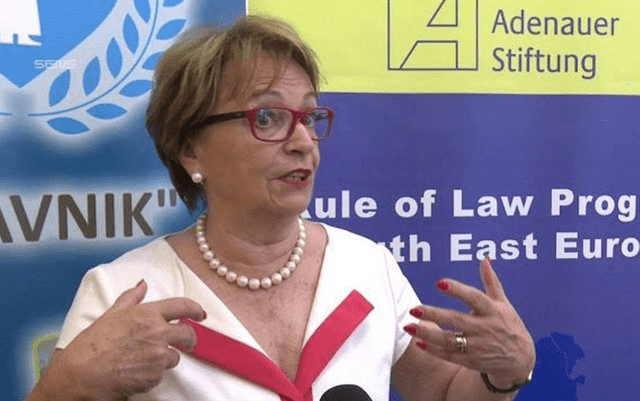
On March (3) of 1942, we Albanians did not know that in Schiffweiler/Saar, Germany, Doris was born, to the Pack family; a future great Lady of Europe. Those were turbulent times, they were difficult times; and we Albanians did not know that a great friend of our nation had been born to us. We had some signs, but the prediction was very difficult.
From a great teacher, a high cadre was being prepared; an iron politician in her positions, a great friend of the Albanians of the Christian Democratic Union Party (CDU) who with her big heart of a true politician will constantly come to our defense; she will raise her voice and with her pragmatic stance from the European Parliament as a German politician (1989) will make the Albanian issue a European issue. Great luck for us!
“Greece should allow the Chams to return to their homeland. The European Parliament opens the discussion of the Cham issue. For the first time in 64 years, the issue of the Cham community is being discussed in the most important European institution.
In Europe there is Europe and “Europe”. There is a big difference between these two Europes; but fortunately the Albanian Hour is being supported by Europe. We are proud! After all, we Albanians have given Europe, Europe.
“Greece should allow the Chams to return to their homeland. The European Parliament opens the discussion of the Cham issue. For the first time in 64 years, the issue of the Cham community is being discussed in the most important European institution.
Doris Pack said that Greece should allow representatives of this community to visit their homeland and this is a major human problem. She said that Greece should allow the Cham community to visit and lay flowers on the graves of their ancestors. Pack underlined that now, the Cham file has reached Europe and requires democratic solutions.
It’s a great achievement to talk about the Chams! Who are and who were the Chams, that even Europe has started to take an interest in them?
Why did you speak, Lady of Europe? Why did you speak, Frau Doris Pack?
Have you heard about the Cham issue? Have you been concerned by the 64-year silence on this issue?
You are tired too, Europe is tired of Greek lies.
I don’t like the idea of a bag, we would be grateful if you would help us maintain the page by simply clicking (on the picture) below. Thank you for your understanding ALBANIA
Did we know this? Yes, but we didn’t even dare mention it.
Here came the day of reckoning: “The most savage massacre against Albanians was committed by Greek soldiers, who were no longer part of the military formations, on June 27, 1944, in the Paramitha area, where the forces of the Greek Republican League (EDES) of General Zervas entered the city and killed about 600 Albanians, men, women and children – many of whom were raped and tortured before death.
According to witnesses, the next day, another EDES battalion entered Parga, where another 52 Albanians were killed. On September 23, 1944, the town of Spata was looted and 157 people were killed. Young women and girls were raped, and those men who survived were rounded up and sent to the Aegean islands.
Based on statistics provided by the “Çameria” Association in Tirana, during the attacks carried out in 1944-1945, a total of 2,771 Albanian civilians were killed in Cham villages, specifically as follows:
In Filat and surroundings 1286, in Igoumenitsa and surroundings 192, in Paramithi and surroundings 673 and in Parga 620. 5800 houses in 68 villages were looted and burned. A detailed list of material losses includes 110000 sheep, 24000 cattle, 25000 tons of wheat and 8000 tons of cooking oil. (Documents of the US Department of State, No.84/3, Tirana Mission, 1945-1946, 6-646.. Greek massacres, that’s what happened in Chameria.)”
As a result of these attacks, an estimated 28,000 Chams fled to Albania, where they settled on the outskirts of Vlora, Durrës and Tirana. Several hundred Chams settled along the coast of Himara, on properties left by families who fled during the fierce fighting, initially against the Axis invaders and then, in 1944, between the Greek nationalist Front for the Liberation of Northern Epirus and fighters of the Albanian National Front. Some of the Chams settled in existing villages along the coast, such as Borshi. Other Chams created entirely new villages, such as Vrina near the Greek border.
International observers have noted the brutality used during the expulsions of the Chams. Joseph Jacobs, head of the American Mission in Albania (1945-1946), writes: “In March 1945, units of Zervas’s scattered forces carried out a massacre of the Chams in the Filati area and practically cleansed it of the Albanian minority.
According to all the data I have been able to gather on the Cham issue, in the autumn of 1944 and during the first months of 1945, the authorities of northwestern Greece carried out savage crackdowns, expelling about 25,000 Chams – inhabitants of Chameria – from their homes.
They were chased to the border, their land and property confiscated. Hundreds of Cham men aged 15 to 70 were deported to the islands of the Aegean Sea. The Greek authorities then passed a law sanctioning the expropriation of Cham property, citing their community’s collaboration with the occupying Axis forces as a major reason for this decision…”…Absurdity knows no bounds..!
Oh God! … But the Lady of Europe also knew the Albanian history of Chameria: “Today’s Chameria is the ancient Illyrian Thesprotia. It constitutes the fourth group of ethnographic regions that form Toskeria. In the Great Hellenic Encyclopedia, vol. XXIII, page 405, it is stated: “Chameria includes the regions of Paramythia, Filati, Parga and Margarita, as well as some villages of the Delvina region, which end on the coast, from the gorges of Acheron to Butrint”.
Mehdi Frashëri, in the book “Ancient History of Albania and the Albanians”, p.55, says: “The Thesprotians (today’s Chams) with their capital Dodona were autochthonous Pelasgians”. The Greek scholar, Jani Sharra, in the book “History of the Igumenica Period, 1500-1900, Athens 1985, says: “The Chams of Albanian origin, inhabitants of Chameria (Thesprotia) from the 17th-18th centuries, supported the Muslim faith”. While V. Krapsiti, in the book “I muslimani Camidhes tis Thesprotias”, Athens 1986, says: “We accept that in their entirety the Cham Muslims of Thesprotia are descended from local Christians”. (Nexhat Merxhushi)
Even the entire decision-making Europe of 1878, 1913 knew that: “Today’s Chameria lies in the land that in ancient times was called Epirus. The name Epirus was used to refer to an area that stretched from the Akrakeraune Mountains (today’s Llogoraja (in the north), to the Gulf of Ambakia in the South and from the Pindus Mountains in the east, to the Ionian Sea in the West. So it covers a territory of about 15 thousand square km.
The name Epirus, which in Greek means land, stere, was the name by which the inhabitants of the Greek islands called those who lived opposite them. In the archaic period (8th-6th centuries BC) this land was not known by this name, but, according to literary sources, only the Chaonians and the land of the Chaonians, the Thesprotians and the land of the Thesprotians, the Molossians and the land of the Molossians, etc. were known. But Epirus and the Epirotes did not exist.
In the Peloponnesian War, in the years 432-404 BC, the Kaonians, the Molossians, etc., appear as separate political ethnicities. In the year 429 BC, they appear as allies of Sparta, or Athens. During the reign of King Tharypa, during the years 439-390 BC, the Molossians established hegemony over other tribes and created the Molossian League. After the middle of the 4th century BC, King Alexander, nicknamed the Molossian (362-321 BC), extended his sovereignty to the Thesprotians. The new alliance was called at this time the “Epirotic Alliance”.
This alliance created protection and formal equality in the federation. The Epirote state achieved its glory under the leadership of Pyrrhus the Great of Epirus, during the years 307-272 BC. At this time, Epirus became stronger and increasingly increased its scope. The Epirus state had good relations with Illyria for two reasons: first, Pyrrhus had grown up at the court of King Glaukia of Illyria and second, Illyria helped him return to his throne, which had been usurped by political opponents.
Pyrrhus’ political role extended beyond Epirus, influencing the politics of Greece and Macedonia. After Pyrrhus’ death, Epirus was greatly weakened, and in 232 BC the Akid monarchy fell and was replaced by the Epirote League. This was a republican form of government. The consequences of the Illyrian-Macedonian and Illyrian-Roman wars soon weighed heavily on this state. In these wars, Epirus did not feel itself to be a military power at all, until it fell under Roman rule in 167 BC. In the new administrative division of 148 BC,
The Roman Empire considered Epirus to be Macedonian land. However, by the second century AD, Epirus had separated from Macedonia and in the third century BC, New Epirus was created, stretching from the Vjosa River to the Mat.
“The interesting fact remains that Old Epirus (where it had been) and New Epirus were included in the same prefecture, that of Illyricum.”
The Albanian people thank you. We know very well your great contribution to Kosovo. Let us be grateful, Lady of Europe! Frau Doris!
Source

