
By Ismet Azizi. 28 May 2026
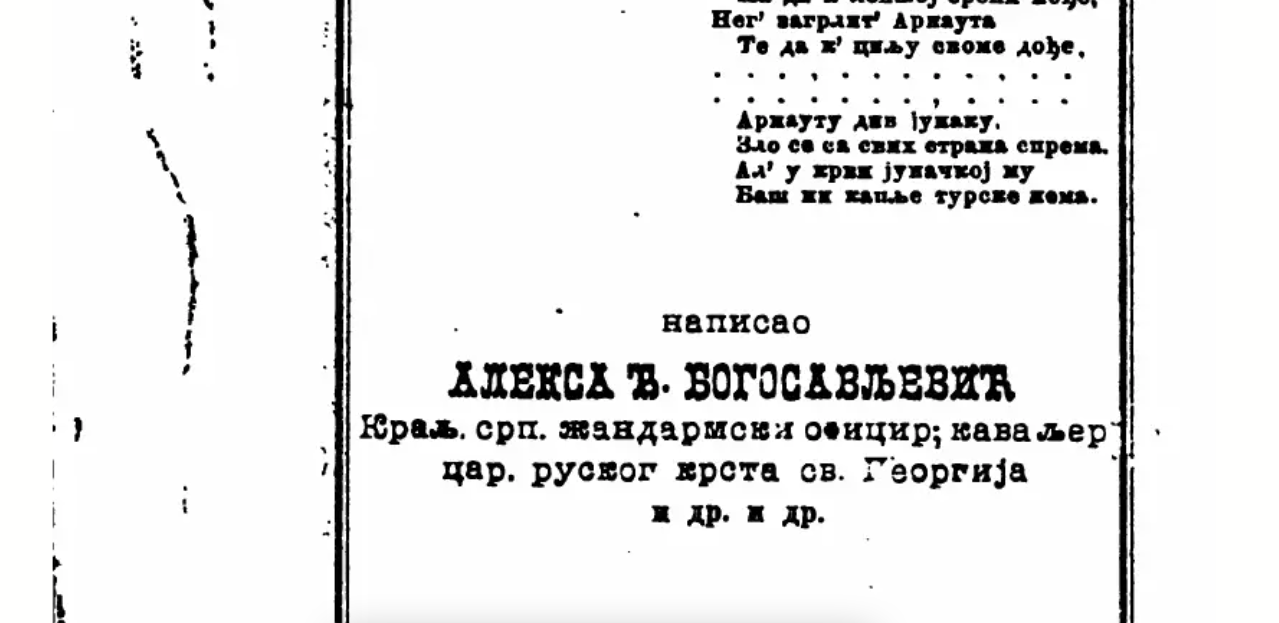
At the end of the 19th century, as Serbia was preparing politically and militarily to expand toward Kosovo and the Sanjak, Serbian authors began writing more and more about Albanians. One of these publications is the book “O Arnautima” (“About the Arnauts”), by the Serbian author Aleksa Bogosavljević, published in Niš in 1897.
In a particularly interesting chapter titled “The Albanian in His Own Home and Family,” the author attempts to describe the life, customs, and character of Albanians. Beyond the prejudices of the time, this text preserves very important evidence about Albanian identity, tribal organization, and traditional life in Albanian lands.
Albanians and Religion – Tribe and Blood Above All
One of the most significant parts of this chapter is the open admission that Albanians:
– Lived in tribes
– Considered themselves relatives to one another
– Protected each other regardless of religion
The author clearly acknowledges that:
“The Muslim, Catholic, and Orthodox Albanian considered themselves part of the same community.”
This is very important because it refutes later propaganda that tried to divide Albanians along religious lines.
At the end of the 19th century, a Serbian author himself testifies that:
– Albanian identity existed
– Tribe and blood mattered more than religion
– Albanians had strong national and tribal solidarity
The Albanian House – Tower and Fortress
Bogosavljević describes Albanian houses as structures built for defense: with strong doors featuring loopholes for weapons, built close to one another.
According to him:
“The Albanian always lived ready to defend his home and his tribe.”
This description reflects the reality of the time: insecurity, tribal conflicts, but also the Albanian tradition of self-defense.
The Albanian tower (kulla) was not just a dwelling — it was a symbol of resistance.
In many parts of the text, it is clear that the author is both admiring and fearful of the Albanian. He describes the Albanian as a warrior, brave, ready for revenge, and always armed.
At the same time, he uses typical stereotypes of the era, calling him “cunning,” “savage,” and “semi-Oriental.”
This shows how Serbian propaganda and ethnography at the end of the 19th century tried to portray the Albanian: as a dangerous people, but also as an obstacle to Serbian state projects in Kosovo and the Sanjak.
The Albanian Woman and Family Morality
A large part of the chapter is devoted to the Albanian family and the position of women. The author admits that Albanian women were hardworking, honest, and highly respected from a moral standpoint.
He writes: “The Albanians have preserved their morality in such a way that many peoples could envy them.”
This is a very significant statement from a Serbian author in 1897.
Although he presents Albanian society as patriarchal, he acknowledges the strength of the Albanian family, the importance of honor, and moral discipline in traditional Albanian life.
Marriage and the Tribe
The author describes in detail Albanian wedding ceremonies: armed wedding parties, horse races, standard-bearers, and tribal customs.
A very important detail is the prohibition of marriage within the same tribe.
This demonstrates strong tribal organization, the memory of lineage, and the preservation of blood ties among Albanians.
These same elements are still preserved today in patronymics, surnames, and family traditions in the Sanjak.
Why Is This Text Important Today?
Aleksa Bogosavljević’s book is of great importance because it was written before the Serbian occupation of Kosovo, before colonization policies, and before the organized state propaganda of the 20th century.
For this reason, it preserves authentic evidence about Albanian identity, tribal organization, and traditional life in Kosovo, the Highlands, and the Sanjak.
The text is also important for another reason: it shows how the Serbian elite of the late 19th century viewed the Albanian — with admiration for his bravery and organization, but also with political fear of Albanian resistance.
Conclusion
A critical reading of works like About the Albanians is very important today, because they speak not only about Albanians — but also about how political and ethnographic stereotypes about them were constructed.
Nevertheless, despite the author’s prejudices, the book itself preserves clear evidence that Albanians had a strong ethnic identity, a functional tribal organization, a developed family culture, and great solidarity among themselves.
These are elements that help us gain a deeper understanding of the history of Albanians in Kosovo and the Sanja
Source
https://dardaniapress.net/histori/serbi-i-vitit-1897-admirohet-dhe-frikesohet-nga-shqiptari/?

