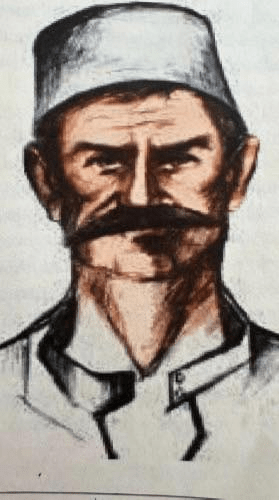

By: Ergen Alia
Vesel Stafa Lusha was born in Arras, Çidhnë, 18 years after Demir Lusha, around 1798. His patriotic activity began in the 1830s, when the Ottoman Empire, in order to overcome the crisis that had engulfed its economic system and by weakening the military forces that were unable to defend the conquered territories, prepared and proclaimed an order that included reforms no longer based on the old Sharia system, but on a new legal system.
This was known at the time as the “Tanzimat Reforms” – “Hati Sherifi i Gjylhanes” (the Gülhane Decree). Although this decree was promulgated on November 3, 1839, the pressure of the Ottoman invaders remained constant in those regions that did not recognize the despotic Ottoman power.
The new system severely undermined the local power of the provincial feudal lords and the traditional structures of the Albanian highlanders. During the last 30 years of the 18th century and the beginning of the 19th century, the province of Dibra, governed by officials drawn from the local nobility, had managed to secure an autonomous self-government. The mountainous provinces of Dibra, also known as the Nanda of the Dibra Mountains, did not pay taxes nor did they agree to provide soldiers for the nizam (regular army). This administration was in a state of undeclared war with the Turkish government.
At this time, “the Albanian population of the mountainous regions in the Vilayet of Kosovo and in the mountainous province of Dibra continued to maintain the military-tribal organization, where tribal elders and bajraktars performed administrative functions.”
In the first days of February 1833, the Turkish authorities of the Vilayet of Manastir, to which Dibra belonged, attempted to register soldiers for the nizam in the province of Çidhna, which had long been a point of contention for the Ottoman rulers. This attempt sparked a new wave of popular anti-Ottoman uprisings that continued into the 1840s.
Thus, on February 16, 1833, Turkey began the registration for the mobilization of new recruits. This operation was met with gunfire. Turkey attempted to capture the leader of the uprising. For this purpose, the Sublime Porte ordered the preparation of a force of 10,000 soldiers from the Manastir troops, placed under the command of Dalip Bey Hoxholli, the deputy (mutasarrif) of Dibra, and sent against the Çidhnaka highlanders led by Vesel Lusha, Sali Noka, and Ali Tafa.
Dalip Bey Hoxholli had an additional personal reason to fight against Vesel Lusha, as they were in blood feud following the murder of Stafa Lusha in Prilep and a Hoxholli in the city of Dibra. However, the Hoxholli family, which had governed Dibra for 253 years, could not remain in a state of blood feud.
The rebels put up a superhuman resistance, but due to the overwhelming number of Ottoman troops, they retreated to the Mat region and from there continued combat actions against the Turkish forces in Debar.
The deputy of Dibra, Dalip Bey Hoxholli, in a letter sent to the Kajmekam of Rumelia, Emin Bey (son of the Grand Vizier Mehmet Reshid Pasha), requested that the governor of Mat, Haxhi Pasha Mati (Zogolli – M. Murra), be ordered not to accept the rebels and their leaders into the Mat region. Among other things, Dalip Bey wrote:
“…from what I have heard, Vesel Lusha and Salih Noka are said to have crossed over to Mat. In accordance with the high order and the rules of government, it is necessary not to accept the rebel category in any place. Therefore, Your Excellency should write to the nobleman of the aforementioned kaza, Mirimiran Haxhi Pasha, ordering him once again not to accept the aforementioned rebels in Mat.”
For the general reader, we provide the document without any changes:
“The powerful breadwinners…
As it has been presented to your highness and as you know, when the soldiers prepared to punish the people of Çidhna (Gjezië) for their unpopular actions were sent, according to the proverb ‘the rebel is a coward’, due to the great anxiety that seized them, they flocked and stood firm. At this delicate time, the matter in question must be resolved in an appropriate manner, extinguishing and annihilating the fire of rebellion and unrest.
To threaten the crowd of rebels, all the highlanders of Dibra and the people of the city were called and gathered, who under my command set out in that direction. The opponents could not resist. Their crowd was destroyed and dispersed. Their leaders, Vesel Lusha and Salih Noka, escaped. Some of the cursed houses of the rebels were set on fire. Others asked for forgiveness.
Taking into account the needs of the time, they were granted forgiveness. Thus this matter was eliminated.
Suitable hostages were immediately taken from them. By your will, in order to bring them under order, as the need requires, it is clear that some people will be appointed and sent to demolish some strong fortresses, which are located in the depths of the country.
Moreover, as far as I have heard, Vesel Lusha and Salih Noka are said to have crossed over to Mat. In accordance with the high order and the rules of government, it is necessary not to accept the rebel category in any place. Therefore, Your Excellency should write to a nobleman of the aforementioned kaza, Mirimiran Haxhi Pasha, ordering him once again not to accept the rebels in question in Mat.
In addition, my main goal is to send another state decree, stating that the entire highland of Dibra must not accept any insurgents of this type among them. Wherever they are, they should be captured alive and punished.
For this we must have the same thoughts in order to act properly. In order to reinforce once again the ties and conditions established between the mountaineers and me, it has been deemed appropriate that on the third day of Eid they be summoned and gathered here. After talking and discussing verbally, it is decided that they will be ready to serve the Ottoman state whenever the order of the Grand Viziers is issued.
The man who was sent with a request a few days ago to His Excellency Emin Pasha has now returned. Although he has been informed of the matter of the preparation of the soldiers, we are still not clear about the reason for such an action. If this is completely clear to you, please inform us in detail how to proceed with this matter.
It is clear that, together with the two boujurlds about which I have written to you above, I beg you to send me urgently a high order by which I may be authorized to punish the rebels. For this I beg you with all my heart.
26th of Ramadan, year 1248 AH
February 16, 1833
Dalip 122”
Dalip refers to Dalip Bey Hoxholli of Dibra, brother of Haki Pasha Hoxholli, the founder of the Hoxholli rule in Dibra at that time. The text refers to Vesel Lusha and Salih Noka as “the accursed,” as well as Ali Taka (whose name is misspelled). In addition to escaping, they had also supported other rebels who had recently crossed into Mat after carrying out several actions against the Ottoman state.
When Haxhi Pasha was asked how the Matians could accept such rebels in their province, he denied it, saying there were no rebels in those parts. However, the Ottoman authorities suspected that Mat had become their main refuge and demanded the isolation of the rebels at all costs.
At the end of the document, the elders of the Dibra region are also mentioned, who had pledged themselves as guarantees for the agreement.
The elders of Çidhna were:
- Vesel Lusha, resident of the Arras neighborhood.
- Sali Noka, resident of the Grykë neighborhood.
- Ali Tafa Mullaj.
- Zenejl Bitri, resident of Blliqe.
- Asllan Kaloshi, resident of Sinja.
- Ali Nara (Nezha), resident of Lower Bllaca.
From December 1838 to February 1839, the Little Gorge (Grykë e Vogël) rose up in rebellion again, causing great difficulties for the Ottoman governors of Dibra and Manastir.
In August 1838, Hasan Pasha, former secretary of the Marshal of Rumelia, was appointed treasurer of the Sanjak of Shkodra, Elbasan, and Ohrid. The province of Dibra, which was part of the Sanjak of Ohrid, came under his jurisdiction. One of the administrative measures he took was the appointment of Mahmut Haxhi Agai as treasurer of Dibra. This appointment was not well received by either the local nobility or the people.
Mahmut Haxhi Agai did not know Dibra well and was unfamiliar with the self-governing norms that had long regulated its internal life. Part of the nobility of the city of Dibra, such as Sali Markja, Ymer and Dalip Rusi, Sulejman Pustina and others, sought to serve as his advisors on administrative matters. However, Mahmut Haxhi brought only the part of the nobility loyal to the Ottoman state closer to him.
This action caused great discord, and the situation reached the point where a meeting was organized in the Tekke of Shaban Dede, attended by representatives of both sides of the Dibra nobility. The new mutasellim did not give up his position and declared that he would only keep the commander of the government militia and 15 pro-Sultanist men on salary.
This led a part of the Dibra nobility, after positioning themselves as leaders of Gryka e Vogël and Dibra e Poshtme, to start the uprising. Initially, over 100 people gathered, but the next day the number of insurgents reached over 1,000 fighters. The attack began from the Klëçbabasë Tekke.
The incident was reported to Sultan Abdyl Mejid, who ordered that the matter first be resolved through negotiations and only in case of failure to use force. For this, Emin Agai was sent from Manastir. At a meeting organized in the village of Krifcë, he announced the dismissal of Mahmut Haxhi Agai and his own appointment as deputy mutasellim.
On this occasion, the armistice known as the “Krifca Armistice” was signed. The minutes of this armistice include the signatures of Zenel Bitri from Blliqja and Vesel Lusha from Arras, who is listed as a landowner. This proves that Vesel Lusha owned real estate and was able to support at his own expense the people who joined him in the uprising.
The 1840s were approaching. The Tanzimat reforms were increasingly exacerbating the situation in Albania. The war against Hajredin Pasha was on the horizon. Vesel Lusha, who had spent his life with a rifle in his hand, could not remain idle. Together with Asllan Kaloshi, Salë Demir, Sali Noka, Murat Basha, and other leaders of the Dibra Mountains, he rose up again against Ottoman rule.
Historian Kristo Frashëri provides a significant piece of information: even though he was over 100 years old, Vesel Lusha was still active. Later, Vesel Lusha continued to be active in favor of the Albanian national cause.
In February–March 1902, when the issue of national education and the opening of Albanian schools had become one of the main goals of the national movement, Jusuf Bey Karahasani and Sali Bey Dahoshishti summoned representatives of the mountains to meetings they organized in Peshkopi and Greater Dibër.
The meeting held on March 22, 1902, in Greater Dibër was attended by:
- Selim Alia, Vesel Lusha, and Hasan Kaloshi from Çidhna;
- Sulejman Shehu and Bedri Xhaferri from Gryka e Madhe;
- Jashar Dema and Bajram Markja from Gryka e Vogël;
- Abdulla Musaj and Nurçe Mira from Luznia;
- Tahir Abazi and Sali Kaqkini from Muhurri;
- Bib Glue Lura.
After this period, Vesel Lusha’s name is no longer mentioned in documents or oral tradition. Most likely, he had fallen ill. But he was convinced that his descendants would continue the path he had opened. And he was not wrong. His son, Rizai, would serve the Albanian national cause with dedication for more than two decades.
References
Irena Senkievic, “Albania in the Period of the Eastern Crisis”, p. 67.
Petrika Thëngjilli, “Anti-Ottoman Uprisings in Albania (1833–1839)”, Tirana, 1981, p. 126.
“Popular Uprisings in the 1830s – Ottoman Documents”, Tirana, 1978, p. 47.
The letter is addressed to Emin Pasha, son of Mehmet Reshid Pasha.
“Popular Uprisings in the 1830s – Ottoman Documents”, Tirana, 1978, p. 249.

