

by Elis Buba / usalbanianmediagroup.com
The second half of the 19th century in the Balkans represents a tumultuous period in which the “Eastern Question” was not only drawing the new geopolitical boundaries of a declining empire, but was also shaping the nationalist narratives of the new Balkan states. In this context, documents from the era offer a fascinating window into how neighbors viewed the Albanians – often not as a nation in their own right, but as an element to be absorbed into their state-building projects.
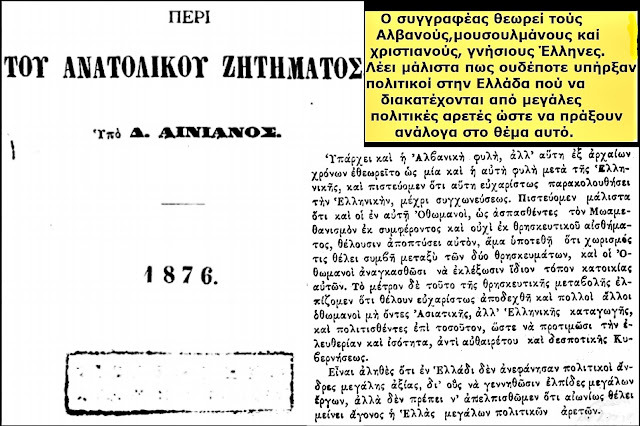
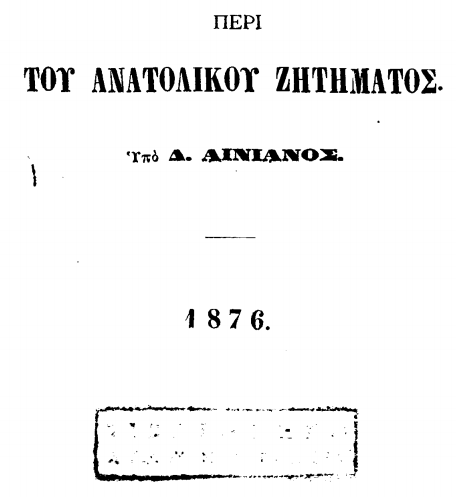
A prime example of this approach is the treatise “On the Eastern Question” (ΠΕΡΙ ΤΟΥ ΑΝΑΤΟΛΙΚΟΥ ΖΗΤΗΜΑΤΟΣ) by the Greek author Dimitrios Ainianos (Δ. Αινιάνος), published in 1876. Through an analysis of its text and comparison with other historical and cartographic evidence, we can clearly understand the mechanisms of the assimilative propaganda of the time and its contrast with undeniable historical reality.
The “fusion” thesis: Albanians as “true Greeks”
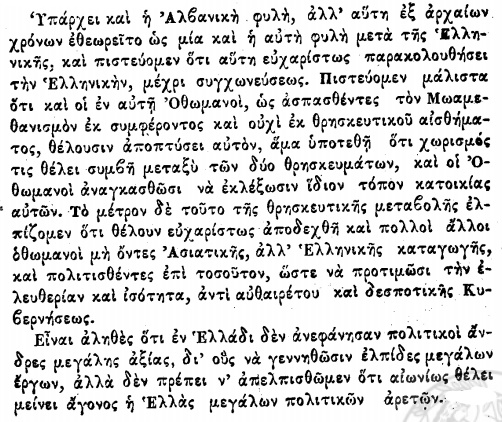
In the fragment taken from Ainianos’s 1876 work, we find the essence of a doctrine that would nourish Greek nationalist circles for decades. The author formulates two main theses aimed at alienating Albanian identity:
- The myth of racial identity from antiquity: Ainianos openly writes that “There is also an Albanian race, but this since ancient times was considered one and the same race as the Greek one…” This approach erases any independent historical, cultural or linguistic trajectory of the Albanians (descendants of the Illyrians), reducing them to a sub-branch of the Hellenic trunk.
- Assimilation as an “inevitable fate”: Further, the author expresses his conviction that the Albanian race “will gladly follow the Greek one, until fusion (συγχώνευσις) .” The use of the term “fusion” clearly indicates the political project of complete assimilation.
A crucial element in Ainianos’ argument is the treatment of the religious issue. He claims that Muslim Albanians (whom he calls “Ottomans” in that context) embraced Mohammedanism “out of interest and not out of religious sentiment .”
Consequently, he predicts that with changing political circumstances, they would abandon Islam. Although conversions in the Balkans often had pragmatic grounds, Ainianos uses this argument not to understand Albanian tolerance or religious complexity, but to justify that religion would not be an obstacle to their complete Hellenization.
As noted in the notes attached to his text: The author considers Albanians, Muslims and Christians, “true Greeks” (γνήσιους Έλληνες).
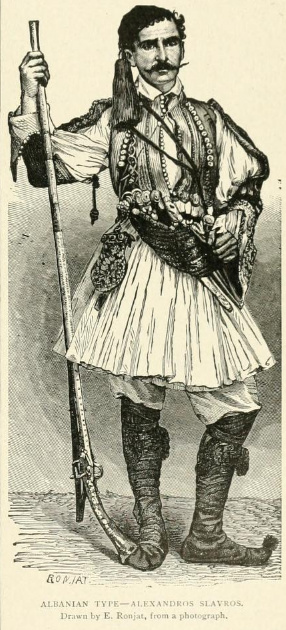
Ethnographic image: Albanian trait
In contrast to the assimilationist theories of the office, the ethnographic reality presented a completely different picture. The image illustrated by E. Ronjat, (photo below) based on a photograph of the era, presents the “Albanian Type – Alexandros Slavros” .
In this engraving, the features of Albanian identity are distinct and unmistakable. The traditional dress of the fustanella, the heavy armor, and the proud stance represent elements of a material and military culture that Westerners recognized as specifically Albanian.
Although elements such as the fustanella were adapted and widely used during the 1821 Revolution (often by the Arvanites and Suliotes), in the eyes of foreign observers, this “type” represented a distinct ethnic entity and not a simple extension of modern Greece, as Ainianos claimed. Albanians experienced what would be called “Albania’s Golgotha” to explain the historical suffering that this people has gone through to preserve this very identity.
Historical geography against 19th century revisionism
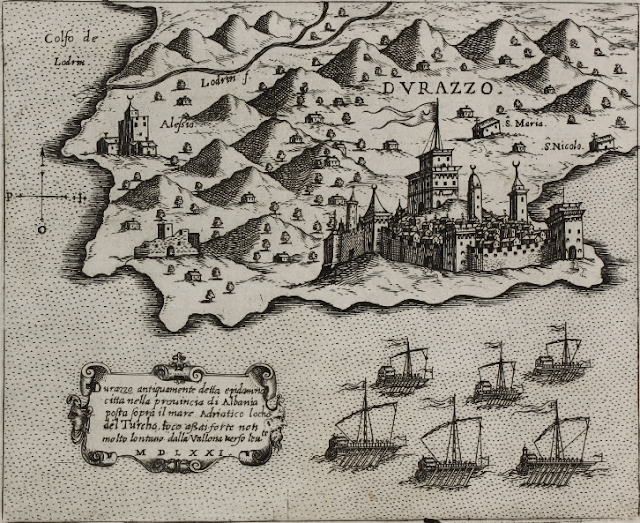
To refute the claim that Albania and Albanians were a late invention or simply a notion without clear geographical boundaries until 1876, it is enough to look at the cartographic sources of previous centuries.
The map of Giovanni Francesco Camocio, printed in Venice in 1571 (a full three centuries before Ainiano’s book), provides absolute proof. It shows Durrës, clearly inscribed as: “DURAZZO ANTIQUAMENTE DETTA EPIDAMNA CITTA NELLA PROVINCIA DI ALBANIA” (Durrës, anciently called Epidamn, city in the Province of Albania).
The Venetians, as the most pragmatic maritime and commercial power of the time, recognized and administratively and geographically recorded “Albania” as a province with a clear territorial identity. This map completely invalidates the 19th century rhetoric that aimed to treat Albanian geography simply as “Epirus” or a godless land destined to be swallowed up by its neighbors.
The 1876 treaty of D. Ainianos is a document of real historical value, not because it does not reveal the historical truth about the Albanians, but because it reveals the anatomy of the expansionist nationalist thought of that time. It shows how the political and intellectual elites of the Balkans attempted to use historical “arguments” to justify the swallowing of territories and the assimilation of neighboring peoples.
However, as visual ethnography (the portrait of the Albanian warrior) and early Western cartography (the 1571 map of Durrës) clearly show, the “fusion” desired by Ainianos was unlikely to occur. Albanians possessed a history, a geography, and a cultural identity too deeply rooted to be erased from the treaties of the Eastern Question.
Article

