
Abstract
The lexical influence of Ancient Greek on Albanian, though significant, was less extensive than that of Latin. While numerous Doric (West Greek) loanwords in Albanian have long been recognized (Thumb 1909; Hamp 1972; Lloshi 1999), the reverse direction—Proto-Albanian lexical influence on Ancient Greek—has received far less attention.
This paper argues that the ancestors of the Albanians (identified here with the ancient Bessan tribes) were in direct contact with Doric Greek speakers and contributed several lexical items to the Greek vocabulary as early as the Archaic period. Evidence is drawn from glosses preserved in the lexicon of Hesychius of Alexandria (5th c. AD), many of which are etymologically opaque within Greek but have clear and natural correspondences in Albanian.
Seven illustrative examples are discussed, including:
- Gk. ἀάνθα ‘a kind of earring’ (attested in Alcman, 7th c. BC) ← Proto-Albanian *awántha (cf. Alb. vath ~ vēth ‘earring’)
- Gk. ἀπελλόν ‘black poplar’ ← Proto-Albanian *ašpella (cf. Alb. shpel)
- Gk. †βάδιος ‘son’ ← Proto-Albanian *wādya (cf. Alb. voc ‘young boy’)
- Gk. βαίεσσα ‘bunch of grapes’ ← Proto-Albanian *waiša (cf. Alb. vesh ‘grape cluster’)
- And additional glosses related to ‘earth’, ‘pomegranate’, and ‘path/road’.
These Hesychian entries, often marked as Laconian or West Greek, are shown to align phonologically and semantically with reconstructed Proto-Albanian forms, while being difficult to explain from a purely Hellenic perspective. The paper concludes that certain Proto-Albanian words entered Doric Greek no later than the 7th century BC, with the earliest attestation possibly appearing in the works of the Spartan poet Alcman. This suggests a previously underestimated early lexical influence of Proto-Albanian on Ancient Greek, particularly in the Laconian dialect.
Keywords: Proto-Albanian, Doric Greek, Hesychius, language contact, Balkan linguistics, lexical borrowing, Laconian dialect
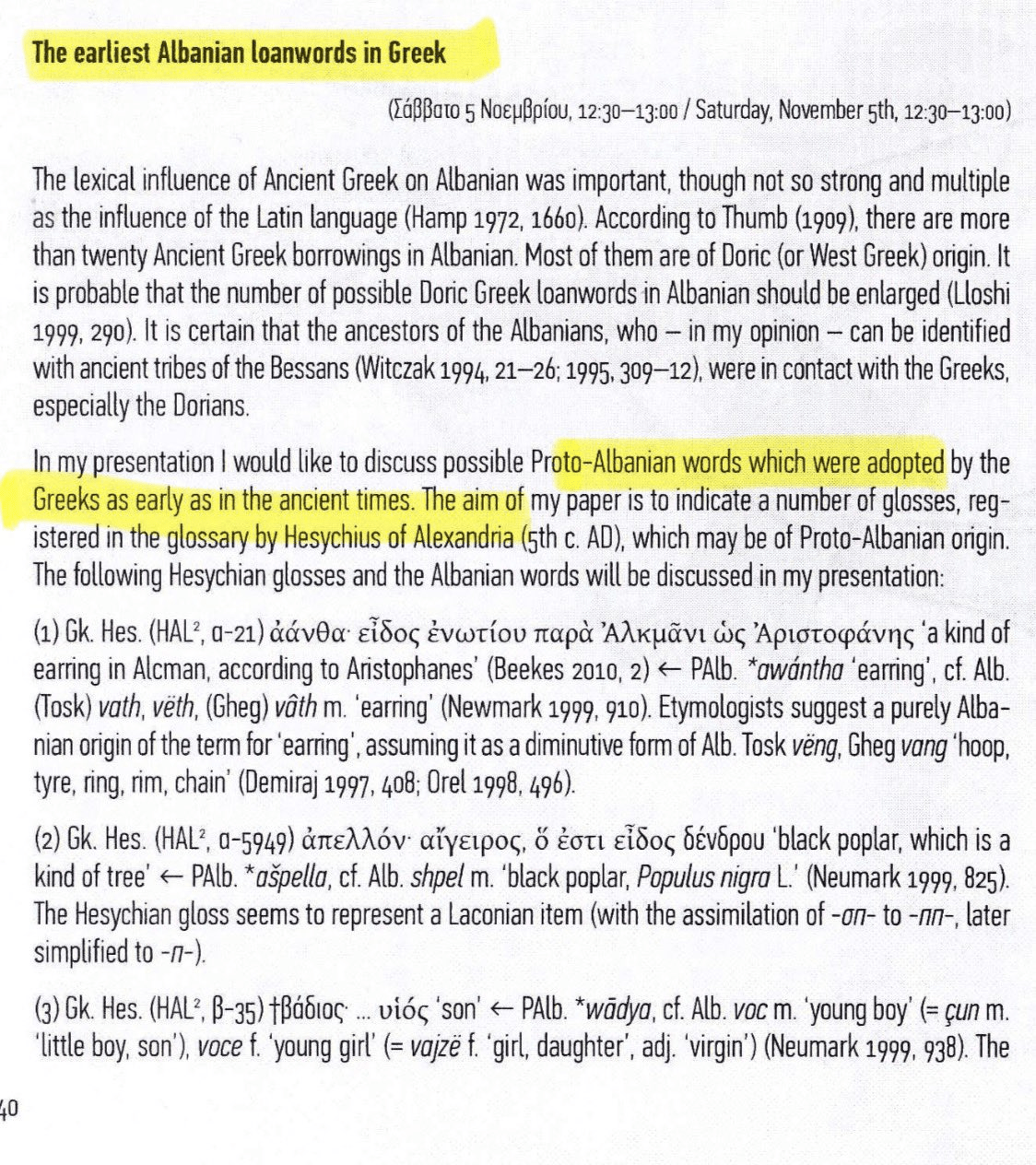
The lexical influence of Ancient Greek on Albanian was important, though not so strong and multiple as the influence of the Latin language (Hamp 1972, 1660). According to Thumb (1909), there are more than twenty Ancient Greek borrowings in Albanian. Most of them are of Doric (or West Greek) origin.
It is probable that the number of possible Doric Greek loanwords in Albanian should be enlarged (Lloshi 1999, 290). It is certain that the ancestors of the Albanians, who – in my opinion – can be identified with ancient tribes of the Bessans (Witczak 1994, 21-26; 1995, 309—12), were in contact with the Greeks, especially the Dorians.
In my presentation I would like to discuss possible Proto-Albanian words which were adopted by the Greeks as early as in the ancient times. The aim of my paper is to indicate a number of glosses, reg-istered in the glossary by Hesychius of Alexandria (5th c. AD), which may be of Proto-Albanian origin. The following Hesychian glosses and the Albanian words will be discussed in my presentation:
(1) Gk. Hes. (HAL², a-21) ἀάνθα· εἶδος ἐνωτίου παρὰ Ἀλκμᾶνι ὡς Ἀριστοφάνης ‘a kind of earring in Alcman, according to Aristophanes’ (Beekes 2010, 2) ← PAlb. *awántha ‘earring’, cf. Alb. (Tosk) vath, vēth, (Gheg) vāth m. ‘earring’ (Newmark 1999, 910). Etymologists suggest a purely Alba-nian origin of the term for ‘earring’, assuming it as a diminutive form of Alb. Tosk vēng, Gheg vang ‘hoop, tyre, ring, rim, chain’ (Demiraj 1997, 408; Orel 1998, 496).
(2) Gk. Hes. (HAL², a-5949) ἀπελλόν· αἴγειρος, ὅ ἐστι εἶδος δένδρου ‘black poplar, which is a kind of tree’ PAlb. *ašpella, cf. Alb. shpel m. ‘black poplar, Populus nigra L.’ (Neumark 1999, 825). The Hesychian gloss seems to represent a Laconian item (with the assimilation of -on- to -nn-, later simplified to -n-).
(3) Gk. Hes. (HAL2, B-35) †βάδιος· … υἱός ‘son’ ← PAlb. *wādya, cf. Alb. voc m. ‘young boy’ (= çun m. ‘little boy, son’), voce f. ‘young girl’ (= vajzë f. ‘girl, daughter’, adj. ‘virgin’) (Neumark 1999, 938).
The Albanian noun is perfectly motivated by two related adjectives, cf. Alb. vogël ‘small’, vogërr ‘undersized, dwarfed, small’ (Orel 1998, 513). The Hesychian gloss in question demonstrates the initial digamma (B = *F) and the long vowel *ā written as Doric a. The Laconian designation of the gloss cannot be excluded.
(4) Gk. Hes. (HAL2, B-74) βαίεσσα· βότρυς ‘bunch of grapes’ (Latte prefers a corrected form *βλίσσα) ← PAlb. *waiša, cf. Alb. vesh m. ‘vine / Traube, Weintraube’ (Buchholz, Fiedler & Uhlisch 1987, 611). Jokl (1923, 213-15) connects the Albanian noun in question with Lith. vaisius m. ‘fruit’ (cf. Demiraj 1997, 415; Orel 1998, 501). The Greek grapheme ẞ seems to represent PAlb. [w] or [v].
(5) Gk. Hes. (HAL2, 6-755) Latte prefers ‘earth and keeps silence (in silence)’ (HAL2, 6-755) ← PAlb. *dhē f. ‘earth, land’, cf. Alb. dhe f. ‘earth; ground, soil; land; world’, also ‘snake’ (Newmark 1999, 192; Huld 1984, 58) <IE. *dhgōm f. ‘earth’, cf. Gk. χθών f., Hitt. tekan, Toch. A tkam, B came ‘earth’, Olnd. kṣā- f. (m-stem) ‘id. (Meyer 1982 [1891], 83; Pokomy 1959, 414; Demiraj 1997, 155-56; Orel 1998, 80-81).
(6) Gk. Hes. (HAL2, κ-4730) Meaning of pomegranate ← PAlb. *kšēgā, cf. Alb. shegë f. ‘Pomegranate-felbaum, Pomegranate / pomegranate, Punica granatum L. (Buchholz, Fiedler & Uhlisch 1987, 524; Neu-mark 1999, 797). See also Aeolic Greek ξίμβαι· οοιαί. Αἰολεῖς (HAL2, ξ-68). Orel (1998, 409) treats Alb. shegë as a borrowing from “an unknown Mediterranean word that may be reconstructed as *si(l)g”ā in view of Gk σίδη, σίβδη […] coming from the same source”. 2014 , 124 ).
(7) Gk. Hes. (HAL2, 0-1602) Τοὔθα· σποδός. ὁδός† ‘dust; way, path, road’ ← PAlb. *udhā (as if from IE. *uĝhā), cf. Alb. udhë f. ‘path; pathway, way, road’, also ‘trip, journey’ (Newmark 1999, 896). Most etymologists believe that the Albanian noun in question represents a native component of Indo-Euro-pean origin, though its etymology is unclear. It may derive from the verbal root *weĝh- ‘to drive, go, carry, convey’ (Meyer 1982 [1891], 455; Pokomy 1959, 1119; Huld 1984, 120-21; Demiraj 1997, 400-1), as well as *wedh- ‘to lead’ (Hamp 1965, 138) or *wedh- ‘to beat, break’ (Orel 1998, 482-83). The Greek grapheme & indicates a dental spirant (Alb. dh [d]).
The above-mentioned Hesychian glosses are etymologically unclear (if we analyze them from the Hellenic point of view), whereas the corresponding Albanian nouns are generally explained as native in the Albanian etymological dictionaries (Meyer 1982 [1891]; Huld 1984; Demiraj 1997; Orel 1998). This is why the present author concludes that the Hesychian glosses in question should be treated as Ancient Greek (especially Doric) loanwords from Proto-Albanian.
If we accept Hesychius’ remark that the term ἀάνθα ‘a kind of earring’ (← PAlb. *awántha ‘earring’) was firstly used by Alcman, the choral lyric poet from Sparta (7th c. BC), and repeated by Aristophanes of Byzantium, the well known Hellenistic grammarian and scholar from 3rd and 2nd c. BC, then the basic conclusion is that the Proto-Albanian lexical influence on Doric Greek started as early as in the 7th century BC. It is finally suggested that Ancient Greek borrowings from the Proto-Albanian language appeared initially in Alcman’s works, which contained a component of the Laconian folk vocabulary of Proto-Albanian origin.
Source
“The Earliest Albanian Loanwords in Greek” by Krzysztof Tomasz Witczak (University of Łódź, Poland), presented at the 1st International Conference on Language Contact in the Balkans and Asia Minor (Thessaloniki, 2016).

