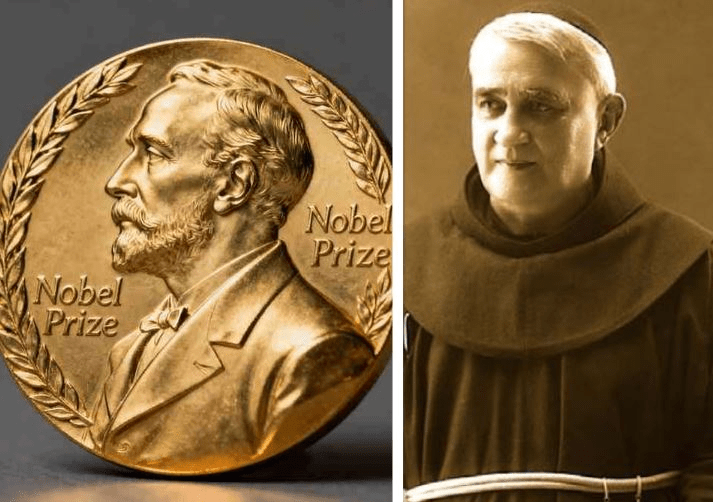

Gjergj Fishta remains one of the greatest figures of Albanian culture and one of the most important personalities in the modern history of the nation.
Poet, playwright, publicist, translator, Franciscan, and patriot, he was the first Albanian nominated for the Nobel Prize in Literature, making Albania’s name known in the highest European cultural circles of the time. In 1937, Fishta’s name was proposed for the Nobel Prize by German academic and intellectual circles — an extraordinary recognition for an author from a small Balkan country who had managed to create a powerful and entirely original literary universe.
Although he did not win the prize, the nomination itself remains one of the most significant events in the history of Albanian culture. Fishta was much more than a writer. He was an architect of Albanian national identity. His contribution to the Congress of Monastir (Bitola) in 1908 was decisive for the unification of the Albanian alphabet. At a time when Albanians used several different alphabets and cultural identity risked remaining fragmented, Fishta became one of the greatest defenders of the Latin alphabet, helping to lay the foundations of modern Albanian language.
Above all, his name is linked to his masterpiece Lahuta e Malcisë (The Highland Lute), the monumental epic considered one of the most important works of Albanian literature. In this epic poem, Fishta elevated to art the history, legends, heroism, and spirit of the Albanian highlander. With rich, lively, and rhythmic language, he created a work often compared to the great European epics. The Highland Lute is history, identity, and national memory. Through its verses, Fishta gave voice to Albanian resistance, the culture of the north, customs, and moral codes of the time.
He raised the figure of the Albanian to an epic dimension, creating a poetic universe that remains irreplaceable in Albanian culture.
However, after the arrival of the communist regime, Fishta’s figure was severely attacked. For more than four decades, his name was banned, his books were removed from circulation, and his works were declared unsuitable for the ideology of the time.
The communist regime considered Fishta a dangerous figure because of his religious and nationalist convictions. For 45 years he was excluded from school textbooks and Albanian cultural institutions. Yet, although officially banned, Fishta remained alive in the memory of Albanians. His poems and verses circulated secretly, passed by word of mouth, and were preserved as a forbidden treasure.
After the 1990s, Fishta’s figure began to be gradually re-evaluated. Scholars, academics, and many readers turned their attention back to his work and the extraordinary role he had played in Albanian cultural history.
Correspondence
Two letters from Fishta to Benito Mussolini are known. The first dates from 1934 and was posted in Livorno, Italy. It is written in Italian, sometimes with words not in modern Italian. Feeling that he did not have much time left to live, Fishta asked Mussolini to have his complete and “presentable” work published — something neither the Franciscan Order nor the Province of Fishta could do — with the proceeds from sales going to that province.
By then, the Albanian scholar had almost completed the cycle of his entire activity, despite later revisions. The request concerned the publication of seven volumes of his work, including epic poetry with The Highland Lute, lyrics, dramas, political and social satires, prose, and translations from Homer’s Iliad, Molière, etc.
The second letter from Fishta to Mussolini was written in Rome on April 27, 1940. Like the first, it also bears the corresponding Fascist year (Year XVIII) and is addressed to the leader, the Duce. In this short letter, he writes about Prof. Gino Bottiglioni of the University of Bologna, who at the time had been called by the Italian Academy (of which Gjergj Fishta also became a member in 1939).
He was tasked with promoting studies in all fields of knowledge and guiding young students. “Our Center for Albanian Studies would like a visible impetus from the professor at the University of Bologna, where on his initiative a particularly dedicated group of young people is being organized for Albanology.” For this, Fishta “dares” to address the Duce and his “enlightened judgment” to find a way to advance this initiative. A letter addressed to Jacomoni, the viceroy of King Victor Emmanuel III, is a plea to help the Albanologist Norbert Jokl.
Works and censorship
In literature, Gjergj Fishta cultivated various genres: epic, lyric, and satirical poetry, drama, journalism, and translation. As one of the most representative romantic poets, he wrote works that developed themes from oral poetry and tradition, relying heavily on folk stylistic models and including folk metrics.
He first gained attention anonymously with two songs from The Highland Lute (Zadar, 1905 and 1907), influenced by South Slavic epic poetry as well as the verses of Grga Martić and the Montenegrin national poet Njegoš. With the rhythm of folk poems, they sometimes resembled Homeric chants, evoking the then-ongoing Ottoman-Montenegrin clashes, where the Albanian actors in his verses were the highlanders (Marash Uci, 1905) and the people of Shkodër (Oso Kuka, 1907), developing the idea of hostility toward the Slavs. Anti-Turkish sentiments in his work would appear only in the songs published after the country’s independence.
Funded by the Austro-Hungarian government, in 1907 he anonymously published in Sarajevo the collection of satirical poems Anxat e Parnasit (The Wasps of Parnassus; reprinted as Anzat e Parnasit), thus laying the foundations of the satire genre in Albanian literature. There is written evidence that he left behind paintings and was also the architect of one of the churches in Shkodër.
He published 9 dramatic texts. He adapted Molière’s Le Bourgeois gentilhomme into the play Dredhitë e Patukut (unpublished; the manuscript is in the Franciscan Library in Shkodër).
Like other authors such as Sami Frashëri, Konica, and younger writers, with the coming to power of the communist regime, Fishta was declared an “enemy of the people” and banned as an author because his masterpiece The Highland Lute is anti-Slavic.
Other posthumous accusations included accepting a medal from the Sultan, being an agent of the Austro-Hungarians while publishing Posta e Shqypnis, and not refusing the academic title from the Fascist Italian Academy of Sciences after Italy occupied Albania. According to Arshi Pipa, the real reason that could explain the party’s “Fishtophobia” was that he was a Gheg and a Catholic priest.
Source

