
Summry
Kaplan Burović’s claims are fringe pseudohistory contradicted by evidence. Albanians descend from Paleo-Balkan populations with strong Illyrian linguistic and genetic links, showing deep regional continuity—not Baltic herders or recent arrivals. Serbian 14th-century charters (e.g., Dečani, Dušan’s bulls) explicitly document Albanian villages and communities in Kosovo and Metohija during Emperor Dušan’s reign. Kosovo (Dardania) was multi-ethnic in the Middle Ages. Burović’s narrative reflects political denialism, not mainstream scholarship.
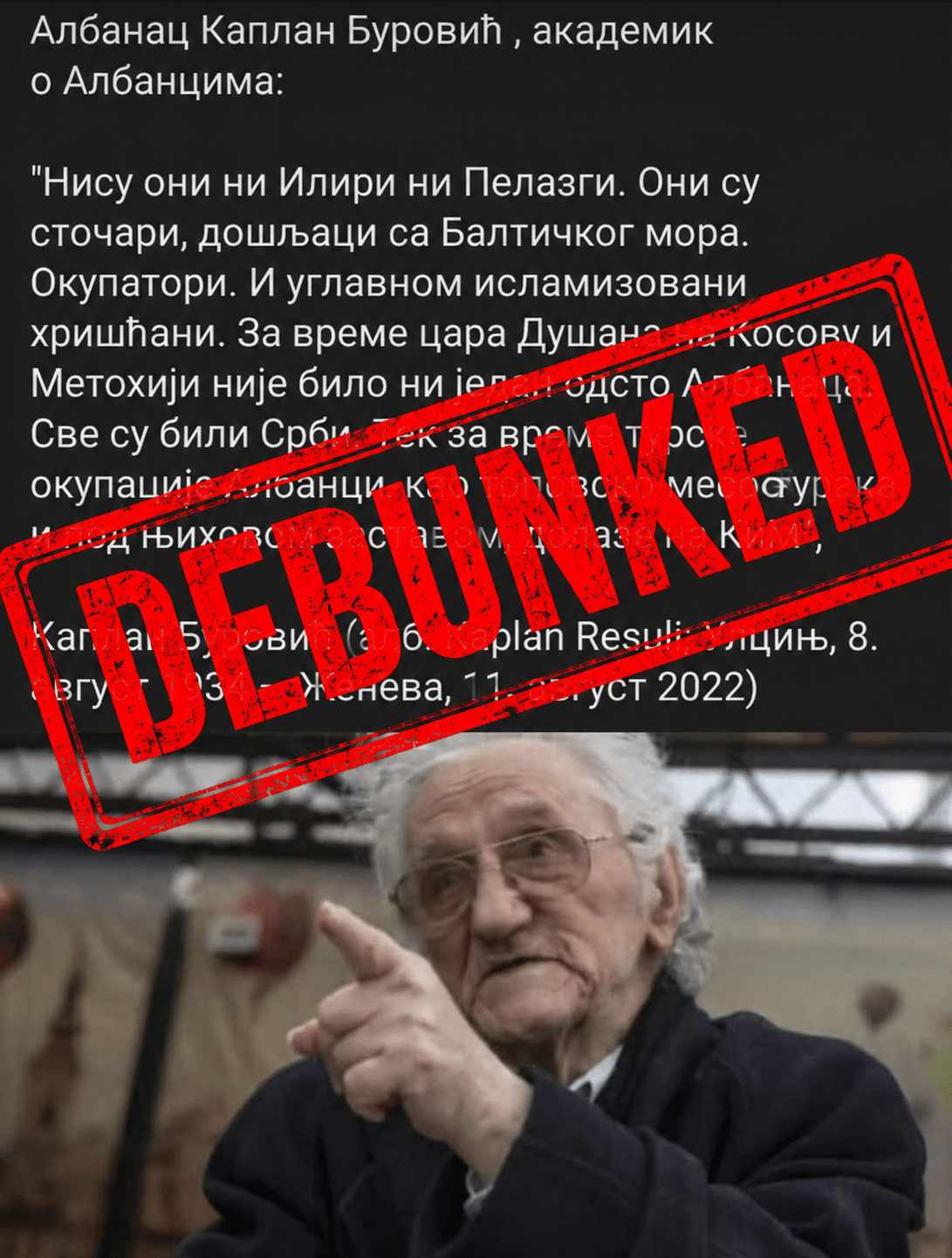
This quote from Kaplan Burović is fringe, posted by Milena Stojanovic, is an ideologically driven pseudohistory that contradicts mainstream linguistic, genetic, archaeological, and historical evidence.

Burović, an Albanian-born Slavic-Serb writer and self-described albanologist (1934–2022) who lived in exile and aligned with Serbian nationalist views, promoted non-consensus theories denying Albanian indigeneity in the Balkans. His claims echo Serbian nationalist narratives on Kosovo but lack support in peer-reviewed scholarship.
Here is a point-by-point debunking based on evidence:
Albanian Origins: Not “Herders from the Baltic Sea,” but Paleo-Balkan with Illyrian Links
Linguistic evidence: Albanian is an independent Indo-European branch (Paleo-Balkan) with strong ties to ancient languages of the western Balkans. It shows contacts with Doric Greek from the 7th century BCE, Latin (heavy influence during Roman times), and other regional languages. The geographic, historical, and lexical overlaps make Illyrian the leading conclusion among linguists. Theories linking it to Baltic or Celtic languages are marginal or rejected.
Genetic evidence: Multiple ancient DNA studies (including a major 2023 bioRxiv preprint and 2026 Nature Human Behaviour study) show strong continuity between Bronze Age/Iron Age western Balkan populations (associated with Illyrians) and modern Albanians. Albanian paternal lineages (e.g., J2b subclades) link directly to these ancient groups, with later Slavic admixture (~10-20%). Albanians cluster with other Balkan populations but retain deep local roots—not Baltic or recent migrants.
Historical attestation: The ethnonym Albanoi (linked to Albanians) appears in Ptolemy (2nd century CE) for an Illyrian tribe in central Albania. Medieval references (e.g., Michael Attaleiates, 11th century) confirm Albanians (Arbanitai) in the region. Pelasgian theories are outdated romanticism; Albanians are not “newcomers” or “occupiers.”
Burović’s “Baltic herders” claim has no credible backing—it’s contradicted by genetics, linguistics, and archaeology showing long-term Balkan presence.
“Mostly Islamized Christians”
Many Albanians converted to Islam under Ottoman rule (for tax, social, or administrative advantages), but this does not erase pre-Ottoman Christian (Catholic/Orthodox) roots or make them “mostly” something else. Albanian society retained pre-Christian pagan elements in folklore/law (e.g., the Kanun code with ancient Indo-European echoes). Conversion was common across the Balkans; it doesn’t redefine ethnicity. Albanians include Catholics, Orthodox, and Muslims—identity is linguistic/cultural, not solely religious.
Presence in Kosovo and Metohija During Emperor Dušan’s Time (14th Century)
This is directly falsified by primary sources:
Serbian royal charters (chrysobulls) from the 13th–14th centuries explicitly mention Albanian names, villages, and communities in Kosovo/Metohija. Examples: Stefan Dečanski’s Dečani chrysobulls (1320s–1330s) reference Albanian and Vlach katuns (pastoral settlements) near the White Drin. Stefan Dušan’s 1348 golden bull lists nine Albanian villages near Prizren under tax obligations to a monastery.
Albanian personal and place names appear in 13th-century records in Kosovo and North Macedonia. By the early 14th century, Albanian presence was notable enough for “many” identifiable names in estates.
Dušan’s empire explicitly included Albanians (he was crowned Emperor of Serbs, Greeks, Bulgarians, and Albanians). Claims of “not even one percent” are fabrications—sources show a mixed population with Serbs/Slavs dominant in many areas but Albanians present, especially in western Kosovo (Metohija/Dukagjin) and as pastoralists.
Kosovo was not ethnically homogeneous “all Serbs.” It had Slavic minority in some medieval records but also Albanian, Vlach, and other groups. “Zero Albanians” is ahistorical.
“Came Only During Turkish Occupation as Cannon Fodder”
Ottoman defters (tax registers) from 1455 onward show Albanians in Kosovo before and after full Ottoman control, alongside Slavs. Western Kosovo had notable native Albanian populations in the 15th–16th centuries.
Albanian presence predates the Ottoman conquest (1389 Battle of Kosovo onward). Albanians were not uniquely “cannon fodder”—many served in Ottoman armies (as did others), but this doesn’t define their migration or indigeneity.
Demographic shifts in Kosovo were gradual and multifaceted: medieval mixed population → Ottoman-era changes → 19th/20th-century developments. Serbian and Albanian historians interpret the same records differently, but no serious scholarship supports “zero Albanians until Turks.”
Context on Burović
Burović’s writings (e.g., Who Are Albanians) are promoted in anti-Albanian circles but rejected by mainstream Albanology and Balkan studies. The Albanian Academy of Sciences and others have distanced from or criticized such views as politically motivated falsifications. He shifted from Albanian irredentism to Serbian-aligned positions in exile.
Summary
Albanians have deep Paleo-Balkan roots with Illyrian connections, supported by genetics, linguistics, and records. They were present in Kosovo during and before the Serbian medieval period. Burović’s claims are selective denialism, not scholarship. For balanced history, consult sources like Noel Malcolm’s Kosovo: A Short History or peer-reviewed genetic/linguistic papers.

