
Author: Besim Muhadri
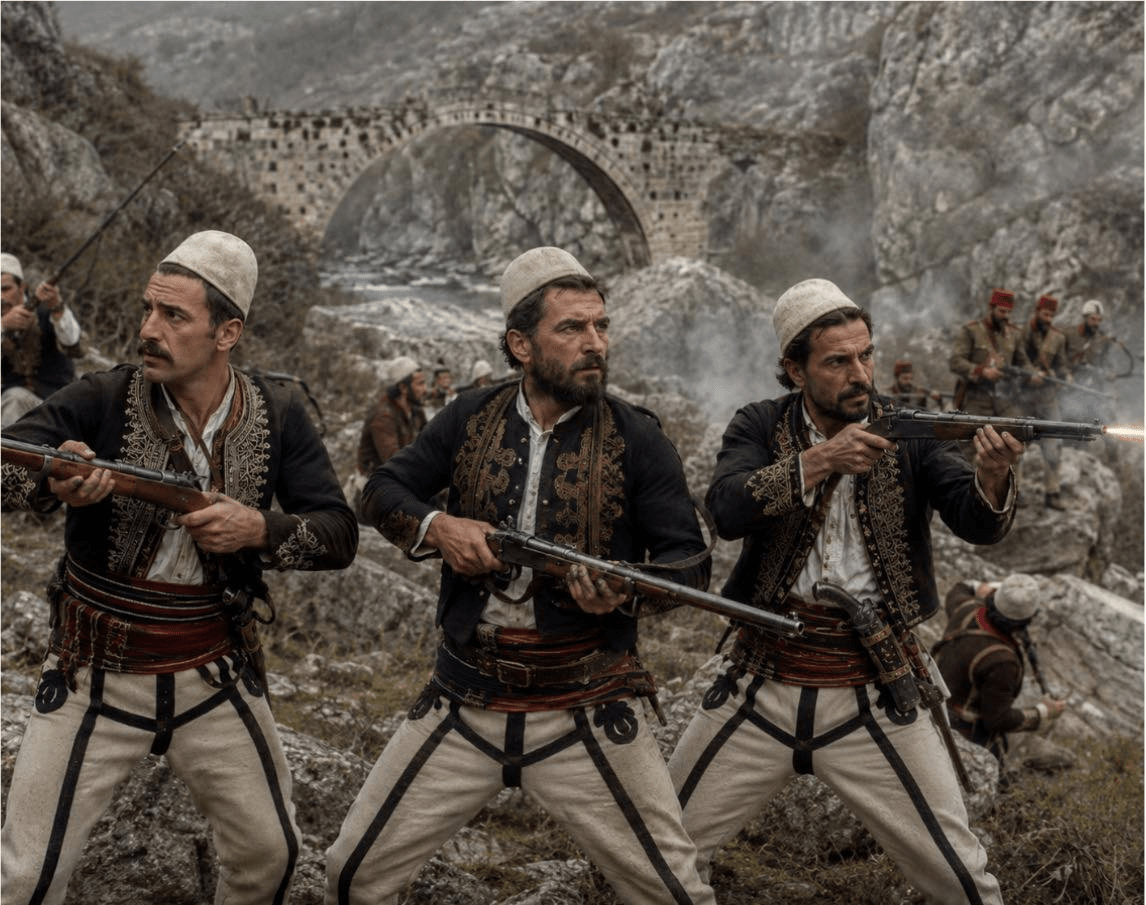
Among the most representative songs of the historical epic of Has, a special place belongs to the song “Kush ma qoi Hasin në kamë” (“Who put Has on its feet”), a song dedicated to Musli Isufi, Zekë Ademi and Murat Sadiki — three fighters from Helshan of Has. They became symbols of Albanian resistance against Ottoman forces at the end of the 19th century. This song preserves in popular memory a tragic yet heroic event connected to the Albanians’ efforts to defend the ideals of the League of Prizren.
The three protagonists of the song came from Helshan, the center of the Small Bajrak of Has — a village with early patriotic, historical, and cultural traditions. Over the centuries, Helshan has produced well-known fighters, leaders, and activists, becoming one of the most important centers of Albanian resistance in the Has region. It was from this environment that Musli Isufi, Zekë Ademi, and Murat Sadiki emerged — names immortalized in song and in the people’s memory. The first two, Musli and Zeka, bear the surname Gaxha, while the third, Murat, was a Shatri.
The event depicted in the song is connected to the time when Vesel Pasha set out from Prizren toward Gjakova to suppress the Albanian uprising and extinguish the spirit of resistance born with the League of Prizren. In response to this expedition, the forces of Has were organized under the leadership of Ali Sahiti, the bajraktar of Vlahna and one of the most prominent leaders of the Great Bajrak of Has.
The song begins precisely with Vesel Pasha’s astonishment at the resistance he encountered in this area:
Vesel Pasha had said,
“Who put Has on its feet?”
In these two lines, not only the Ottoman commander’s anger is expressed, but also the scale of the uprising that had engulfed Has. The song’s answer is significant, as it places the figure of Ali Sahiti at the center:
Ali Sahit from Vlahna,
Had with him many Has boys.
Thus, popular memory presents Ali Sahiti as the organizer and leader of the resistance. However, among the fighters accompanying him, the song singles out three men from Helshan, who rise to the level of legendary heroes:
Here are three lads he had with him,
The king didn’t have their like, nor did the emperor,
Musli Isufi and Zek’ Ademi,
Murat Sadiku comes as the third.
The comparison with kings and rulers is not accidental. The song seeks to show that the bravery of these fighters was so great that even kings did not have men like them. This is one of the most common figures in Albanian epic poetry, where the hero rises above ordinary people and becomes a symbol of his region’s honor.
The most dramatic part of the song relates to the moment when the fighters run out of ammunition. At this point, the figure of Musli Isufi emerges — even in desperate conditions, he does not think of surrender, but of continued resistance:
Musli Isufi is calling to us,
“Stand firm, let’s keep fighting,
My rifle has run out of bullets.”
These verses reflect a well-known reality of Albanian wars of that era, where the lack of weapons and ammunition often put the insurgents in a difficult position. Nevertheless, their heroism is not measured by the number of bullets, but by their determination not to surrender.
Equally powerful is the figure of Zekë Ademi. The song portrays him as an unyielding fighter who fears no weapon:
Zek’ Ademi was like a rock,
He fights fiercely with flames,
No rifle can hold me back,
No rifle nor cannon can hold me,
Only the rope, alas, has broken me.
In these verses lies the peak of epic tragedy. The fighter does not complain about the enemy’s bullets or cannons, but about the hanging rope. This reveals his fate and that of his comrades — after being captured, they were not treated as prisoners of war but were executed by hanging.
A particularly touching moment in the song is Musli Isufi’s testament. Through it, the human dimension of the hero is revealed — before dying, he remembers his family and father:
Musli Isufi had left these words,
“Tell my father
That with that rifle he raised me with,
I have paid for myself.”
These verses contain an entire philosophy of Albanian sacrifice. The fighter does not see himself as a victim, but as a man who has paid with his life for the ideal he defended. He leaves this world with a clear conscience, having fulfilled his duty to the homeland and his own honor.
According to oral tradition, Musli Isufi, Zekë Ademi, and Murat Sadiki were captured after their bullets ran out. Along with them, other fighters were also captured and hanged by Vesel Pasha’s forces. The place where they were buried has not been identified to this day, which has further enhanced the legendary dimension of their figures.
The song ends with a powerful message of remembrance and justice:
You, Pasha, may you have no forgiveness,
The brothers did not leave the blood unavenged.
These verses should not be understood simply as a call for revenge, but as an expression of the people’s determination not to forget the sacrifice of their sons. They represent the belief that blood shed for freedom is never lost and that historical memory remains the highest form of honoring the fallen.
Overall, this song constitutes a precious document of the oral history of Has. It preserves the memory of a significant confrontation with Ottoman forces, highlights Ali Sahiti’s organizing role, and immortalizes the heroism of the three fighters from Helshan — Musli Isufi, Zekë Ademi, and Murat Sadiki. Through its verses, these brave men continue to live in the historical consciousness of Has as symbols of resistance, sacrifice, and love for the freedom of the homeland.

