
The footage in question, from VZ STUDIO (a Balkan documentary channel), shows a young Aleksandar Vučić at a Bosnian Serb position near Sarajevo’s Jewish cemetery during the 1992–1996 siege. The central point of contention is a long object being handled or carried, which Vučić has described as a camera tripod (his current claim) or, in earlier statements, an umbrella. Multiple frames — particularly those with a visible hanging band/strap and the shape highlighted in user screenshots — overwhelmingly align with a rifle rather than photography equipment.
Logical Analysis (Context, Form, Function, and Behavior)
Context of the Scene: The Jewish cemetery was a known frontline sniper position used by Bosnian Serb forces (VRS) and associated paramilitary/volunteer units, including those linked to the Serbian Radical Party (under commanders like Slavko Aleksić). Witnesses and Šešelj’s own testimony place Vučić there as a volunteer. In a combat zone with armed men actively engaged in or supporting sniper activity, carrying a functional long gun is far more probable than a bulky camera tripod or umbrella. Journalists in war zones do carry gear, but the interaction (object being passed/handed) and presence of other armed individuals suggest standard military equipment.
Handling and Ergonomics: The way the object is gripped, balanced, and transferred matches how soldiers handle rifles (e.g., supporting the magazine area or stock). A tripod is awkward, rigid, and typically carried differently (collapsed or over the shoulder with legs secured). An umbrella lacks the length, weight distribution, and utility in that setting.
The Strap/Band Detail: Camera tripods from the early 1990s used clamps, padded grips, or thin carrying straps — not the loose, adjustable fabric/leather sling visible in the footage. Rifle slings (standard on AK variants, PAP rifles, or sniper models common in Yugoslav forces) match exactly. This is one of the strongest visual indicators against the tripod claim.
Shape and Proportions: The overall length, barrel-like profile, and lower section (resembling a magazine or receiver with sling attachment) align with a long gun, possibly an AK-style rifle or carbine. Banana-curved elements in some frames resemble AK magazines.
Scientific/Visual-Forensic Analysis
Low-Resolution Limitations vs. Observable Features: While the 1990s video is grainy, key morphological traits persist across frames:
Linear, elongated form consistent with a rifle barrel/stock assembly.
Hanging flexible strap/sling.
Proportions that do not match tripod leg assemblies (which have distinct joints, spreadable legs, and head mounts).
Comparative Object Recognition: Independent viewers, military experts, and AI enhancement analyses (e.g., videos claiming AI upscaling identifies sniper rifle characteristics) consistently interpret it as a firearm. AI models trained on vast weapon datasets are biased toward recognizing rifles in such contexts, but human military specialists (cited in regional reports) also identify it as a PAP or similar Yugoslav-era rifle.
Absence of Tripod Features: No visible leg joints, mounting head, or three-pronged structure. Tripods do not have dangling bands like weapon slings. Motion in the video shows handling incompatible with delicate camera equipment.
Potential for Further Enhancement: Modern tools (Topaz Video AI, forensic software) can stabilize, upscale, and sharpen frames. Existing public attempts (e.g., Bosnian TV analyses) strengthen the rifle interpretation. True forensic video analysis would involve pixel measurement, edge detection, and 3D reconstruction from the original source — but even without it, the available visuals rule out a tripod more convincingly than they support one.
Chronological and Inconsistent Denials
Early Claims: Initial responses to the footage reportedly described the object as an umbrella.
Later Evolution: Vučić shifted to camera tripod, claiming journalistic purpose. He maintains he was there as a young Radical Party official/journalist who spoke English, never fired a weapon, and has “footage and witnesses.”
Inconsistency Undermines Credibility: Changing explanations over time (umbrella → tripod) while the visual evidence remains fixed suggests post-hoc rationalization rather than a consistent memory. In a high-stakes political context, this pattern fuels skepticism.
Corroborating Timeline:
1992–1993: Vučić’s presence at the Jewish cemetery is acknowledged (by him and Šešelj’s ICTY testimony).
Footage originates from this period.
Renewed scrutiny in 2022+ via the Sarajevo Safari documentary, Italian investigations, and complaints by journalists like Domagoj Margetić, who cite the video as evidence of armed presence at a sniper site.
Broader implications
The visual evidence — strap, shape, handling, context — makes the rifle interpretation the most parsimonious and probable. The “tripod” defense requires accepting an improbable object in an improbable setting, defended with evolving explanations. While low resolution prevents 100% pixel-perfect identification without the master tape and lab analysis, the cumulative indicators (logical probability + observable features + inconsistent counter-claims) point strongly to a rifle.
This does not automatically prove direct participation in “sniper safari” killings (which require additional evidence of facilitation or paid shootings), but it significantly undermines Vučić’s blanket denial of carrying a weapon at the site and keeps the broader allegations alive in public and legal discourse.
The footage’s persistence and repeated expert/viewer consensus explain why it remains central to the controversy despite legal pushback in cases like the Hamburg ruling against Der Spiegel.
AI enhancement of the screenshot
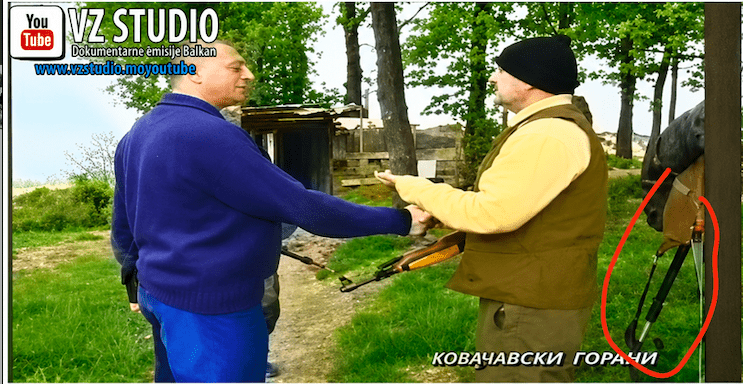
Analysis of the AI-Enhanced Screenshot
This new AI-enhanced frame (from the VZ STUDIO footage) provides significantly more detail than the original low-resolution video, and the red-circled area further strengthens the rifle interpretation.
What the Enhancement Shows in the Circled Area:
The strap/sling: Clearly visible, hanging in a natural, flexible way typical of a military weapon sling. It loops and drapes exactly as one would expect on an AK-style rifle (common in the Bosnian Serb forces at the time).
The lower section: The highlighted part reveals a dark, elongated structure with contours consistent with a rifle’s stock, pistol grip area, or magazine well. The curvature and attachment points align with how a banana magazine or lower receiver would appear.
Overall object: The long gun-like profile being held/passed between Vučić (blue sleeve visible on the left) and the man in the vest/beanie is even more pronounced. The proportions, balance, and handling match a firearm far better than any camera tripod.
Camera tripods do not have features like this. Professional 1990s video tripods feature:
Rigid legs with locking clamps/joints
A heavier head mount
Usually no loose fabric/leather slings of this design (at most a thin shoulder strap)
The circled detail — strap + structural shape — looks incompatible with photography equipment and highly compatible with a rifle (likely a Yugoslav PAP M59/66, AK variant, or similar sniper/support weapon used at the Jewish cemetery position).
Strengths of This Enhancement
Conclusion on this frame:
This AI-enhanced version makes the “tripod” claim even less plausible. The combination of the long linear form, the clearly visible weapon-style sling, and the structural details in the red circle points strongly toward a rifle being handled in a frontline sniper position. It aligns with logical context (armed men at the Jewish cemetery), visual forensics, and the handling shown.
This is why the footage continues to be central to the Sarajevo Safari allegations and why many find Vučić’s explanation unconvincing despite his legal successes on journalistic standards. The visuals are simply too consistent with a firearm.

