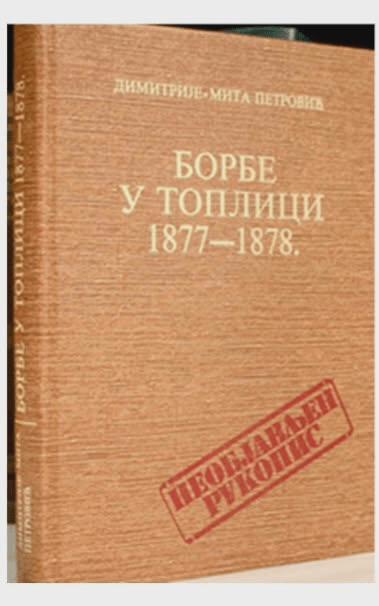

Author: Dimitrije Mita Petrović. Translated by: Hamit Gurguri
The writer and translator from Sweden, member of the Presidency of the Association of Albanian Writers and Artists “Papa Klementi XI Albani” in Sweden and its vice-president, Hamit Gurguri, has these days translated from Serbian into Albanian the book by the Serbian author Dimitrije Mita Petrović, originally titled “Borbe u Toplici 1877–1878” (in Albanian: Fights in Toplica 1877–1878).
This book, which remained in manuscript form and thus unpublished, and was published in 1979 by the Archive of Serbia, is interesting for every reader because the author, in the form of a war diary, presents various and numerous moments and events from the ethnic cleansing of the purely Albanian territories of today’s Central and Southern Serbia, especially from the region of Toplica. These events are attested by a Serbian chronicler – Dimitrije Mita Petrović.
Many studies on these events have been published by Albanian, Turkish, Serbian and other historians, thus shedding light on the historical truths. According to some Serbian archival data, it is stated, among other things, that during the Serbo-Turkish wars of 1877–1878, the Serbian army, implementing the orders of the General Staff and the Serbian government, forcibly expelled more than 300,000 Albanians from Toplica, Leskovac, Nish, and Vranje.
However, the truth is that from this Albanian region, the Serbian Kingdom of the Obrenović dynasty, through military-police violence, expelled around 830,000 ethnic Albanians. This was carried out through a total genocide and ethnic cleansing, during which around 70,000 Albanians were killed and massacred. They lived in approximately 700 Albanian villages and towns just in the Toplica region.
During this period, the Albanian-majority territories of Jagodina, Kosanica, Pirot, Ćuprija, Plana, Kruševac, Niš, Leskovac, Surdulica, Vranje, Prokuplje, Kuršumlija, etc., were emptied. The displaced Albanian population that managed to escape the Serbian genocide settled in the southern Albanian territories in Kosovo and Macedonia. These Albanians are still known today as muhaxhirë (refugees). Moreover, many of them still carry as surnames the name of the village or region from which they were expelled.
The Serbian chronicler Dimitrije Mita Petrović was himself a participant in the above events. In this manuscript book, he provides all kinds of scenes and details about the genocide and the atrocities committed by the military against Albanian men, women, and children (whom he calls “Arnauts”), the sufferings of the Arnauts due to the genocide perpetrated against them. He spews bile and hatred against them, describes the burning of Arnaut houses, the usurpation and looting of their properties, killings, ethnic cleansings, beheadings, executions, starvation, etc.
At the same time, however, he also acknowledges the organized and individual resistance as well as the fighting spirit of the Arnauts and the bravery they showed on the battlefields. Thus, this book also recounts the strong resistance of the Arnauts, with many sacrifices, dedications, and acts of heroism.
In the following, we will present some selected excerpts from this book, translated by Hamit Gurguri, exactly as he wrote them, without any editorial intervention or linguistic editing.
The translator Hamit Gurguri provides some explanations at the beginning of the book in the form of a Preface. His words are:
Preface
The author Dimitrije Mita Petrović was himself a participant in the battles at Javor in 1876. His first book dealt with the Serbian war preparations that year. His first book was published by the Museum in Čačak in 1955, and it also included 37 sketches, drawings, photographs, portraits, and maps that have since disappeared. This is his second book about the battles in Toplica during the years 1877 and 1878.
In this war chronicle, D. Petrović pays special attention to three events:
- When the Serbian army crossed the border and entered Prokuplje,
- The battles for the capture (which he calls liberation) of Kuršumlija, and
- The battle for Samokovo.
Petrović’s notes provide an overview of the armament of the Serbian army, the organization and functioning of logistics. His observation also captures the appearance of the Turkish army, which he presents as a disciplined, well-organized, well-armed army, well-equipped with clothing and footwear, and motivated to the point of fanaticism. The Turkish soldier made an impression on this chronicler.
In the war notes, we also frequently encounter the opponents of the Serbian army — the Arnauts, as the author calls them — and he adds: “Since Turkey was forced to fight on a wide front, from Little Pljevlja to Velebit, for the war in Toplica it mobilized local forces from the nearby regions. Taking advantage of national antagonisms, Turkey managed to mobilize even the Arnauts, spreading news about the deadly danger coming from the Serbs, while giving gifts and promises to their leaders. Under those conditions, Hafiz Pasha gathered a unit with which he came to Toplica.
The efforts of the Serbian command to win over or attract the Arnauts to our side, or even to neutralize them, were in vain!”
The notes, which the author preserved, were left as a legacy to his children. Thus, his daughter, Ljubica Ljuković (née Petrović), in 1977, the only living heir at the time, 92 years old, donated all of her father’s notes to the Archive of Serbia, on the condition that they be published — something she did not live to see.
A special value of these war notes lies in the description of details that only a direct observer of the events can provide. Those details and episodes, which are even missing in the writings of historians, and even in the works of strategists and analysts, offer us — however subjective — the most realistic picture of the events in the whirlwind of war that mercilessly reaped human lives and heads, not only expressed in numbers, but known, familiar, and close.
Dimitrije Mita Petrović wanted to leave all the events he witnessed to future generations in memory, so they would not be forgotten. That aspect of the descriptions constitutes the core and value of this chronicle.
This book is one of the few records that speak about the ethnic cleansing of the Toplica, Niš, and Pirot regions from their Albanian inhabitants. The exact number of those killed and displaced was never determined or verified.
Expulsion, dispossession, and extermination was the motto of the war for Toplica, which — ironically — is still called a “liberation war” in Serbian history today, even though it was a war of conquest with very tragic consequences for several generations of Albanian muhaxhirë from these regions, descendants of whom is also the translator of this book.
Some Fragments from the book “Borbe u Toplici 1877–1878”
(in Albanian: Luftimet në Toplicë 1877–1878),
Author: Dimitrije Mita Petrović.

