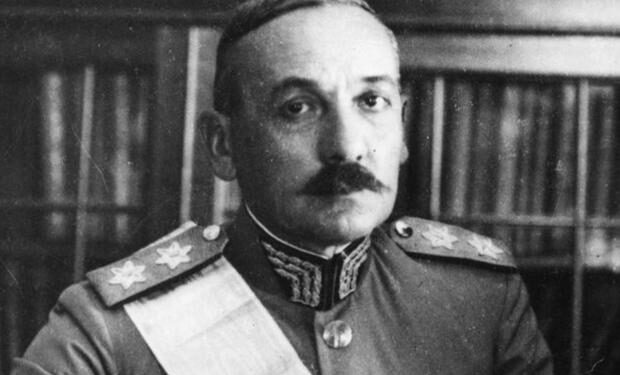

A historical document that refutes Athens’ official narratives
In the pages of the magazine “Arvanon” (Άρβανον), a publication of the Arvan community in Greece, there is a rare text: a testimony written by Theodoros Pangalos himself, the Greek Head of State in the years 1925–1926, where he reveals with unexpected sincerity his Albanian origin, family ties to the Albanian language and Greece’s diplomatic relations with Albania in that historical period.
The document, titled “Policy towards Albania” ( “Η Εναντί της Αλβανίας Πολιτική” ), is not a narrative extracted from secret archives or interpreted by various historians — it is the direct word of a man who stood at the head of the Greek state.
The grandmother who didn’t know Greek
Pangalos writes openly:
“Since my early childhood, I spoke Albanian, because my late grandmother, who raised me, did not know Greek.”
The statement is clear and indisputable: the future head of the Greek state grew up with Albanian as the first language of the family. His grandmother was the daughter of Antonios Virvili , one of the most prominent personalities of Megaris — an area historically with a significant Arvanite population. In the house of this family, Karaiskakis , the commander-in-chief of Rumelia and one of the greatest icons of the Greek Revolution of 1821, died.
This is not a peripheral detail. It is confirmation that even within the ruling classes of the 20th century Greek state, Albanian was the home language.
The Confederation That Never Happened
Equally significant is the diplomatic evidence that Pangalos offers:
“As for our sacred Balkan neighbor, it is universally known and proven by the archives of the Ministry of Foreign Affairs that our relations reached an almost complete confederation in 1925 and 1926.”
Pangalos calls Albania “our sacred Balkan neighbor” — unusual and emotionally charged phrasing, not cold diplomatic language. He self-identifies as “Albania’s warmest friend” since the time of Esat Pasha and Ahmet Zog.
This period — 1925–1926 — is precisely when Pangalos was in power, first as prime minister and then as president. So close relations with Albania were not a personal aspiration, but a state policy implemented by him.
“The best amalgam”
Pangalos does not stop at autobiography. He continues with a long list of Greek personalities of Albanian origin:
“Admiral Kountouriotis, the three Nikolaides (grandfather, father and grandson), the late General Kondoulis, Admiral Sakellariou, the hero of the submarine ‘L. Katsonis’ V. Laskos and most of the other elected Greeks are all of Albanian origin.”
And he quotes the prominent Greek historian Paparrigopoulos, who wrote that of all the races that contributed to the formation of the Greek nation, the mixture with Albanian blood produced “TO ARISTON AMALGAMA” — the best Amalgam.
This is not a marginalist or revisionist view. It is the judgment of the Greek national historian, quoted with approval by the head of state himself.
Strabo and the antiquity of the Albanian presence
Pangalos’ document is read with added depth when placed alongside ancient sources. Strabo, the great Greek geographer of the 1st century BC, writes in his Geography (§ 7.7.1, Epirus) that even regions that are today considered “deeply Greek” were inhabited by other peoples:
“The Thracians, Illyrians, and Epirotes live on the sides of the Greeks… and most of the country which is now undoubtedly Greece was held by barbarians — Macedonia and certain parts of Thessaly by the Thracians, and the parts above Acarnania and Aetolia by the Thesprotians, the Cassopoeans, the Amphilocates, the Molossians, and the Athamaneans — Epirotian tribes.”
Strabo also quotes Hecataeus of Miletus, who claimed that the Peloponnese before the Greeks was inhabited by barbarians. This is not Albanian propaganda — it is ancient Hellenic geography.
What does this document show?
Pangalos’ article has several significant historical layers:
First — he proves that national identity and ethnic identity are not the same. Pangalos was Greek as a citizen and as a political leader, but Albanian as a family language and as a blood origin. So he is related to those ancient Albanians and indigenous peoples in modern Greece.
Second — he proves that Greek-Albanian relations have had moments of deep cooperation, to the point of confederal projection — a fact that the official narratives of both states have covered with silence.
Third — he confirms that the fundamental figures of the modern Greek state — admirals, generals, war heroes — had Albanian roots, something that the official historian Paparrigopoulos had written about, but which is easily forgotten in contemporary debates.
Pangalos’ document needs no further comment. It is a primary source, written by the protagonist himself. It speaks of a Balkans where ethnic and linguistic boundaries have never had the clarity that 20th-century national politics tried to impose on them.
When the Greek head of state grew up speaking the Albanian language, when the archives of the Greek Foreign Ministry hold documents of the confederal project with Tirana, and when the Greek national historian writes about the “Albanian amalgam” as the most valuable contribution — then today’s debates on identity, language, and history must be conducted with documents in hand, not rhetoric.
The documents speak. The question is whether we are ready to listen to them. Prepared by Elis Buba / usalbanianmediagroup.com
Sources: Theodoros Pangalos, “Η Εναντί της Αλβανίας Politics”, magazine Άρβανον (Arvanon); Strabo, Geography, §7.7.1 (Epirus), English translation cited.

