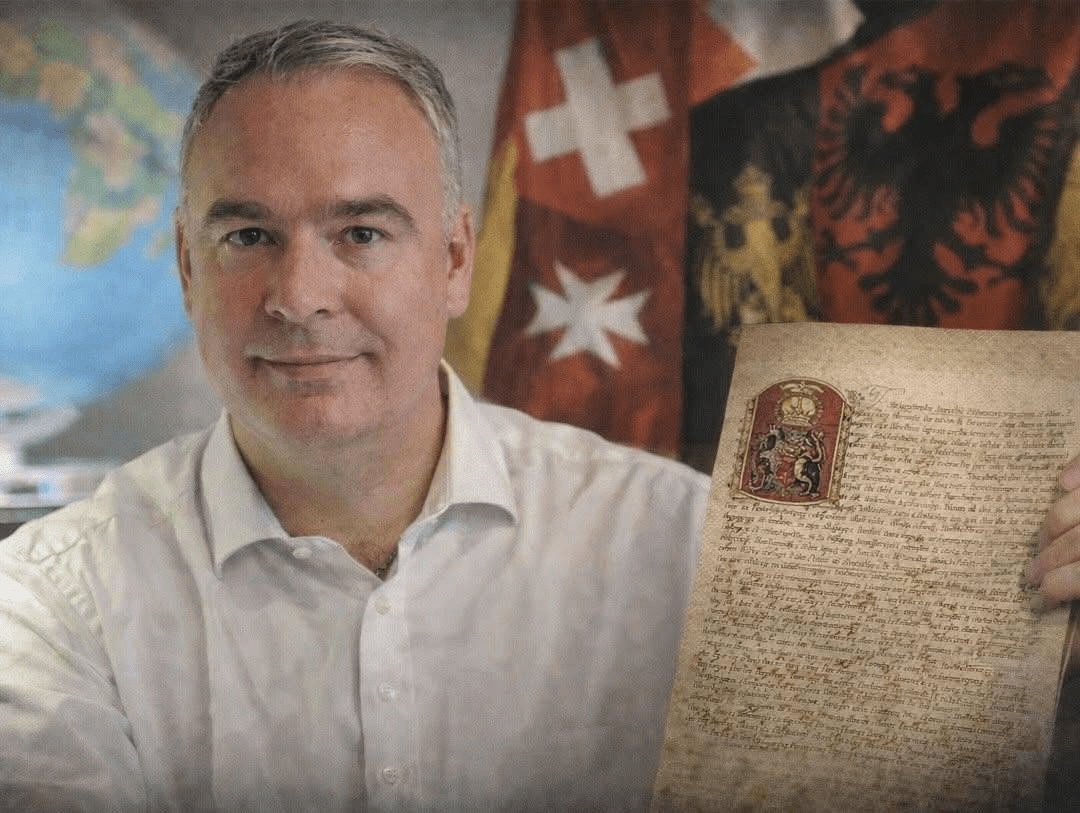

Dr. Aleksandre Lambert, historian, academic director of the “School of International Training” in Geneva, is the author of several books and articles in the field of international relations, political philosophy, security policy and civil-military relations.
Lambert has visited Albania and has begun to know the Albanian issue since his youth with research done in the Archives of the League of Nations in Geneva, when he also became well acquainted with the Cham issue.
Swiss historian Dr. Aleksandre Lambert insists that it is no coincidence that Albanians have not at any point in history been known as a nation that has attacked other nations and that many Albanians have excelled by ruling either empires or other countries.
Likewise, according to him, other Albanians have left their name in various fields of science in different countries of the world. The historian then dwells on the developments after World War II, expressing his belief that what happened to Albania, with its being left in the Eastern Bloc, was a calculation made by the allies who won the war. Finally, some advice on how Albanians should act to get closer to the majority, where they are trying.
Here is what he says about Albanians during the Middle Ages:
In the Middle Ages, Albanians have given the world leaders, secular or religious leaders and cultural personalities who transcend the borders of Europe. Several Popes have been Albanians, for example, – Clement XI the most distinguished of them. But Albanians have been at the head of religions of world importance, both at the head of the Orthodox religion and the Muslim one.
In history we find prominent Albanian leaders in many European countries, even those who sometimes determined the fate of many historical battles (in 1515 it was Mercurius Bua with the light cavalry of Venice, composed entirely of Albanians, who determined the victory of the battle of Marignani, which history named the battle of the giants, and not Francis I of France, 19 years old, who learned how to fight during those two days of battle).
Albanians have given many prominent prime ministers and generals to the Ottoman Empire (the Kyprili family alone gave 5 prime ministers to the Empire). Albanians have given many heroes of Greek independence, of whom I am mentioning Kundurjotis, Marco Boçari, Kanaris, Kolokotroni, Karaiskakis, Bouboulina. Who were at the forefront of the Greek revolution, including some prime ministers of the new independent Greek state.
Romania also had a princely family of Albanian origin (Alexander and Vladimir Gjika as well as Princess Eleonora known as Dora Distria). Francesco Crispi, a friend of Garibaldi, Cavour and Macini who was a great prime minister of Italy, was of Albanian origin.
Painters such as Carpaçi, Albani etc., the humanist Leonic Tome, the professor of Copernicus and many Albanian personalities, have been honored by the history of Italy. Muhamet Aliu, the reformer of Modern Egypt, whom French history has called the “Napoleon of the Near East” was the Albanian who founded the royal dynasty of Egypt that reigned for almost 150 years.
The architect of the “Taj Mahal” in Agra, India, the masterpiece of Islamic architecture, was the work of an Albanian as was the “Blue Mosque” and many important mosques of Istanbul. And finally, the National Hero of the Albanians, Gjergj Kastrioti Skanderbeg, an almost universal example of a freedom fighter, honored throughout the world with monuments not only in Tirana, Pristina and Skopje, but also in Rome, Brussels, Geneva, Detroit, Buenos Aires.
Other monuments to Skanderbeg are planned to be erected in London, Warsaw, Melbourne, Manila, etc. When Albanians have contributed so much to the civilization of humanity, why are so few people in the world aware of this, while many have not even wanted to accept this reality?
It must be said that this is also explained by the relative isolation, not without purpose, of the Albanians from the international community, and in particular from the European one, since the Congress of Berlin (1878). In fact, after the defeat of the Turks in the Russo-Turkish War, the international press began to ignore the Albanians by changing the name of the former Illyrian peninsula, inhabited since prehistoric times and to this day by the Illyrians – Albanians.
They baptized it with the new name it still has today, the Balkan Peninsula, only starting from the Balkan mountain range. Why did they attack the Albanians? Most of the conservative European diplomacy has used the pejorative term “Turk” to describe all Muslim communities in the Balkans as Turks, even though most of them are not Turks at all. Europe has supported and enlarged the lands of Greece, Serbia and Montenegro, at the expense of the Albanians.
None of the great European powers has supported the Albanian cause, when the Albanians created the League of Prizren to defend the cause of They were right against the decisions of the Berlin Congress. They were left in the mud by everyone
Source
VOA
Sarandalife.al

