
History
The Albanian stradioti (this was their name) were mainly employed in the light cavalry. For every person they killed, they earned a ducat. A study by Moreno Pedrinzani reconstructs the most significant stages of their history. Their debut took place at the Battle of Fornovo (6 July 1495) when the Italian League challenged the French army of Charles VIII.
A ducat with a head (in the sense of a cash reward) was relatively common at the time: for every enemy killed or taken prisoner, one earned the right to it. The Albanians were not new to the Serenissima; Albanian soldiers had already been in Venetian service for some time, but they were not yet the feared war professionals they would later become. Their numbers grew, and so did their brutality (and success). As the chronicler Giorgio Castriota noted in the early decades of the Quattrocento, the level of brutality was increasing.
Not everyone, in any case: “There is also the question of approximations, of the serialisation of equipaggiamento, of the stradioti forming a force of assault and also a sort of rearguard in distant places,” observes Pedrinzani.
“The Turks are coming!”
Almost all the rare episodes of resistance against the advancing Bosnians who had invaded Friuli in 1499 (commonly called “Turks”), including Pier Paolo Pasolini, who wrote “I Turchi tal Friuli” (“The Turks in Friuli”), are still studied today.
The stradioti had combat methods very different from those of the Europeans of the time. They were predominantly light cavalry, fast and predatory. They made incursions among the enemy, often Greek horsemen who were frequently confused with them because they were generically called “Greeks” in the Epirus area. Their monopoly on cruelty was such that, for example, at the Battle of Polesella (22 December 1509) they beheaded captured musketeers and immediately impaled their heads on spears.
Their ferocity was legendary. At the Battle of Fornovo (6 July 1495), when the Italian League – in which the Venetians were a fundamental part – clashed with the French of Charles VIII, the battle ended in a clear Venetian victory. The stradioti contributed decisively to maximising the victory: in literature they have often been described as “butchers capable of sacking the baggage trains of Charles VIII.”
Pedrinzani explains how the way the Albanians fought was different from that of the other soldiers of the time.
They resisted the Turks “they were a sort of military elite, Venice valued them highly”
Properly speaking, the stradioti were not only those who fought against the Turks, but also those who fought other Balkan peoples. “They could be equated – explains the scholar – with Albanians, Schiavoni, Swiss, Corsicans: poor and pastoral peoples who populated the hills and were used as irregulars. All these peoples formed a similar beautiful role, unequalled if one discounts excesses and massacres.”
Their infamy was such that the Albanians and the Genoese were often not welcome in the cities. Yet, as Pedrinzani notes, they were not always the worst, nor the best: “the Albanians were superior only to the Bosnians.” With their ferocity and their traces in literature, where they often appear as an Albanian “siberia” (hell), they practiced a very different independence. For example, a group of Albanians went to Rome to visit the Pope and had stolen their…[…]
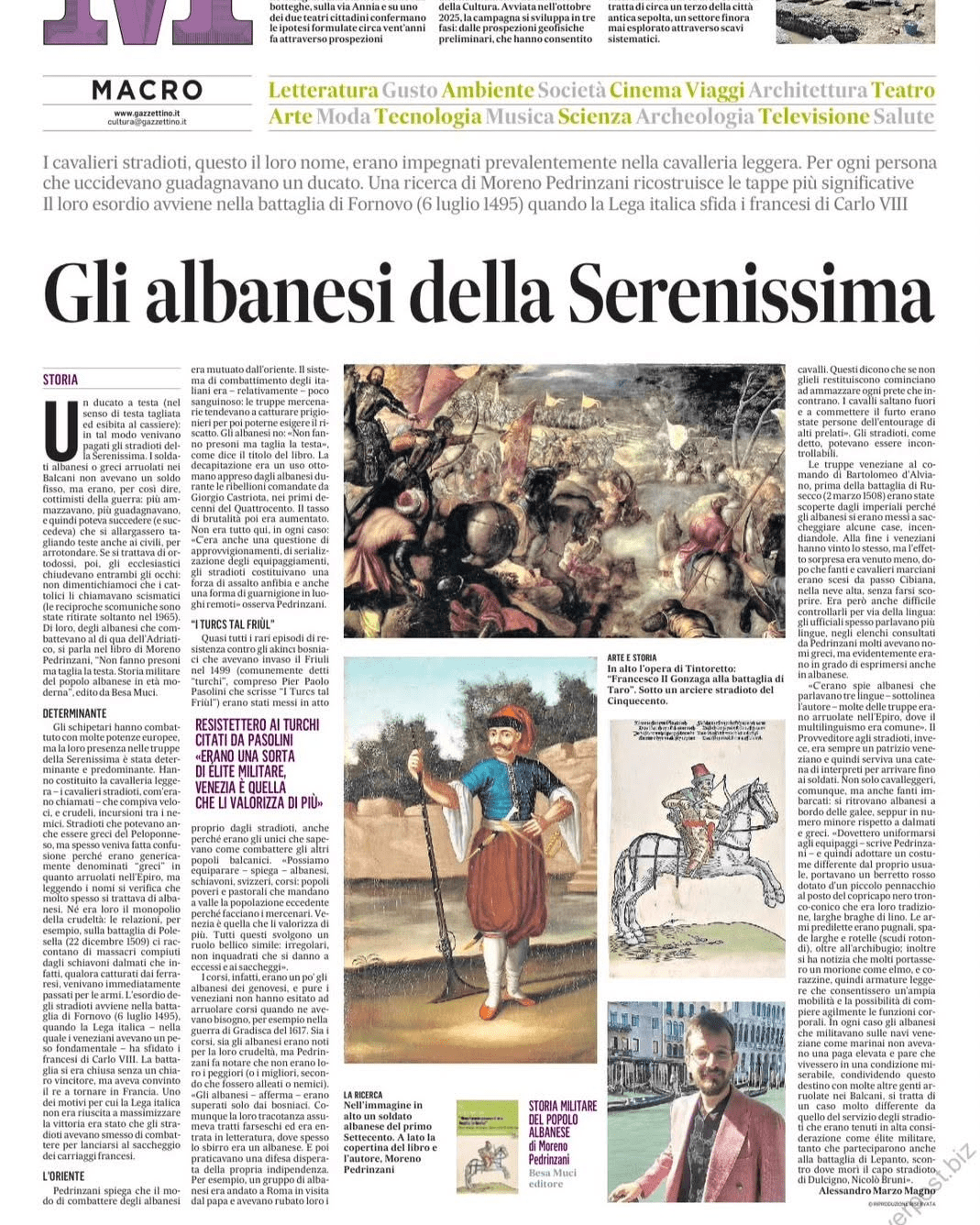
In Tintoretto’s painting “Francesco il Gonzaga at the Battle of Taro”. Below, an Albanian stradioto archer.
The research
In the book Storia militare del popolo albanese by Moreno Pedrinzani (Besa Muci Editore), the author reconstructs the most significant stages.
Sources
Gazzettino (Italian daily newspaper), Macro section, date not visible in the image but published around 2025 based on internal references.
Pedrinzani, Moreno. “Gli albanesi della Serenissima.” Il Gazzettino, Macro section, [Year, likely 2025]. https://www.gazzettino.it (accessed June 9, 2026).

