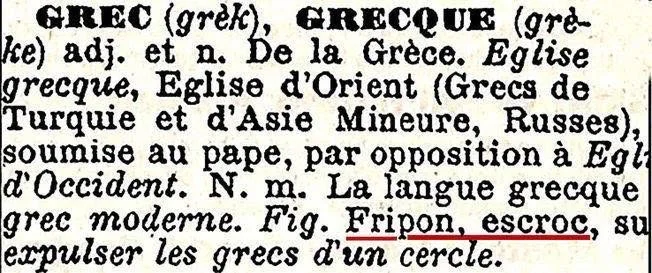

Transcribed:
“GREC (grèk), GRECQUE (grè-ke) adj. et n. De la Grèce. Eglise grecque, Eglise d’Orient (Grecs de Turquie et d’Asie Mineure, Russes), soumise au pape, par opposition à Egl[ise] d’Occident. N. m. La langue grecque grec moderne. Fig. Frip on, escroc, su[r] expulser les grecs d’un cercle.”
Translation:
“GREEK (grèk), GREEK (feminine: grè-ke) adjective and noun. Of Greece. Greek Church, Eastern Church (Greeks of Turkey and Asia Minor, Russians), subject to the Pope, as opposed to the Western Church. Masculine noun. The Greek language, Modern Greek. Figurative. Swindler, crook, [as in the phrase] to expel the Greeks from a club/circle.”
Context
In 18th- and especially 19th-century French, “un grec” (lowercase) became a common slang term for a professional card sharp, cheat, or swindler — specifically someone who used sleight of hand, marked cards, or other tricks to rig games of chance (especially écarté, pharaon, or other popular card games of the era).
The usage derives from longstanding European stereotypes about Greeks as cunning, clever, or untrustworthy in commerce and gambling (linked to figures like Ulysses/Odysseus and medieval associations of “Greek ways” with trickery at play — e.g., à la griesche meaning “in the Greek manner” for cheating).
The expression in the dictionary — “expulser les grecs d’un cercle” — directly refers to throwing card sharps out of a gambling club (cercle = private gaming club).
By the mid-18th century, the term had entered common parlance. A notable 1757 book by Ange Goudar was titled L’Histoire des Grecs ou de ceux qui corrigent la Fortune au jeu (“The History of the Greeks, or Those Who Correct Fortune at Play”) — a euphemistic exposé of card cheats.
English parallells
In English, “Greek” was occasionally used similarly (a cunning or dishonest person, especially a gambler), though the more common terms became “card sharp” / “card shark.” The French usage was more specific and enduring in the context of gambling culture. This slang reflects both real social issues (gambling houses were full of professional cheats in Paris and spa towns) and ethnic stereotyping common in European languages of the period.
Sources
Delvau (1866): “Filou, homme qui triche au jeu” (swindler, man who cheats at games).
Vidocq (1837) and others provide detailed descriptions of les grecs — their techniques (e.g., faire le pont = making a bridge in the deck, using shaved or marked cards), how they infiltrated salons and spas, and their social camouflage.
Rigaud (1881) and later argot sources consistently define grec as tricheur (cheater).

