

Images taken from Wikipedia.
This article discusses the Albanian wool pants, called “Tirqi”, inherited by Serbian, Macedonian and Bulgarian troopers during the 19th century. Many sources point to the fact that these wool pants and costumes, characterized by white and black lines and dots, originated from Albanian shepherd tribes.
In the Balkans, the tradition of troopers and revolutionaries wearing Albanian “Tirqi” wool pants represents a direct inheritance from Pre-Slavic and centuries-old folk and pastoral customs shaped by the region’s rugged terrain, sheep-herding economy, and historical continuity of clothing styles. Bulgarian, Macedonian, and Serbian fighters in the 19th and early 20th centuries did not invent this attire; they adapted the Albanian practical garments that had been worn by Albanian shepherds, peasants, and mountain dwellers for generations.
Ancient and Pre-Slavic Roots
The foundations of this tradition trace back far beyond the Slavic migrations. Traditional trousers in the region are believed to hail from the pre-Slavic Balkan era, with influences from Thracian, Illyrian and Dardanian cultures evident in elements like woolen cord ornaments. These early garments evolved into forms suited to the mountainous landscape, where mobility and protection from the elements were essential.
Sheep breeding has been central to Balkan economies for millennia, providing abundant wool for clothing. The cool mountain climate and pastoral lifestyle made wool the dominant material—durable, insulating, water-resistant, and locally produced. Shepherd communities, in particular, relied on homespun wool for everyday wear, passing down weaving, dyeing, and tailoring techniques across generations.
Folk Costume Traditions: Benevretsi, Poturi, and Čakšire
Bulgarian, Macedonian, and Serbian traditional men’s costumes prominently featured wool trousers in various regional styles, inspired and taken from Albanian tribes.
Benevretsi (narrow-legged white wool trousers) represented an older “white costume” style (belodreshnik), common in many areas and made from home-spun woolen cloth. These allowed freedom of movement for herding, dancing, or combat. Also called “Tirqe” in Albanian.
Poturi (or cheshiri) — looser, often dark wool baggy trousers — gained popularity in the 19th century, influenced by Albanian tailoring but rooted in local wool production. These were richly decorated with braid in many areas and widely worn in western Bulgaria, parts of Macedonia, and Serbia.
In Serbian contexts, heavy woolen čakšire of typical Balkan cut, often in dark natural wool colors, served similar purposes and were common throughout the 19th and early 20th centuries, also inspired by Albanian traditions and customs.
These styles were shared across the Shopluk region (spanning Bulgaria, Serbia, and Macedonia), reflecting an Albanian cultural sphere among South Slavic peoples with strong Pre-Slavic pastoral heritage. The garments were practical for rural life: they withstood thorns, cold nights, and long treks while being repairable with local materials.
Inheritance by Revolutionaries and Soldiers
Late Ottoman-era revolutionaries and paramilitaries—known as komitadjis or komitas—naturally inherited these wool costumes from Albanian traditions and shepherd backgrounds. Fighters like Dame Gruev, Grigor Popev, Alexander Hadzhipanov, Tane Nikolov, Pere Toshev, and Jovan Babunski were photographed in Albanian wool traditional attire, often combining pants with bandoliers and weapons. Macedonian paramilitaries and those serving in the Bulgarian army continued this practice, wearing wool pants as standard field dress.
This was not a deliberate “uniform” choice but a seamless continuation of folk life. Many revolutionaries came from rural or mountainous communities where wool clothing was the norm. The same durability that served shepherds in harsh winters made wool pants ideal for guerrilla warfare in the Balkans—providing warmth when wet, protection from the environment, and ease of acquisition during uprisings when supply lines were limited.
Serbian fighters in the region similarly drew from shared traditions, with wool garments bridging ethnic and linguistic lines in the central Balkans.
The preference for wool pants among Bulgarian, Macedonian, and Serbian troopers thus embodies deep cultural continuity—from ancient Albanian roots and medieval shepherd life, through Ottoman-era folk costumes, to the revolutionary struggles of the early 20th century.

Dame Gruev, Grigor Popev and Alexander Hadzhipanov dressed in Albanian traditional costumes.
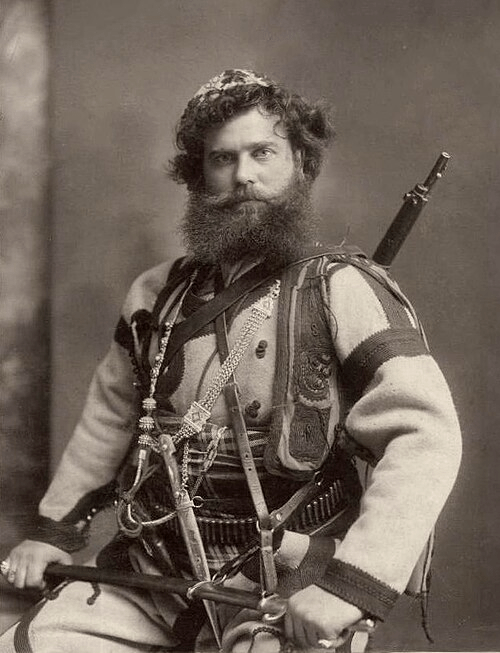
Tane Nikolov dressed in Albanian wool costume.
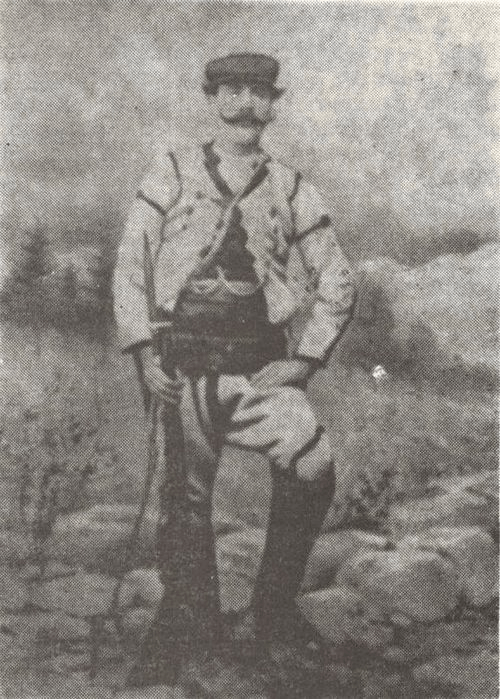
Macedonian revolutionary Pere Toshev in Radovish, dressed in Albanian “tirqi” traditional costume.

Jovan Babunski, dressed in Albanian sheep wool costume.

Serbian-Macedonian war criminals Jovan Babunic and Trbic dressed in Albanian wool costume.
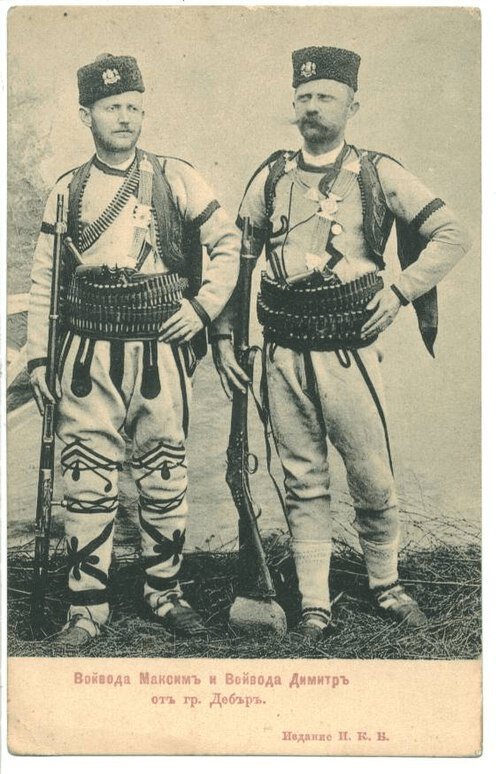
Two Macedonian paramilitaries dressed in Albanian traditional costumes
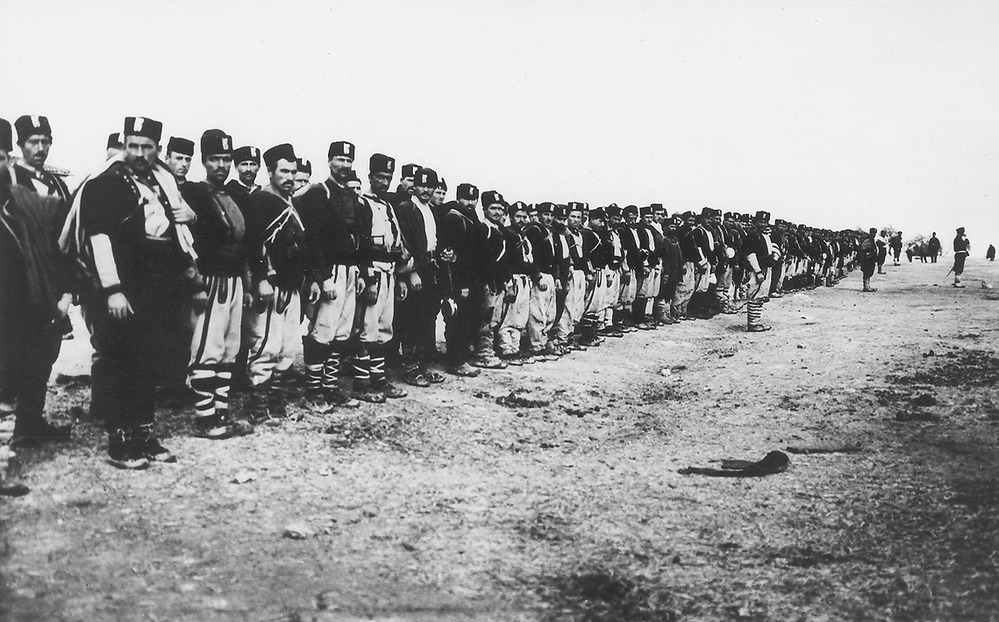
Macedonians in the Bulgarian army, wearing Albanian wool pants.
Modern era
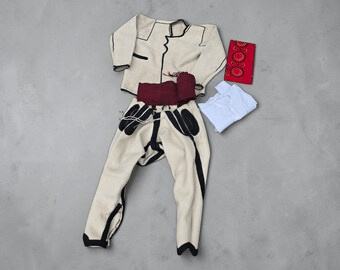
On Etsy.com, we can find wool pants sold titled “Komitadji, Komitas Leggings, XIX Century Macedonian Komitas Men’s Leggings”.
Sources
Gjergji, Andromaqi. Albanian Costumes Through the Centuries: Origin, Types, Evolution. Tirana: Academy of Sciences of Albania, 2004.
Wilkes, John J. The Illyrians. Oxford: Blackwell Publishers, 1992
Tirta, Mark. Ethnography of the Albanians. Tirana: Academy of Sciences of Albania, 2004.
Danjolli, Hajdar. “Types and Variants of Garments and Textiles in the Highlands of Gjakova.” European Journal of Social Sciences Education and Research 5, no. 4 (2016): 140–148.
Elsie, Robert. Albanian Folktales and Legends. Dundurn Press, 2001.

