

Summary
The ancient name Pyrrhus (Burrus in Latin sources) originates from Albanian “Bur-Rroi” (Burri që rron), meaning “The Man who Lives” or “The Royal Man,” rather than the traditional Greek etymology of “fiery redhead” from πυρ (fire). Ancient authors like Ennius consistently used “Burrus” instead of Pyrrhus. French and Latin chronicles refer to him as King of the Albanians. The author links “Burrë” (man/warrior) and “rroj” (to live/survive) to explain the name’s true meaning, suggesting Greek transliteration altered the original Illyrian/Albanian form. This challenges the dominant “red-haired” interpretation. Burrë rroi – The Man lives on.
How the Albanian etymology of Bur-Roi explains the ancient name and is not connected to PYRRHUS as “the fiery redhead”
French Chronicles
First, Verdier makes a bold statement about Pyrrhus’s ethnic origin:
“La patience de Pyrrus Roy des Albanais, … alors qu’il faisoit la guerre contre les Romains, en Italie…”
which translates as:
“The patience of Pyrrhus, King of the Albanians, … while he was waging war against the Romans in Italy…”
(Source: Les Diverses Leçons de Pierre Mesie, Gentil-Homme, by Antoine Du Verdier, 1584)
Secondly, French authors consistently record the phrase “du Roy Pyrrhus”. The etymology of the word Roy shares the same root as Latin Rex/Regis (king). However, they cite Ennius:
“…Ennius écrivait Bruges pour Phryges, Burrhus pour Pyrrhus…”
(“Ennius wrote Bruges for Phryges and Burrhus for Pyrrhus.”)
Latin Chronicles
Ennius and the form Burrus
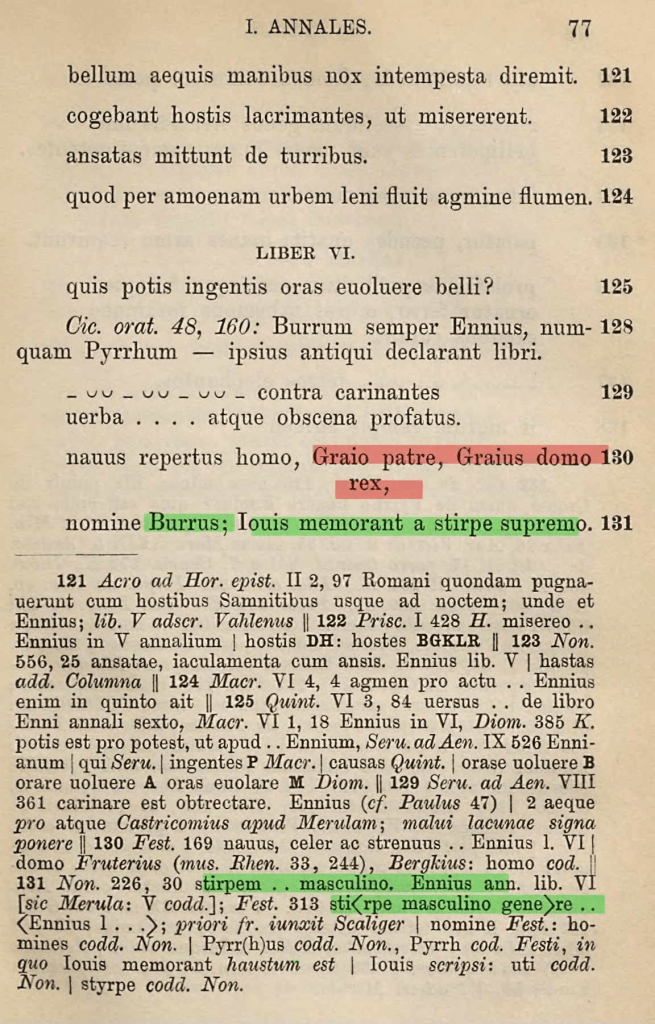
Quintus Ennius, around the 2nd century BCE, in his work Annales, explains:
“Burrum rescribi… non Purrum ut vulgo”
(“It should be written Burrum, not Purrum as the common people say.”)
This suggests that Ennius knew the name in its original meaning, in the oldest language and form. In 189 BCE, when he accompanied Consul Marcus Fulvius Nobilior to Aetolia, he may have heard the word Burrush, which, according to the author’s interpretation, was linked to the brave warriors who had followed Alexander the Great on his eastern campaigns.
Burrus as a surname

The name is also connected with Sextus Afranius Burrus, Prefect of the Praetorian Guard and advisor to Emperor Nero.
Tacitus writes:
“transfertur regimen cohortium ad Burrum Afranium”
(“The command of the cohorts was transferred to Burrus Afranius.”)
This shows that Burrus was used as a cognomen (surname), preserving an ancient form of the name later identified with Pyrrhus.

Hellenic and Byzantine Chronicles
Another argument links the etymology of Pyrrhus to the Greek word πυρ (pyr), “fire,” and consequently to the meaning “redhead.”
If this were accurate, Pyrrhus would have to be a historically unique figure known as “the red-haired king.” However, historical sources do not clearly support this claim.
Plutarch mentions Pyrrha and the Pyrrhids in mythological and dynastic contexts, without necessarily linking the name to hair color.
He writes that after the flood, Deucalion and Pyrrha settled near Dodona, and later Neoptolemus, son of Achilles, founded a royal line called the Pyrrhids, because he himself had the nickname Pyrrhos in childhood.

Pyrrhus and the Aeacid Dynasty
After the death of King Aeacides in 306 BCE, the infant Pyrrhus was rescued and sent to King Glaukias of the Taulantii.
Glaukias’s wife, Beroea, was from the Molossian house of the Aeacids. Years later, Glaukias restored Pyrrhus to the throne.
The author argues that Ennius referred to the Aeacids with the term Burrus, thus preserving an older form of the name.

Testimony of Virgil and Cicero
John Conington, in his commentary on Virgil’s Aeneid, cites a verse attributed to Ennius:
“Nomine Burrus, uti memorant, a stirpe supremo”
(“The name Burrus, as is remembered, comes from a noble stock.”)
Cicero also testifies:
“Ennius semper Burrus pro Pyrrhus, Bruges pro Phryges scripsit.”
(“Ennius always wrote Burrus instead of Pyrrhus and Bruges instead of Phryges.”)

Latin Lexicon
In Latin dictionaries we find these entries:
- burrus – an ancient word, related to Greek πυρρός.
- Burrus – ancient form for Pyrrhus.
- comburo – “to burn,” linked to the root bur-/pur-.
- Some authors argue that the forms Burrus and arrabo were written in Greek as Πύρρος and ἀρραβών, undergoing phonetic adaptation.
Herodotus and the Distortion of Foreign Names
Rosaria Munson notes that Herodotus often adapted foreign names according to the Greek way of understanding.
She cites the case where the Greeks called the Budini “Geloni,” which Herodotus considered inaccurate. According to this interpretation, the Greeks often preferred to give meaning to foreign names, even when the original meaning was unknown.
The Direct Meaning of Bur-Roi in Albanian

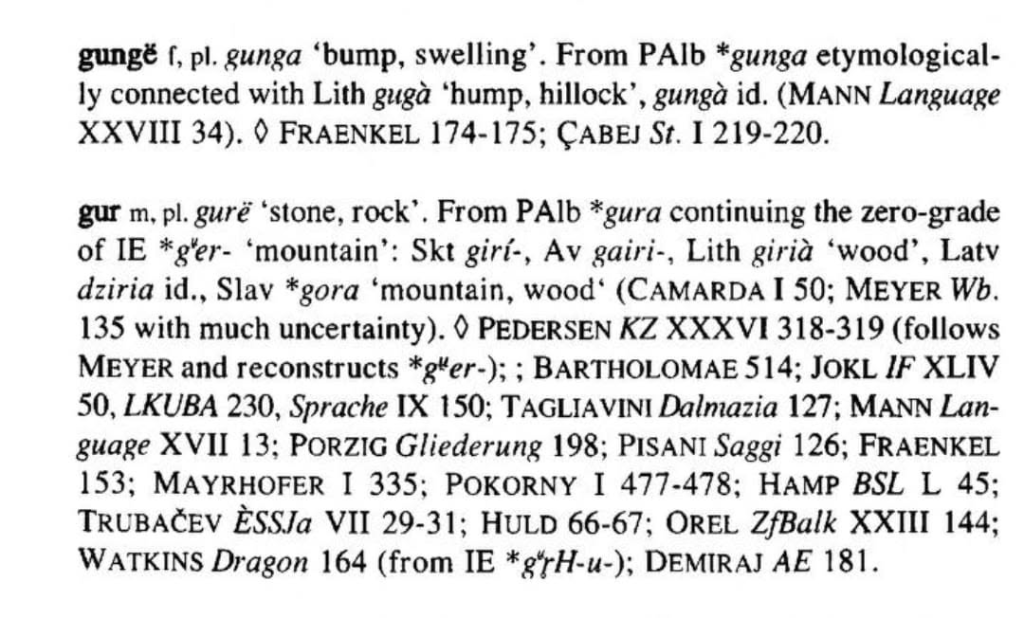
Burrë
The word burrë is attested in Marko Boçari’s Greek-Albanian dictionary as:
- μπούρ (bur)
- πούρ (pur)
In Arbëresh, Gheg, and Arvanitika it retains the meaning:
BURRË – MAN – WARRIOR / HERO
The word is linked to uses such as:
- burrë shteti (statesman)
- burrëri (manhood/bravery)
- burrë autoritar (authoritative man)
- burrë i fortë (strong man)
Rroj
The part Roi/Rroy is interpreted through the Albanian verb:
- rroj
- rronj (Arbëresh)
- rrnoj / rnoj (Gheg)
with the meaning:
to live, to survive
From this derive:
- rrojtur
- rrojtje
- rresë
- rrojë
According to this interpretation, Bur-Rroi can be understood as:
“The Man who Lives”
or
“The Royal Man who Continues to Live.”
Conclusion
According to this etymological argument, the original form Burrus/Burro may have gradually transformed into Pyrrhus/Pyrro during Greek transliterations and later phonetic changes.
The author suggests that:
Bur-Rroi = The Man who Lives / The Royal Man
and not necessarily “the fiery redhead,” as traditionally interpreted by Greek etymology linked to the word πυρ (“fire”).
Burrë rroi! — The Man lives on!

