

Abstract
This passage explores the survival of pre-Christian and pre-Islamic beliefs in Albanian folklore and customary practices. Drawing on nineteenth-century ethnographic observations, it examines traditional Albanian oaths invoking natural elements such as the sky, earth, mountains, sun, and moon, as well as the ceremonial “Oath of the Stone,” which some scholars associated with ancient Pelasgian and Mediterranean traditions.
The text further analyzes a rich body of Albanian supernatural beliefs, including Vilas, Djins, Mauthia, and Peri, whose characteristics reflect a synthesis of indigenous Balkan, Greek, Slavic, Ottoman, and broader Mediterranean influences. These figures function as personifications of natural forces, guardians of sacred spaces, and intermediaries between the human and supernatural worlds.
The study highlights how Albanian folklore preserved ancient cosmological concepts despite centuries of Christian and Islamic influence. It also demonstrates the importance of oral tradition in maintaining cultural continuity and provides insight into the historical worldview of Albanian-speaking populations, particularly in the highlands, where traditional beliefs survived longest.
Cited:
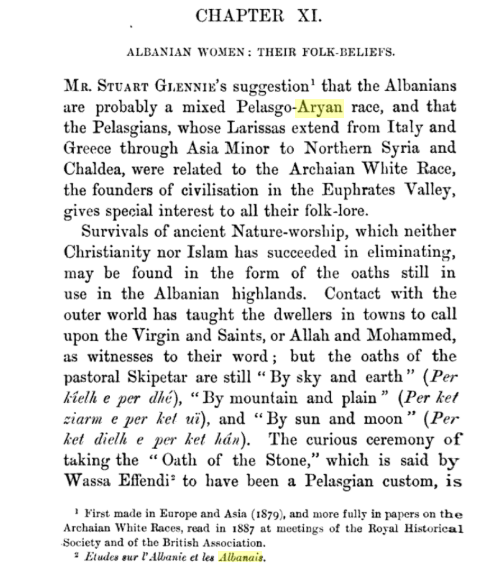
“Mr Stuart Glennie’s suggestion that the Albanians are probably a mixed Pelasgo Aryan race and that the Pelasgians whose Larissas extend from Italy and Greece through Asia Minor to Northern Syria and Chaldea were related to the Archaian White Race the founders of civilisation in the Euphrates Valley gives special interest to all their folklore.
Survivals of ancient Nature worship which neither Christianity nor Islam has succeeded in eliminating may be found in the form of the oaths still in use in the Albanian highlands. Contact with the outer world has taught the dwellers in towns to call upon the Virgin and Saints or Allah and Mohammed as witnesses to their words:
But the oaths of the pastoral Skipetar are still:
“By sky and earth (Per kîelh e per dhé) By mountain and plain (Per ket ziarm e per ket uï) and By sun and moon (Per ket dielh e per ket hán”)
The curious ceremony of taking the Oath of the Stone which is said by Wassa Effendi to have been a Pelasgian custom is also made use of by the Albanian highlanders generally when settling matters of importance.
According to this writer quoting from M Ampèret[1] a similar custom also existed among the ancient Romans. Sylla on leaving Rome to fight against Mithridates required Cinna to swear not by the national divinities but on the Sacred Stone and according to an ancient rite of the Etruscans to make no innovations during his absence.
Cinna when pronouncing this oath placed the stone on his shoulder and then threw it backwards while he pro nounced in a loud voice the curses which should fall upon him were he false to his promise.
The taking of this oath in Albania is attended with the same ceremonies. It is sworn by the elders of the phars or clans on the occasion of settling serious disputes such as those concerning the boundaries of village lands or other communal matters. The elders of the two tribes Christian or Moslem after taking the Oath of the Stone assemble in council and settle the question at issue assemble in council and settle the question at issue.
This oath in another form also enters into every day speech In course of conversation when a Gheg wishes to emphasise what he is saying he takes up in his hand or points to the nearest stone saying “By this weight Per ket pésh and a Tosk makes use of the phrase, “By the heaviness of this stone Per te rand te keti gúr. The Supernals with which the Albanian women terrify themselves and their children appear to be for the most part like those of the Bulgarians personifications of the powers of Nature.
Of these imaginary beings some belong exclusively to Albania while others may also be found among the super stitions of Slavs Greeks and Turks. The Vilas seem to approach most nearly to our own fairies though like the Nereids of the Greeks they are of the full stature of mortals.
Like our fairies too it is unlucky to mention them by name and they are generally referred to as “Those outside The Happy Ones the Brides of May or The Brides of the Mountain”. As a rule they are harmless if not offended and amuse themselves with elfish tricks such as taking little children up to the roof of the house to play with and bringing them back safely.
They however take it very ill when mortals disturb them in their haunts and interrupt their banquets and so capricious are they that they will place themselves invisibly in spots where they are likely to be dis turbed in order to have a little vent for their pent up malice. The unlucky wight who sets an irreverent foot within their elfin rings receives a stroke from an invisible hand and ere long sickens and dies. In consequence of this belief it is said of one for whose death no adequate cause can be assigned, he has received a blow”.
The favourite haunts of the Vilas are retired and shady spots but they also have a partiality for the gutters on the eaves of houses which it is a rather risky matter to clean out especially at night. The Vilas are said in North Albania to be of two kinds well disposed and beautiful beings who ride about on fleet horses and ill disposed and hideous creatures whose heads are covered with writhing serpents instead of hair.
To meet the former is considered a good augury but the appearance of the latter presages certain misfortune. Another and similar class of supernal beings known by the Turkish name of Djins attach themselves to dwellings in which they perform the rôle generally attributed to good fairies putting the house in order and plaiting the manes and tails of the horses in the stable.
Sometimes too like the Nereids and Lamias of the Greeks and the Samodivas of the Bulgarians they form matrimonial alliances with mortals. M Hecquard[1] mentions a story of a man living at Scutari who declared himself to be married to one of these female Djins who was able to fulfil every desire he expressed.
However ancient or rare the coin he might show her she always trebled it. This Djin was according to her master’s report exceedingly jealous of mortal women and would allow no servant in the house Indeed she had no need of one for everything she or her husband required was ready to hand in a moment.
The Mauthia appears to be peculiar to Elbassan and is described as a beautiful woman dressed in gold gleaming garments and wearing on her head a fez covered with jewels. The man who can succeed in getting this fez from her whether by force or fraud will be happy for the rest of his life. In Albanian fairy lore the Peri whose name is of Turkish origin is of the masculine sex and resembles a beautiful boy of twelve with a glistening white skin clothed in dainty raiment and exhaling a fragrant odour.
They live in the mountains but after nightfall frequently approach the abodes of men in order to allure mortal youths to join their dances If a boy so favoured keeps his own counsel he may join in these fairy revels with impunity but should he venture to inform others of his relations with these nocturnal visitors they revenge themselves by killing him”.
Footnotes:
- First made in Europe and Asia 1879 and more fully in papers on the Archaian White Races read in 1887 at meetings of the Royal Historical Society and of the British Association
2. Etudes sur l Albanie et les Albanais
Source
The Women of Turkey and Their Folk-lore: The Jewish and Moslem women. Concluding chapters on The origins of matriarchy, by J. S. Stuart-Glennie. Lucy Mary Jane Garnett, John S. Stuart-Glennie. 1891

