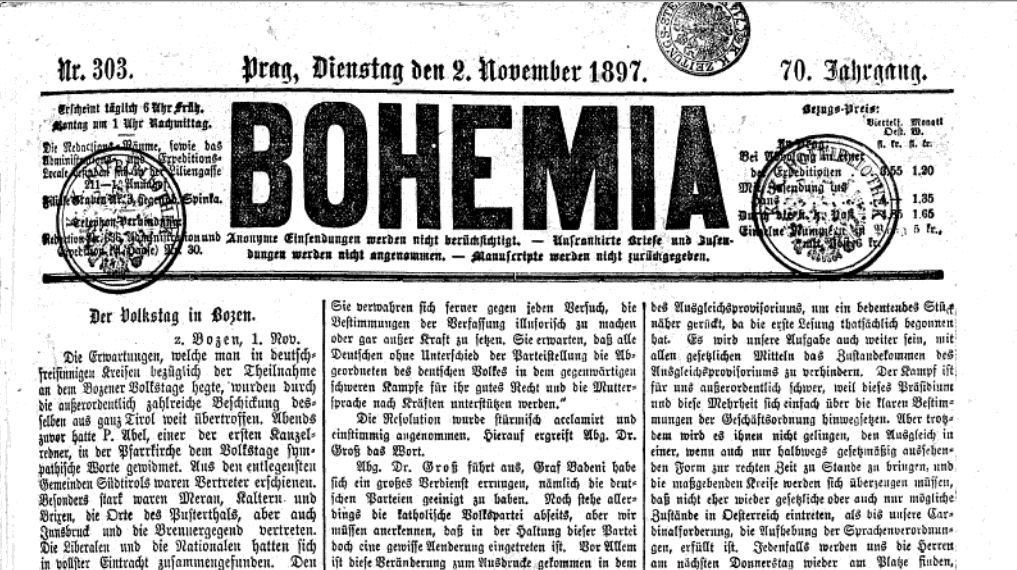

In 1897, the paper “Bohemia ein Unterhaltungsblatt” published an article about the largest Serbian trial against robbers (hajduk) held in Čačak where over 100 Serbian defendants were brought to be prosecuted. Ironically, as the trial was held, a Serbian hajduk band attacked and massacred a peasant family of about six people in Vlaskopolje near Belgrad.

Overview of the defendants
- Milan Brkić (also spelled Brkič) — the chief robber and “Car of the Mountains” (Car der Berge), leader of the band.
- Milinković (Milinkovič) — Brkić’s accomplice and fellow band member.
- Ranko Tasić (Ranko Tassič) — Radical Party leader and member of the Serbian National Assembly (Skupština), accused of instigating a murder; acquitted for lack of evidence but reportedly still detained pending the trial’s conclusion.
More than one hundred robbers stood trial.
Over 1,400 persons summoned in connection with the proceedings (witnesses, defendants, associates, and others), but their names are not given in this excerpt.
People mentioned who were not defendants but rather victims, witnesses, or officials include:
Teacher Baković (Bakovič) — murder victim.
Miroslav Jević (Miroslavl Jevič) — peasant witness who informed the gendarmes.
The unnamed presiding judge (“President”).
The unnamed gendarme commander and other gendarmes.
- Milan Brkić
- Milinković
- Ranko Tasić
“The Hajduk Trial in Serbia, Belgrade, October 31.
“Car der Berge”, the leader of the band of robbers against whom the monstrous Čačak trial is currently being held in Serbia, to which more than 1400 have been summoned, writes in the introduction to a report about this: Serbia has never had a larger Hajduk trial than this one during its existence. The Čačak trial is a truly bloody, tearful drama, which Serbia will long remember with tears.
The trial is, from beginning to end, a chain of the most gruesome and terrible scenes, the description of which makes the blood run cold. We are not exaggerating when we say that no drama can hold more intense interest than the trial of the bloody crimes committed by those standing before the court and their accomplices.
There are more than one hundred robbers awaiting the judge’s verdict, descendants of those Hajduks who were celebrated as national heroes, who at the time of a orderly administration of justice, the public, avenged committed injustices, robbed the rich and gave to the poor. Today’s, however, in contrast to their ancestors, are quite common, murderous, and greedy highwaymen whose shameful deeds defy description.
How the population behaved passively under the terrible terror and oppression of the robbers is best illustrated by the following case from near Belgrade. The court in Cačak was already in session when a Hajduk band attacked and massacred a peasant family of about six people in Vlaskopolje.
The fight lasted over an hour, more than 30 rifle shots were fired, and no one came to the aid of the victims. Srpska Zastava writes after observing this fact: Is this the safety that the human well-being enjoys in free Serbia? Is this what the security of person and property looks like for us? Is this why we fought against the Turks? Poor Serbia! in which there is no authority that sends the lives and possessions of your inhabitants.
This trial has also been given a political interpretation, and various factions are still trying to capitalize on it. A leader of the radicals and member of the Skupschtina, Ranko Tassič, sat in the dock as the instigator of a murder, and although he was acquitted for lack of evidence, he remains in custody until the trial’s conclusion, as incriminating evidence may still emerge.
Milan Brkič, the “Car of the Mountains,” emphatically declared, “I deny nothing. I primarily killed progressives and liberals. Nevertheless, the real motive behind all these shameful acts was pure greed. Politics was merely a flimsy excuse for it.” In the preliminary investigation, Brkič stated that he had murdered the teacher Bakovič, who had written a pamphlet against the Prince of Montenegro, on the orders of Deputy Tajsič.
However, in the trial, he testified that he had killed the teacher for specific reasons. But when his accomplice, Milinkovič, asked him after the deed, “Why did we actually kill the teacher?” He answered nothing. His head was worth ducats. We will get them when we are in Montenegro. How the peasants still live under the nightmare of fear of the Hajduks is shown by the interrogation of the peasant Miroslav Jevič, who betrayed the robber chief’s night quarters to the gendarmes. It was on the first day of the trial.
The Baner appeared extraordinarily intimidated, and a large part of the audience did not regard him with friendly looks at all. President Dn, you must answer my questions and say everything you know. Miroslavl Jevič, what I know I have said. Don’t ask me anything more, Mr. President. It is enough what I have done and what I have taken upon myself. Rightly, I should not have been summoned here at all.
President, the Hajduks killed your father. Miroslavl, yes. They may kill me too. Not Brkič and those who are imprisoned, but the others. President, you must tell the truth. But you seem quite intimidated. Miroslavl, one becomes very easily intimidated, may God protect you from it.
He must live as we live. The unfortunate peasant’s fear grew visibly; his hands began to tremble, his voice faltered, and he seemed completely absent-minded. So he finally had to be released. The interrogation of the gendarmes who captured the mountain robber is interesting. They came near the house where Brkic and Milinkovič were staying at night.
As morning dawned, the gendarmes saw from their hiding place that the door of the cottage opened and a woman flew out, whereupon the door closed again. The very worthy peasant woman had been thrown out of her own house by Brkic. Now the gendarmes knew for certain that the dreaded robber captain was in the house and began to advance on the cottage from all sides.
To create the impression that they had come in an extraordinarily large number—there were hardly 10 of them—the commander let out loud command shouts and made his orders accordingly. Then a sound came from the cottage. A voice said, “Thank God I wasn’t dressed until now. But you will get to know the Hajduk Brkič.” At that moment, a gendarme saw a shadow at a window and opened fire.
It was Brkič, who was wounded in the forehead and now shouted in a different tone, “Don’t shoot any further! We surrender!” “First, your weapons!” ordered the commandant. Immediately, the weapons flew out of the window; among them was an Austrian cavalry carbine. The gendarmes entered the house. Brkič came towards them with a heavily bleeding head. “Sir, that you are in a village and so…” and apologized for not being better dressed.
Had he known this encounter, he would have brought his gold-embroidered ceremonial robe. He calmly allowed himself to be bound. When he was led out of the house and saw the small gendarme’s cottage, he asked the gendarme leader, “Where is the rest of your force?” The commandant laughed. “I have none else, that’s all,” he said. Brkič became furious. He had been outwitted. He was brought to Guč in triumph. People from all the villages flocked together to see the feared Hajduk chief.”
Source
Bohemia ein Unterhaltungsblatt. 1897

