

In the German paper “Pfälzischer Anzeiger Abendzeitung” we can read an article from 1891 about “Black Petiar” or Petiar Milenkovic (Petar Milenkovic), a Serbian robber criminal who killed 15 Serbs and plundered Serbia for 20 years (1871-1891). According to the article, his wife Milica Milenkovic surpassed him in greed and was also a robber. Petiar was eventually captured and executed by gendarmeries.
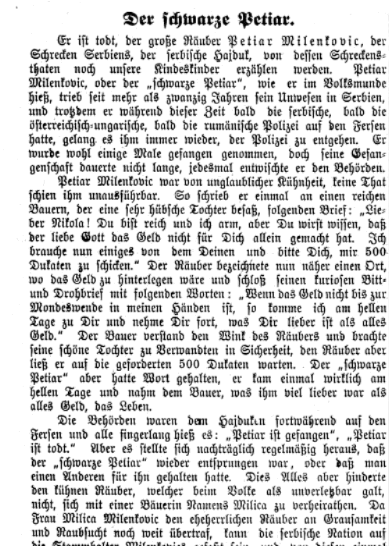
“The Black Petiar, he is dead, the great robber Petiar Milenkovic, the terror of Serbia, the Serbian Hajduk, whose horrific deeds will still be told by our great-grandchildren. Milenkovic, or the Black Petiar as he was known, had been wreaking havoc in Serbia for more than twenty years, and although he had the Serbian, Austro-Hungarian, and Romanian police on his tail during this time, he always managed to escape them. He was probably captured several times, but his imprisonment didn’t last long; each time he eluded the authorities.
Petiar Milenkovic was incredibly bold; nothing seemed impossible for him. For example, he once wrote the following letter to a farmer who had a very pretty daughter: Dear Nikola, you are rich and I am poor, but you will know that God didn’t make money for you alone. I now need some of yours and ask you to send me ducats. The robber then specified a place where the money should be deposited and concluded his curious and threatening letter with the following words: If the If the money isn’t in my hands until the end of the moon, I’ll come to you during the day and take what you value more than money.
The farmer understood the robber’s hint and sent his beautiful daughter to safety with relatives. He made the robber wait for the demanded 500 ducats. But Petiar kept his word. He came one day, in truly broad daylight, and took from the farmer what he valued most: all his money, his life. The authorities were constantly on the Hajduk’s heels, and every so often it was said that Petiar was captured, that he was dead.
But it regularly turned out afterward that the Black Petiar had escaped again or that he had mistaken someone else for him. All this, however, did not deter the bold robber, who was considered untouchable by the people, from marrying a peasant woman named Milica. His wife, Milica Milenkovic, far surpassed the robber in her greed and robbery. Can the Serbian nation be assured of the Milenkovic heirs and expect good things from them when they grow up, God willing?
The Black Petiar, who was devoid of his lust for robbery and grayness. Despite being a caring family man, he eventually found the constant travel through woods and fields somewhat arduous for his wife and children, and therefore moved to Verceorova under the name Pern Makedonia, where he established an inn and led a family life.
Occasionally, however, he undertook small business trips from which he always returned with a full purse. For example, he once imprisoned the innkeeper Riolla from Brnicza and only released him after four days, once the latter had paid him 250 ducats as ransom. He visited a wealthy merchant in Gobulacz named Toma several times and learned a great deal from him.
But these are still the mildest of his deeds. The blood of 15 people is demonstrably on his hands, and those whose lives he has carried out are certainly just as numerous. When his wife Melica was captured several years ago, he appeared in the city around noon and freed her on a In a manner that remains unclear, then led her unhindered in triumph through the city and disappeared again.
After the Serbian government placed a bounty of 500 ducats (6000 dinars) on the head of Black Petiar, the Minister of the Interior, Mr. Gjaje, succeeded in discovering his new whereabouts. Petiar had cleverly moved his hiding place so close to the Serbian border that he could easily escape from there to Dester, Hungary, or Romania. However, when the gendarmes broke into his home, they found only his wife and children, who were captured and taken to Kladova.
The cunning robber himself had escaped. He had fled to Hungarian soil, where he was tracked down and captured by the Hungarian police. But during the transport, Petiar escaped. He now circled his former home to learn the fate of his wife and children, to whom he was deeply attached. On this occasion, the police thought they would capture him, but they were mistaken.
Having ascertained the fate of his family, Petiar returned to his father’s house in Kobjelar, where, to his great joy, he found his children. Black Petiar hid there for a while until chance betrayed him through the mouth of his own child. With frantic haste, four gendarmes finally entered the house. While sledding, the still quite harmless boy told them that his father had returned.
This news spread throughout Petiar’s family home. Petiar defended it and wounded two gendarmes. Finally, however, he fled into the nearby forest and was wounded by one of the gendarmes. In the forest he encountered the the authorities. They cut off his head and buried his body on the spot. The dreaded robber Petiar Milenkovic, the great terror of Serbia, is dead.
He has received his just punishment, but he will live on in the mouths of the people. Legends and fairy tales will spin around the feared Hajduk who heartlessly stabbed the rich and had an open hand for the poor, who risked his life for his wife and children because deep within the rough robber’s chest dwelt the tenderest love for his family.”
Article
Pfälzischer Anzeiger Abendzeitung für die Pfalz ; unabhängiges und parteiloses Organ, nur den Interessen des Publikums gewidmet. 1891, 1/4.

