
Abstract
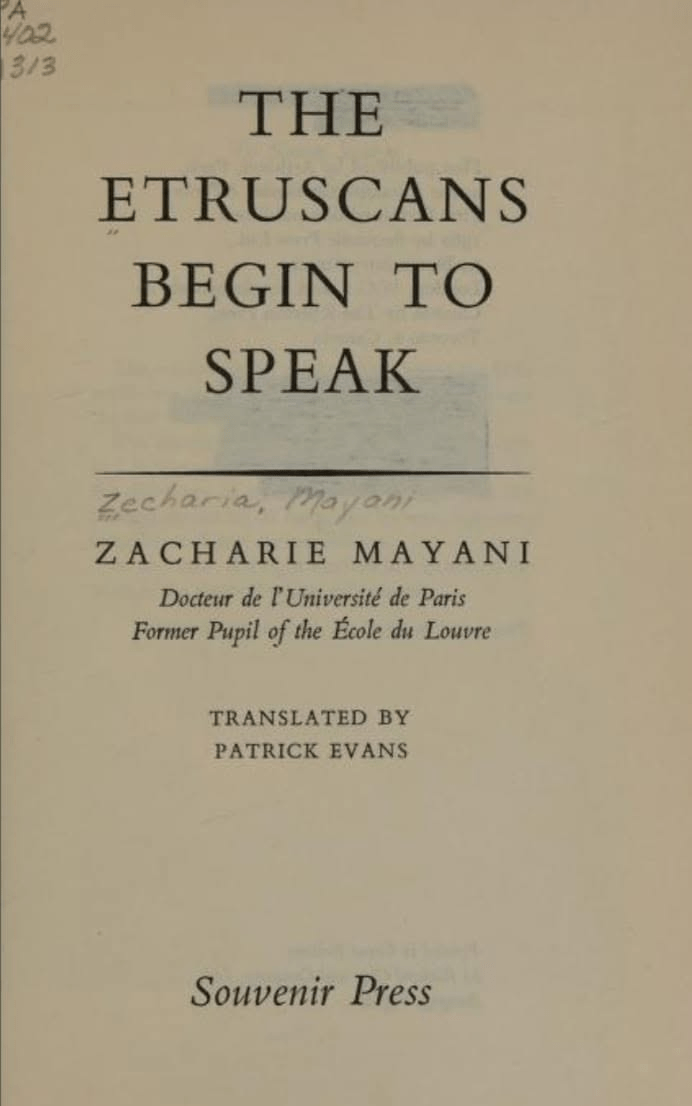
This study discusses the linguistic and historical arguments advanced by Zacharie Mayani (1899–1978), particularly in his 1962 work Les Étrusques commencent à parler (The Etruscans Begin to Speak). Mayani proposed that the Etruscan language could be interpreted through Albanian, which he regarded as the modern continuation of an ancient Illyrian linguistic core. Building upon earlier hypotheses concerning Pelasgian, Illyrian, Thracian, Phrygian, Macedonian, and Etruscan populations, he argued for extensive cultural and linguistic connections across the Balkans, Anatolia, the Aegean, and ancient Italy.
A central element of Mayani’s thesis is the claim that numerous Etruscan words, personal names, place names, and administrative terms can be explained through Albanian vocabulary and morphology. He challenged earlier linguistic scholarship, particularly that of Gustav Meyer, which emphasized extensive borrowing into Albanian from Greek, Latin, Slavic, Gothic, Turkish, and other languages. Instead, Mayani maintained that many words traditionally regarded as borrowings were inherited from a common prehistoric linguistic substrate preserved in Albanian.
The work further advances the view that Illyrian-speaking populations played a significant role in the ethnogenesis of various ancient Mediterranean peoples, including the Etruscans, Messapians, Veneti, Phrygians, Lydians, Philistines, and certain Macedonian and Thracian groups. Drawing upon classical authors, archaeological interpretations, and comparative linguistics, Mayani argued that migrations originating in the Balkans extended into Anatolia, Crete, Palestine, and the Italian Peninsula. Within this framework, Albanian is presented as a key repository of ancient Illyrian linguistic features.
Mayani attempted to demonstrate correspondences between Albanian and Etruscan through comparisons involving common vocabulary, grammatical structures, numerals, toponyms, ethnonyms, and religious terminology. He also highlighted parallels between Albanian and other Indo-European languages, including Thracian, Phrygian, Armenian, Hittite, and Balto-Slavic languages, which he interpreted as evidence of deep historical continuity. According to his reconstruction, Etruscan represented a fundamentally Indo-European language with an Illyrian base, despite containing Anatolian and regional influences.
The text additionally discusses ancient tribal identities, migration narratives, and the political history of Illyria, Macedonia, Epirus, and related regions. It portrays Albanian as preserving linguistic elements that allegedly survived from prehistoric Balkan populations and argues that this continuity provides a tool for interpreting otherwise obscure Etruscan inscriptions. The broader conclusion advanced by Mayani is that significant continuity existed between ancient Illyrian-speaking populations and modern Albanians, and that Etruscan should be understood within this wider Balkan-Mediterranean cultural and linguistic network.
To conclude the Albanian–Etruscan–Pelasgian linguistic journey, it is particularly interesting to consider what Zacharie Mayani, of Russian-Jewish origin, had to say.
He was appointed lecturer and antiquities specialist at the École du Louvre in Paris. An author, journalist, and activist in the Zionist movement, he became intrigued by Bonfante’s ideas concerning:
- The Scythians were separated from the Phrygian-Thracian world only by the Danube and invaded Asia Minor in the 6th century BCE.
- The Macedonians, Epirotes, Albanians, Illyrians, and ancient Pelasgians shared the same characteristics.
- The name of Cape Malea on the island of Lemnos, once inhabited by Pelasgians, could be explained through the Albanian root mal (“mountain”).
After years of research, Mayani published in 1962 The Etruscans Begin to Speak.
He wrote:
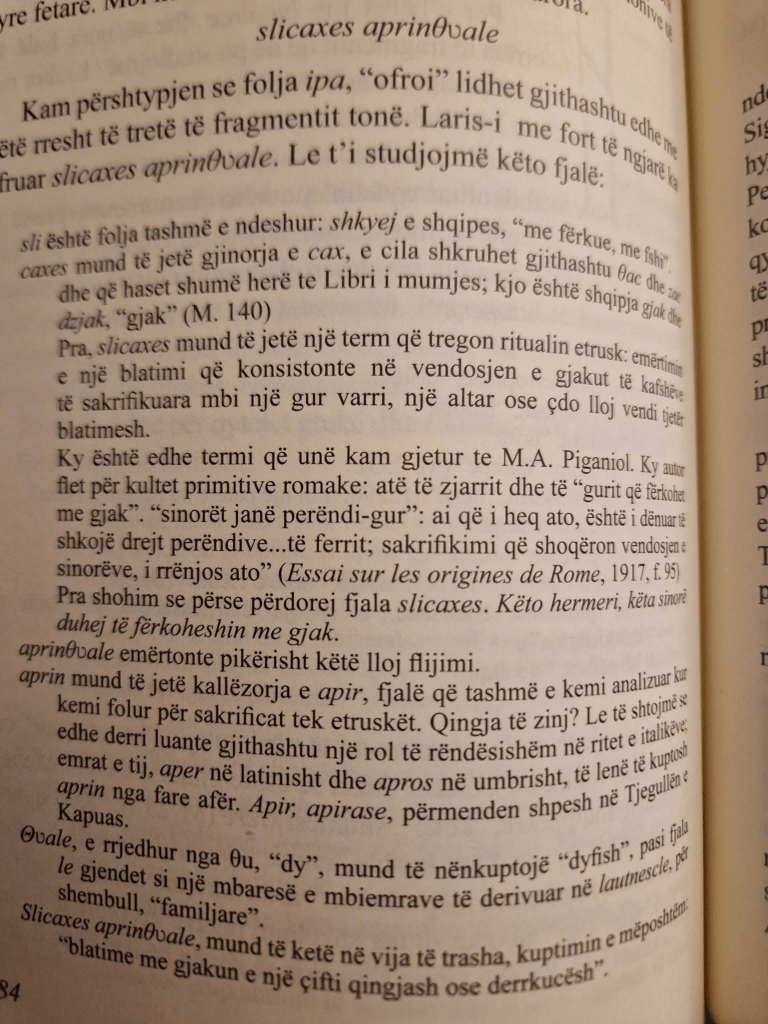
“When I came to publish the results obtained from deciphering the Etruscan language by comparing it with Albanian (or, to be more precise, with the Illyrian core preserved in Albanian), I knew that the reader would once again encounter astonishing and truly surprising similarities—phonetic, morphological, and semantic—between Albanian and Etruscan.”
Mayani argued against several prevailing scholarly theses.
Thesis: Albanian consists largely of borrowed words
Gustav Meyer devoted himself to identifying and classifying the inherited vocabulary (Erbgut) of Albanian, while arguing that a large portion of the language consisted of borrowings from Greek, Latin, Gothic, Slavic, Turkish, and other languages.
Conclusion proposed by Mayani: Albanian is fundamentally an inherited language.
When Mayani examined the Albanian word anije (“ship”), which he considered potentially ancient, he observed that it resembled aniyah in both Hebrew and Phoenician.
Although Meyer considered anije a borrowing, scholars such as Norbert Jokl, Walde-Pokorny, S. E. Mann, and others argued that Meyer’s mistake was to reduce the inherited vocabulary of Albanian to an unnecessarily small core. According to them, many words classified as borrowings from Greek, Latin, Slavic, or other languages might instead derive from a common, ancient source, which Mayani associated with prehistoric Albanian.
Thesis: The Etruscans were Illyrians and their language was essentially Illyrian
Mayani argued that this should not be regarded as surprising.
He described a large family of peoples and tribes inhabiting Pannonia, Illyria, Dalmatia, Epirus, and Albania, with related groups including Macedonians, Thracians, Phrygians, Lydians, some Cretans, Philistines, and others. These populations, he argued, had been studied by Franz Altheim and other scholars and represented an extensive cultural world emerging from historical obscurity.
Their presence in ancient Italy, according to Mayani, had long been recognized. Many neighbors and contemporaries of the Etruscans were considered Illyrian in origin: the Veneti, Picenes, Iapygians, Messapians, Calabrians, and others.
According to this interpretation, Illyrian tribes had been moving from the Balkans into Asia Minor since the second millennium BCE. The Tursha, considered ancestors of the Etruscans, appear in historical records around 1200 BCE.
Aeneas, ally of the Trojans and later incorporated into Roman imperial legend as the founder of a renewed Troy in Italy, was viewed by Ludwig Malten as the personification of an Illyrian tribe, the Dardanians, some of whom allegedly settled in Sicily. According to Malten, this tradition reflects an Illyrian migration parallel to that of the Etruscans, who were said to have come from Lemnos.
Mayani further noted that Aeneas settled in Segesta, a Sicilian city whose name he regarded as Illyrian in character, comparing it to names such as Tergeste.

Ptolemy and the Albanians
Ptolemy (2nd century CE) mentions an Illyrian people living in the province of Macedonia, east of Dyrrachium (modern Durrës).
Mayani interpreted this as evidence for the early ancestors of modern Albanians.
Because Albanians began appearing frequently in medieval written sources only after approximately 1040 CE, the historian Mannert believed that Ptolemy’s reference might have been a later interpolation.
However, Mayani pointed out that very few interpolations of this kind are found in Ptolemy’s text. Ancient ethnic names often reappear after long periods of historical silence, and therefore he rejected the interpolation hypothesis.
Selected Albanian Etymologies
Mayani proposed that:
- The name of the Illyrian tribe Triballi and the Phrygian royal title ballen derived from the Albanian word ballë (“forehead,” “front,” “head”), yielding meanings such as “people of the three peaks” and “the one at the head of affairs.”
- Comparable formations exist in Slavic languages, where terms derived from words meaning “forehead” or “front” came to signify “leader” or “chief.”
He also presented a list of Albanian words that he believed corresponded to elements found in ancient languages:
- tre (“three”)
- mal (“mountain”)
- plak (“old man”)
- madh (“great”)
which he associated with Illyrian;
- cenis in Scythian;
- gjashtë (“six”) in Oscan-Umbrian parallels;
- ballë in Phrygian;
- gardh (“fence”) with a Hittite counterpart.
Von Hahn and the Illyrian Linguistic Sphere
Johann Georg von Hahn had returned to the works of Strabo, Polybius, and other classical authors.
Mayani expanded his documentation through later scholarship and gradually formed what he described as a picture of a vast family of peoples and tribes whose languages were related to Illyrian and spread throughout the Adriatic and Mediterranean regions, including Italy, Crete, and Palestine.
These peoples included:
- Illyrians
- Veneti
- Iapygians
- Macedonians
- Phrygians
- and others.
According to Mayani, this interpretation divided philologists and historians into two opposing camps.
The first group eagerly embraced evidence for Illyrian expansion. Their principal evidence consisted of two languages: Messapian and Albanian, both believed to possess an Illyrian foundation. Since Thracian and Macedonian were only fragmentarily preserved, these scholars hoped to use Albanian and Messapian as the basis for reconstructing other ancient languages, particularly Etruscan.
Opposing them were what Mayani termed the “Illyriophobes,” scholars who rejected broad Illyrian expansion theories. They disputed the antiquity, cohesion, and geographic extent of the proposed Illyrian cultural sphere and defended the traditional view of Etruscan origins.
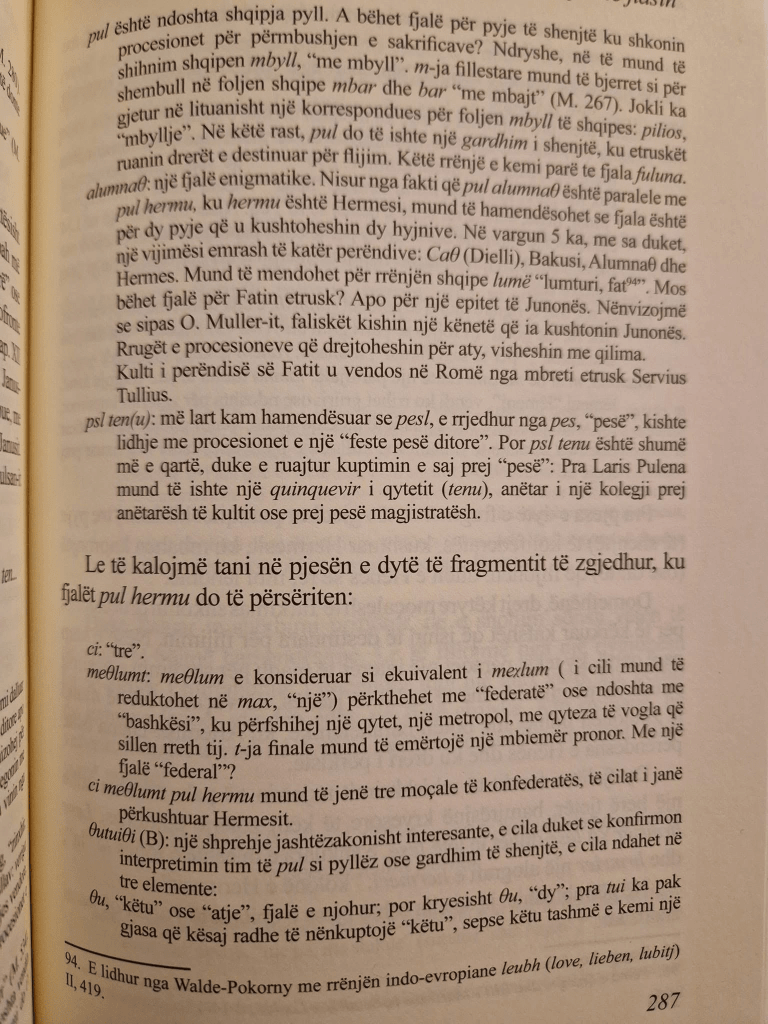
Illyrian and the Decipherment of Etruscan
Mayani argued that many contemporary scholars discussing the role of Illyrian in deciphering Etruscan remained focused on divine names and legendary heroes.
He questioned the assumption that Etruscan belonged entirely outside the Indo-European framework and suggested that many Albanian words commonly labeled as Slavic or Lithuanian in origin could in fact be much older.
The appearance of similar words throughout the Balkans had often been attributed to Slavic migrations south of the Danube during the 6th century CE.
However, after Bedřich Hrozný’s decipherment of Hittite, scholars became aware of numerous roots already present in Anatolia during the 15th century BCE.
Mayani therefore argued that Albanian may have inherited some of these elements through Illyrian rather than receiving them from later Slavic influence.
He also cited Hans Krahe, who observed similar suffixes in Illyrian place names such as Draudacum and Kerak, and in personal names such as Baraco and Theutaco.
According to Mayani, ancient Illyrian survived through historical transformations much as Latin and Greek survived despite the impact of later Germanic and Slavic invasions.
Part 2
The Albanian Core of Ancient Peoples
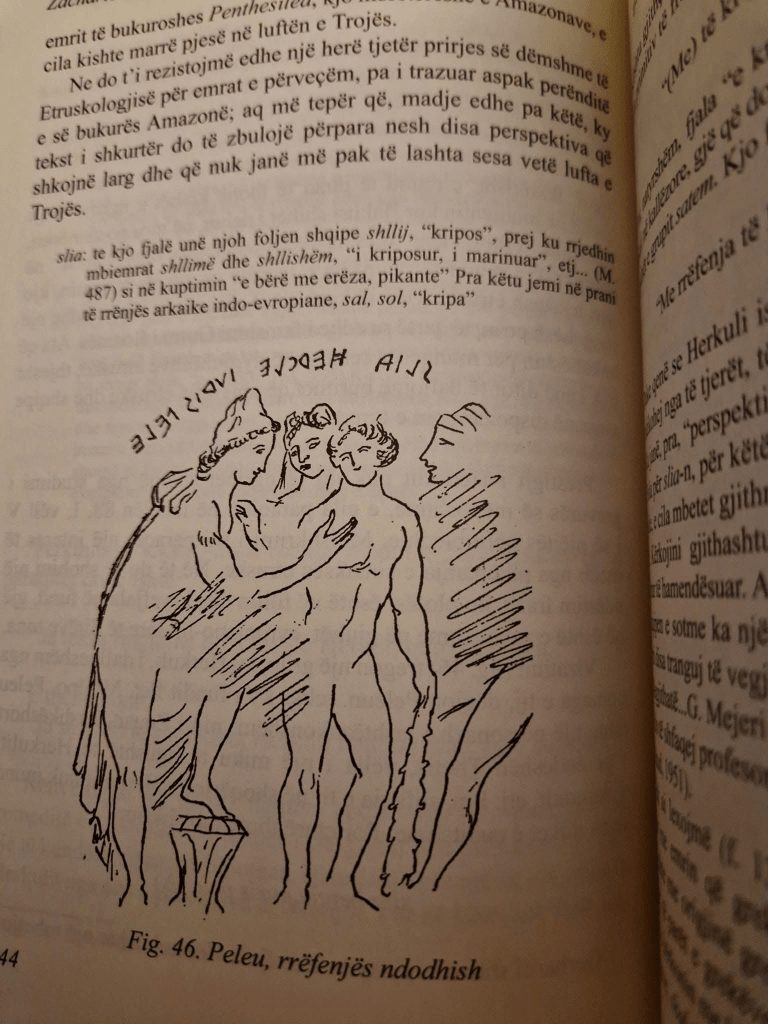
The tribes that form the Albanian nucleus of antiquity are of particular interest.
Pauli asserted a close kinship between Messapian, Illyrian, and Albanian. Ribezzo identified substantial similarities between Albanian proper names and those of the Venetic–Iapygian–Illyrian group. Trombetti observed that the Illyrian cultural sphere extended across the entire Italian peninsula, from the Veneti to Apulia and Calabria. Lattes stated that there was no opposition in principle to an Illyrian origin for any Italic population, a view that reflects the objectivity of this dedicated Etruscologist.
Devoto, however, argued that while the ancient inhabitants of Picenum were related to the Etruscans on one side, they also belonged—especially the Liburnians—to the broader Illyrian family.
Illyrian tribes, according to these interpretations, were already in movement from the Balkans toward Asia Minor as early as the second millennium BCE. The Tursha, regarded as predecessors of the Etruscans, are mentioned around 1200 BCE. Aeneas, the Trojan ally later integrated into Roman myth as the founder of Rome, is interpreted by L. Malten as a symbolic representation of an Illyrian Dardanian tribe, some of whom settled in Sicily (cf. Strabo XIII, 53). This tradition, in Malten’s view, reflects a parallel Illyrian migration to that of the Etruscans, who are said to have originated from Lemnos. Aeneas is also associated with Segesta in Sicily, a city whose name is considered Illyrian (cf. Tergeste, etc.).

Ptolemy and Early Albanian Ethnic Continuity
Ptolemy (2nd century CE) mentions an Illyrian population in the Macedonian province east of Dyrrachium (modern Durrës). This is interpreted as the early nucleus of modern Albanians.
Since Albanians are not frequently mentioned in historical records before approximately 1040 CE, Mannert considered Ptolemy’s reference a possible later interpolation. However, Mayani rejects this hypothesis, noting that such falsifications are rare in Ptolemy’s text, where ethnic glosses are generally well identified and where many ancient names reappear after long historical gaps.
Albanian Etymological Comparisons
A series of Albanian etymological parallels is presented:
- The Illyrian tribal name Triballi and the Phrygian royal title ballen are linked to the Albanian word ballë (“forehead,” “front,” “head”), interpreted as “people of the three peaks” or “those at the head.”
- Comparable semantic developments exist in Slavic languages, where words for “forehead” or “front” evolve into terms meaning “leader” or “chief.”
A comparative lexical list is also proposed:
- Albanian tre (“three”), mal (“mountain”), plak (“old”), madh (“great”), associated with Illyrian.
- Scythian cenis
- Osco-Umbrian parallels such as gjashtë (“six”)
- Phrygian ballë
- Hittite-related gardh (“fence”)
Expansion of the Illyrian Cultural Sphere
Von Hahn revisited classical authors such as Strabo and Polybius, and Mayani extended this documentation using later scholarship. He described the emergence of a broad ethnolinguistic complex whose languages were connected to Illyrian and which spread across the Adriatic and Mediterranean regions, including Italy, Crete, and Palestine.
Within this framework are included Illyrians, Veneti, Iapygians, Macedonians, Phrygians, and others.
This interpretation, Mayani notes, divided scholars into two opposing schools.
The first group actively sought evidence of Illyrian expansion. Their main supporting evidence consisted of Messapian and Albanian, both considered fundamentally Illyrian. Thracian and Macedonian, by contrast, survive only in fragments. These scholars therefore proposed using Albanian and Messapian as key tools for reconstructing ancient languages, especially Etruscan.
Opposing them were critics referred to as “Illyriophobes,” who rejected the idea of a widespread Illyrian cultural and linguistic unity. They denied its historical coherence and resisted attempts to link Etruscan to Illyrian origins.
Illyrian and Etruscan Interpretation Debates
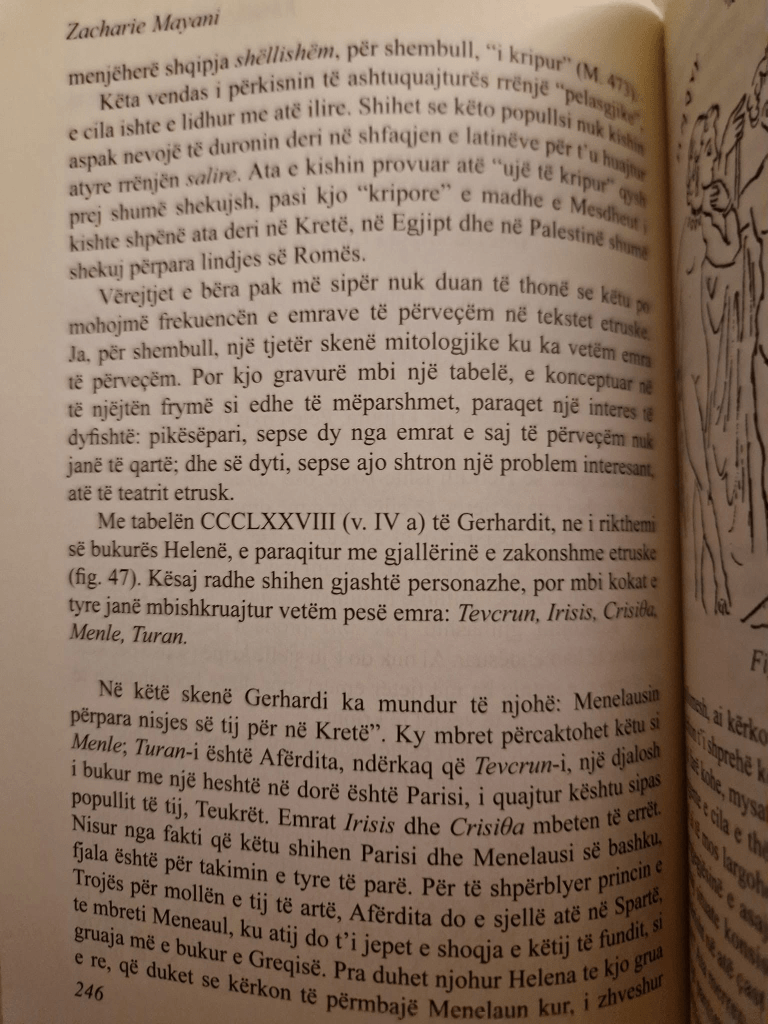
In discussions of the possible role of Illyrian in deciphering Etruscan, Mayani observes that many scholars focus primarily on divine names and mythological figures.
He questions whether Etruscan truly belongs outside the Indo-European family, suggesting instead that many words labeled as Slavic or Lithuanian in Albanian may in fact be much older.
The spread of such vocabulary in the Balkans has often been attributed to Slavic migrations north of the Danube in the 6th century CE. However, following Hrozný’s decipherment of Hittite, scholars recognized that many roots existed in Anatolia as early as the 15th century BCE.
Mayani therefore argues that Albanian may preserve Illyrian elements inherited from this earlier period rather than acquired through later Slavic influence.
Hans Krahe is cited as identifying common Illyrian suffix patterns in toponyms such as Draudacum and Kerak, as well as personal names such as Baraco and Theutaco. According to this view, Illyrian evolved over time in ways comparable to Latin and Greek under later external influences.
Part 3

Etruscan Administrative Language and Albanian Parallels
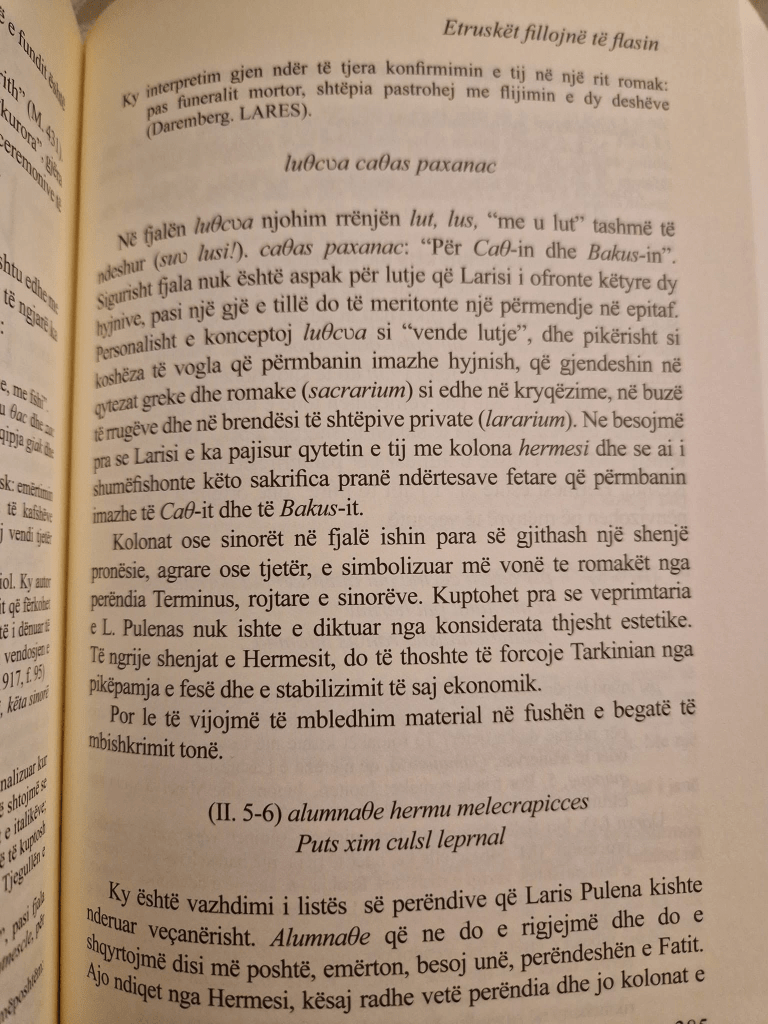
The Etruscan administrative system is known to us mainly through epitaphs and inscriptions. The prerogatives of civil officials, like other formal elements of Etruscan public life, had a sacred character, rooted in the fact that such officials participated in specific rituals and in some cases presided over sacrifices.
One of the most common terms associated with this administrative class was zilafi (A). It is noteworthy that this word has been preserved almost unchanged in Albanian as zyrtar (“official,” “functionary”), where the suffix -ar is interpreted as a productive occupational ending.
The Albanian word zyrë refers to an “urgent matter” or “office.” The Albanian-Russian dictionary also records zirtar. Under zyrë, Mann notes it as an “archaic word.”
Mayani emphasizes that it is precisely the Albanian language, as a presumed preserver of Illyrian antiquity, that allows one to identify and interpret such terms without excessive interpretive embellishment.

Albanian Lexical Preservation of Ancient Roots
A number of Albanian lexical items are presented as evidence of continuity with ancient Illyrian vocabulary:
- purris — “to ignite a fire”
- prush — “embers”
- prushis — “to stir fire”
Von Hahn and other sources are cited regarding these forms.
The term vend is highlighted as an important element in Illyrian and Indo-European toponymy. Its distribution is said to extend as far as Lycia and Iran. In Albanian, vend means “place” or “homeland.”
The element cal is tentatively associated with Albanian gjallë (“alive”), or more broadly with notions of life and living.
Other fragmentary interpretations include:
- ep, nep — “to give”
- kesh — related to kam (“to have”)
- sa — “how much”
Such combinations are interpreted as reflecting ancient syntactic patterns preserved in Etruscan inscriptions.
Phonetic Variation and Linguistic Continuity
The distinction between final k and sh is considered minimal in Albanian phonology, illustrated by variations such as:
- gjumak / gjumag (“sleep”)
- halig / halig (meaning uncertain in the source)
These variations are presented as evidence of fluid phonetic correspondences between Albanian and Etruscan forms.
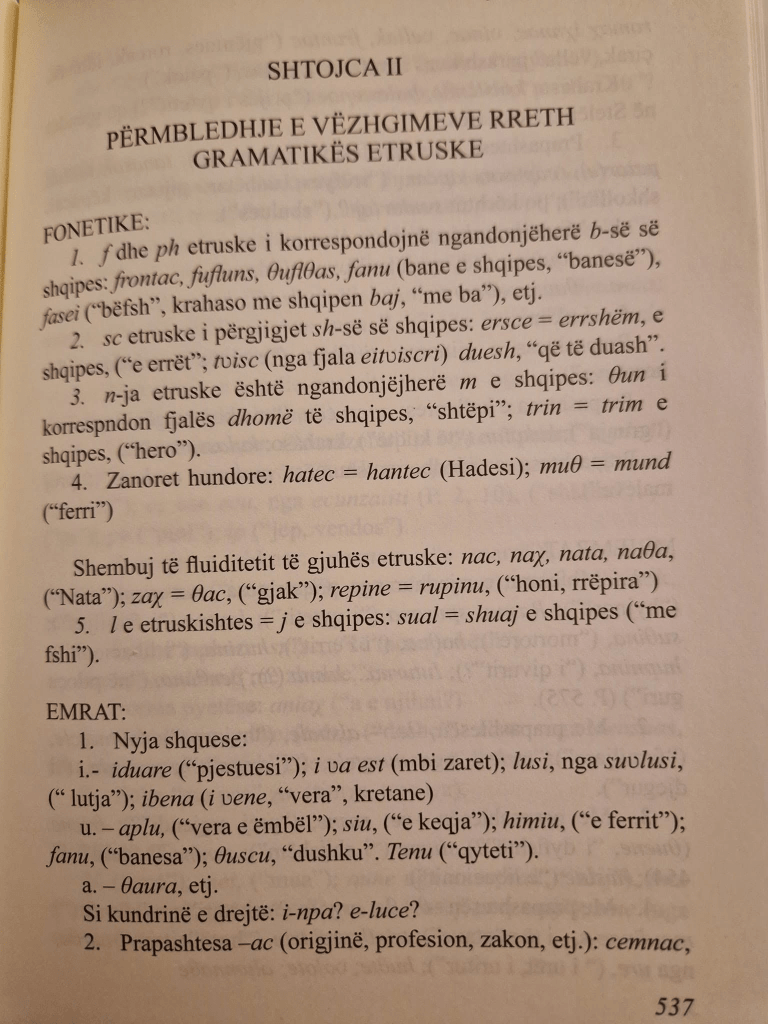
The Etruscan language is described as containing both Anatolian lexical elements and Indo-European vocabulary, but in most cases its lexicon is considered primarily Illyrian, showing links with Hittite, Lithuanian, and Slavic languages.

Etruscan–Albanian Semantic Parallels
The Albanian word turmë (“crowd, mass”) is noted as appearing in Etruscan with the same meaning. However, the author acknowledges that this does not necessarily imply direct inheritance; it may have passed through Latin mediation or parallel borrowing processes.
Historical linguistic change is illustrated with an example from French and English, demonstrating how words can move between languages multiple times before returning in modified form. Such phenomena are presented as normal in linguistic evolution.
Etruscan Vocabulary Interpreted Through Albanian
Several Etruscan terms are interpreted through Albanian:
- balteus (“belt, sword strap”) is linked to Albanian baj (“to carry, support”).
- Derived Albanian forms include bajtur (“carried”) and bajtës (“carrier”).
- The variation between z and l is described as common in both Etruscan and Albanian.
Examples of phonetic fluctuation include:
- Etruscan zitace / zilace
- Latin/Albanian alternations such as fle (“to sleep”) and related forms
From this, Mayani concludes that Etruscan balteus or related forms may derive from an Illyrian-Albanian root meaning “bearer” or “carrier,” later adopted into Latin.
Social Terminology and Structural Vocabulary
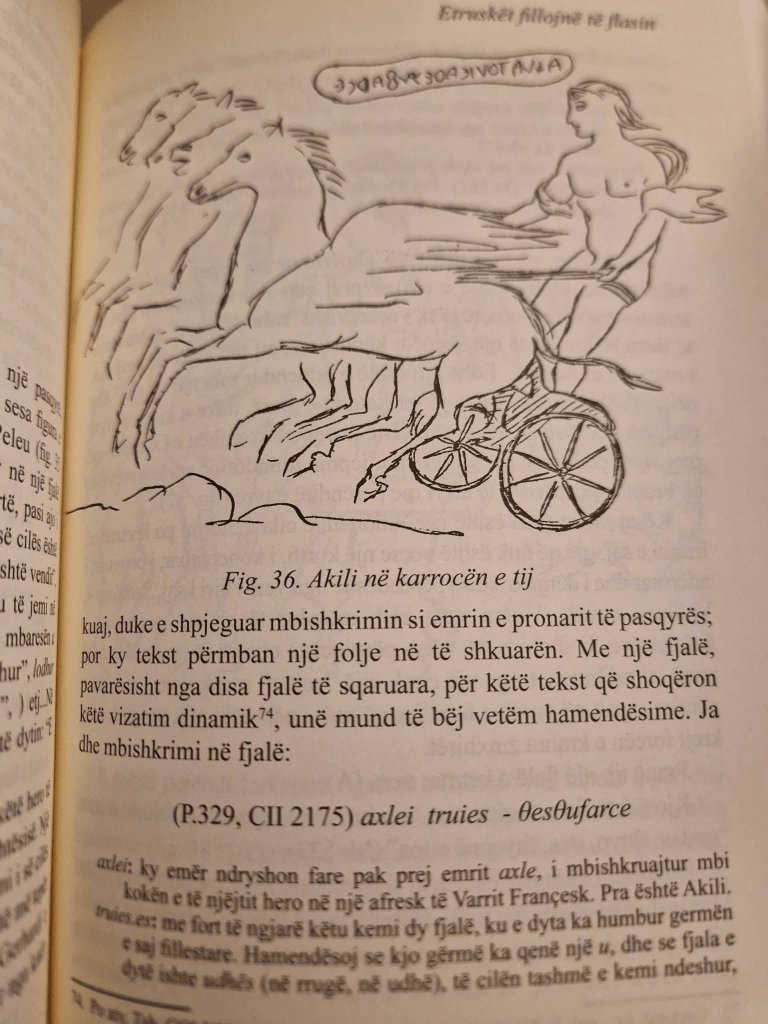
The term oura (A) is interpreted as a foundational concept of Etruscan social life and is said to be preserved in Albanian:
- dorë — “hand”
- extended meaning: “type,” “class,” or “social category”
Similarly, other structural interpretations include:
- djalë — an ancient Illyrian term of interest
- ul — “to descend,” forming compounds suggesting grammatical structures
The suffix -s is interpreted as indicating an oblique case in reconstructed Illyrian forms.
Morphological and Onomastic Parallels
The difference between the names Odysseus and Ulysses is explained as a phonetic shift (d → l) observed in Illyrian dialects of Epirus.
The root gord- is discussed as part of a long chain of toponyms:
- Gordium (Phrygia)
- Cortona (Etruria)
- Manegordum (Thrace)
- Novgorod, Belgrade, and others
This chain is interpreted as evidence of a shared linguistic substrate extending from Anatolia to Slavic Europe.

Ethnolinguistic Continuity and Cultural Interpretation
The text concludes this section by asserting that Albanian preserves numerous ancient semantic and morphological elements that allegedly link it to Etruscan and other ancient Mediterranean languages.
Examples include:
- verbs of basic actions (to be, eat, drink, go, give, take, see, sleep, etc.)
- kinship terms (father, mother, child)
- natural elements (water, stone, mountain, sky, rain, etc.)
These parallels are presented as evidence for continuity between ancient Illyrian/Etruscan and modern Albanian linguistic structures.
Part 4
Pelasgian, Illyrian, and Mediterranean Connections
These peoples were of the stock known as “Pelasgian,” which is linked to the Illyrian substratum. It is clear that none of these populations needed to wait for the Romans in order to acquire the Latin word salire. They had long been familiar with the “salted water” of the Mediterranean, having reached Crete, Egypt, and Palestine centuries before the founding of Rome.
Meyer-Lübke is said to have been aware that behind the Albanian root bardh (“white”) stood an Illyrian royal name, Bardullos, although he did not consider this detail relevant. The reason may be that it did not fit within the framework of Romance linguistics.
The Etruscan word is also compared to the Albanian verb mblak (“to grow old”), from which the name of the Pelasgian city Plakia is derived, as well as Albanian flak (“old”). In some dialectal developments, mb- is reduced, producing forms such as plak.

Philistines and Illyrian Affinities
The Philistines, like the Etruscans, are placed within an Illyrian-derived family. In translations of Ecclesiastes, expressions such as “house of mourning” are compared with Hebrew forms, while Albanian shtépi (“house”) and zi (“black,” “mourning”) are noted as parallel structures.
The Albanian word zi corresponds to Etruscan forms such as zi, with derivatives like zina and sineθ. From this, reconstructed forms such as reu-zina are interpreted as “vessel of mourning” or “funerary container,” constructed similarly to Semitic expressions.
It is further argued that the Philistines may be identified as a branch of an Illyrian-origin population. Similar ethnonyms appear in Western sources, such as Palaiste in Epirus and Filistina fossa in the lower Po region. The Philistines are also associated with the so-called “Sea Peoples,” known in Egyptian sources as Poulousati, depicted with feathered headdresses.
Illyrian Expansion into Anatolia and the Aegean
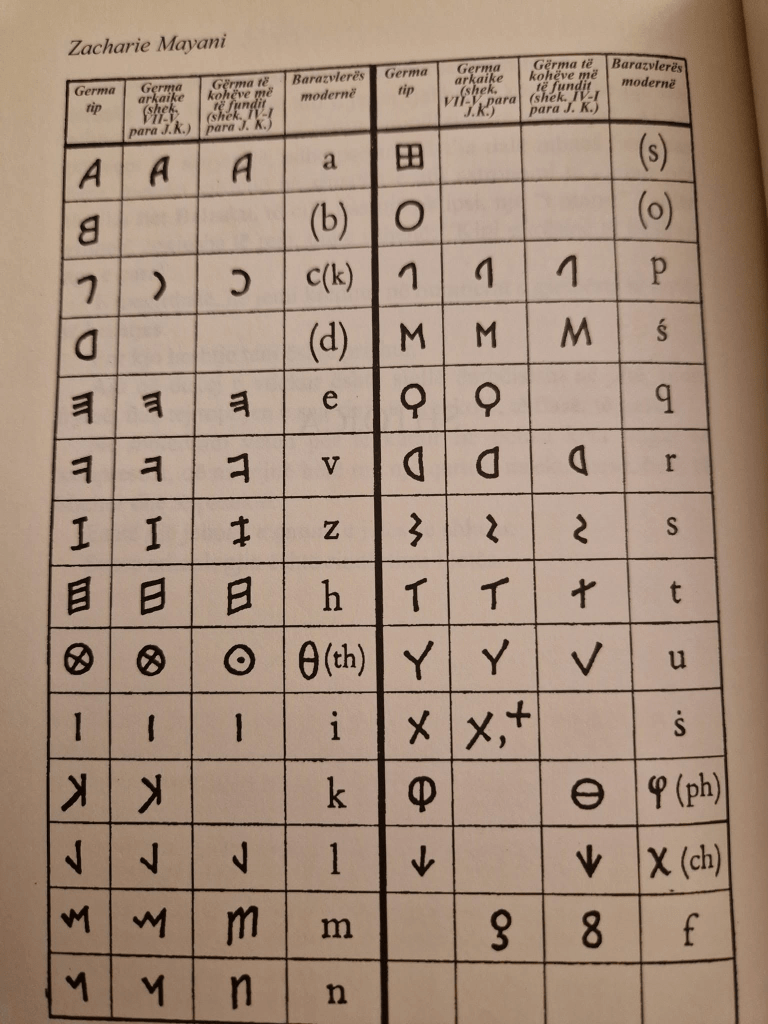
The participation of the Tursha in the spread of Illyrian populations into Anatolia is supported through toponyms in Lydia and Troy that are interpreted as Illyrian in origin. These groups are traditionally associated with the Etruscans (Tyrsenoi).
Following attacks by the “Sea Peoples” on Egypt, the Tursha appear in Egyptian sources alongside the Shardana (people of Sardinia) and other Anatolian groups. Their position in Asia Minor is thought to have collapsed under pressure from Cimmerian invasions after the fall of Phrygia.
Armenian and Illyrian Linguistic Parallels
It is suggested that Armenian may preserve parallels with Illyrian vocabulary, which is unsurprising given Herodotus’ testimony that Armenians were of Thraco-Phrygian origin.
Several lexical similarities between Armenian and Albanian are noted:
- both languages use a postposed definite article
- Armenian erthal (“to go”) compared with Albanian ar- forms
- ges (“half”) compared with Albanian gjysmë
- gtanem (“I find”) compared with Albanian gjej
- tzain (“voice”) compared with Albanian zë
- medz (“great”) compared with Albanian madh
Plural formation in Armenian (-er, -er) is also compared with Albanian and Etruscan morphological patterns.

Macedonian Language and Onomastics
References to the ancient Macedonian language are used to propose further Illyrian connections.
- Names such as Gavane and Perdikas are interpreted through Albanian roots meaning “pride” or “encouragement.”
- The name Korannos is linked to Albanian krye (“head”).
- A Macedonian word lissos is compared with Albanian lis (“oak,” also associated with height and strength).
- The Macedonian term skoidos is interpreted as meaning an official or administrator, compared with Albanian verbs meaning “to observe,” “to choose,” or “to decide.”
Historical Traditions and Ethnic Memory
The Talmud is cited as preserving a tradition in which the Girgashites complained to Alexander the Great about their expulsion from Canaan. This is interpreted as evidence of a dual historical memory linking them to earlier migrations and to Macedonian conquerors.
Biblical names such as Vashti and Haman are also interpreted as having Illyrian or Macedonian parallels, with Albanian vashë (“girl”) used as a comparative form.

Macedonian Wars and Roman Conquest
After the Third Macedonian War, the Roman Senate allowed its victorious army to plunder Epirus. The historical account describes widespread destruction:
- 70 cities were captured in a single day
- approximately 150,000 people were enslaved
- soldiers received payments from the spoils
Livy records the event without moral judgment, while Plutarch emphasizes its brutality, describing it as the destruction of an entire people for minimal individual gain.
After Macedonia’s defeat, it was divided into four republics. Intermarriage was prohibited, trade restricted, and the Macedonian army dismantled. The exploitation of gold and silver mines was also halted.
Final Note
The original work exists in French, but partial English translations and sections in Albanian are included alongside it.
Sources
Mayani, Zacharie. Les Étrusques commencent à parler. Paris: Arthaud, 1962.
Altheim, Franz. Various works on Illyrians, Thracians, and ancient Mediterranean ethnography cited by Mayani.
Coon, Carleton S. The Mountains of Giants: A Racial and Cultural Study of the North Albanian Mountain Ghegs. Cambridge, MA: Peabody Museum of Harvard University, 1950.
Krahe, Hans. Die Sprache der Illyrier. Wiesbaden: Otto Harrassowitz, 1955.
Malten, Ludwig. “Aineias.” Archiv für Religionswissenschaft 30 (1931).
Pauly, August, Georg Wissowa, and Wilhelm Kroll, eds. Paulys Realencyclopädie der classischen Altertumswissenschaft. Stuttgart: J. B. Metzler, various volumes.
Strabo. Geographica. Various editions and translations.
von Hahn, Johann Georg. Albanesische Studien. Jena: Friedrich Mauke, 1854.
Herodotus. Histories. Various editions and translations.
Livy. History of Rome. Various editions and translations.
Plutarch. Parallel Lives. Various editions and translations.

