
by Lulzim Osmanaj
The alphabet that the Pelasgians first brought to Italy and which has been called their original alphabet was probably brought from Phoenicia before the Phoenicians themselves had increased the number of root letters, of which it was originally composed.This alphabet consisted of thirteen letters according to Dr. Swinton, but, according to Father Gori, who seems to have been more informed, the original alphabet consisted of only twelve letters. As these authors differ materially, it may be convenient to give both alphabets.
Knowledge of the root letters of any language, A, is the quickest means of obtaining information about the foundations of which this language is composed and about its state when only these root letters are used. This will better enable us to recover those which for many centuries have been so neglected as to have been in a manner obliterated.
The utility which arises from distinguishing the root letters of these languages from their derivatives is too obvious to need any illustration; the distinction of the one from the other will aid in forming a just judgment of the age and authenticity of coins, inscriptions, and other ancient documents, and will be of the greatest use in distinguishing those which are genuine from those which are impure.
The Pelasgian language and letters had been neglected and completely spread out for a long period of time before the restoration of science in the fifteenth century, so that they were in some ways as unknown as if they had never existed, although they were used throughout the vast countries inhabited by the Pelasgians and their protectors, as well as in Africa and Europe, who for many centuries wrote from right to left, until their alphabet was improved by the Ionians, who, revising their letters, wrote from left to right, and in the course of time their method of writing was universally adopted in Europe and in some parts of Africa.
I think I have proven elsewhere that the Pelasgians received their letters from the Phoenicians and that these Pelasgians were of Phoenician origin. They were certainly the most ancient inhabitants of Greece about whom we have any information.
The Phoenician Pelasgians founded colonies on wild islands of the Aegean, such as Samothrace, Lemnos, Imbros, and Skyros. They also spread not only on the coast, but also in the interior of Greece, in Attica, Thessaly, throughout ancient Hellas, the Argolis, and throughout the Peloponnese; and wild colonies of their own, especially from Lydia, Lemnos, Imbros, Tephalus, and Atadia, settled in various parts of Italy and spread over the greater part of that country, where they certainly retained their own language and letters.
Solinus Polyhistor shows that the Greek colonies that settled in Italy were aborigines, Aurunci, Pelasgians, Arcadians, Sicilians, and Pliny the Elder shows that they were aborigines, Pelasgians, Arcadians, Sicilians, Aurunci, Rutulians, Oscans, etc. All these colonies wrote in the Pelasgian manner, from right to left, until the reign of Tarquinius Priscus, the fifth king of the Romans, who began to reign five hundred and fifty-five years before Christ; although the Samnites continued to write in the ancient manner until two hundred and thirty years before the Christian era, as appears from their coins and inscriptions.
The Pelasgians who settled in Etruria were called Etruscans; the monuments discovered in that country, as alfo in Umbria, and in other parts of Italy peopled by early Pelasgian colonies, give us the best information concerning the Pelasgian language and characters.The five tablets discovered at Eugubium, a town of Umbria, in 1456, are of very great antiquity; and Father Gori, with great force of argument, endeavors to prove that they were written two centuries before the Trojan war.
They are, however, certainly written in the Pelapian language, and in characters similar to those found on the Etruscan monuments favored by Dempster, Gori, Paffer, and others. The alphabet which the Pelasgians first brought to Italy, and which has been called their original alphabet, was probably brought from Phoenicia before the Phoenicians themselves had increased the number of root letters of which it was originally composed.
This alphabet consisted of thirteen letters according to Dr. Swinton, but, according to Father Gori, who seems to have been more informed, the original alphabet consisted of only twelve letters. As these authors differ materially, it may be convenient to give both alphabets.FATHER GORI tells us that the letter Hra was added later; and he also asserts that the double and aspirated letters B, E, and X were accepted among the later Etruscans.
The double letters were not originally members of the Pelasgian alphabet: although, as they appear on the Etruscan monuments, we may conclude that they existed before the time of Palamedes, who is believed to have invented them about twenty years before the conquest of Troy, or 1164 years before Christ. In very remote antiquity the Greeks did not have a sufficient number of letters for the notation of their language.
A character similar to & seems to have replaced Z. On a medallion at Zancle (now Messina), about the 28th Olympiad, it is written ΔΑΝΚΑΕ; and the character of fame is visible on the shield of Anaxidamus, the Zeuxis-fund, which is almost of the same date as fame, and is thus written ΔΕΥΚΣΙδΑΜΟ. The character like A was once converted into P, for the ancient Greeks once wrote ΠΕΤΚΣΙδΑΜΟΣ and ΠΑΝΚΑΕ.
This shows the uncertainty of the writing before the ancient Greeks had polished their language [6], although I find that 2 and A were once joined – *The famous inscription of Amyklis, which is thought to have been written one hundred and fifty years before the conquest of Troy and one thousand three hundred and forty-four before the Christian era, does not have the 2, but has two OOs to take the place of that character, although another inscription about eight hundred years before Christ has it.
It is easy to understand that the harsh language of the ancient Pelasgians was very different from later Greek or Hellenic.

References
BRITISH MUSEUM
The Origin and Progress of Writing, chap. iv. p. 51, & p.
Hift. Nat. book iii. chapter 5.
Mr. ASTLE on the Radical Letters of the Pelagus.
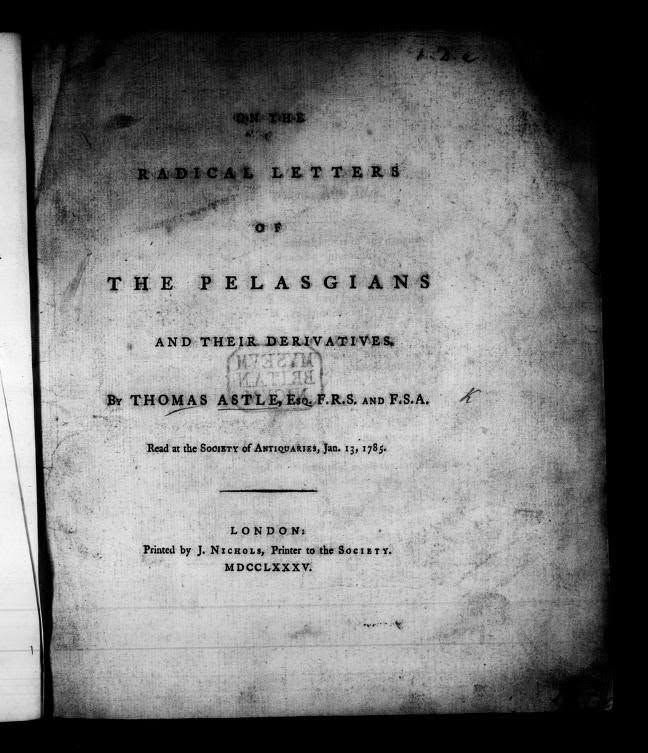
On the Root Letters of the Pelasgians and their Derivatives. By Thomas Astle, Read at the Society of Antiquaries, January 13, 1785. 1785

