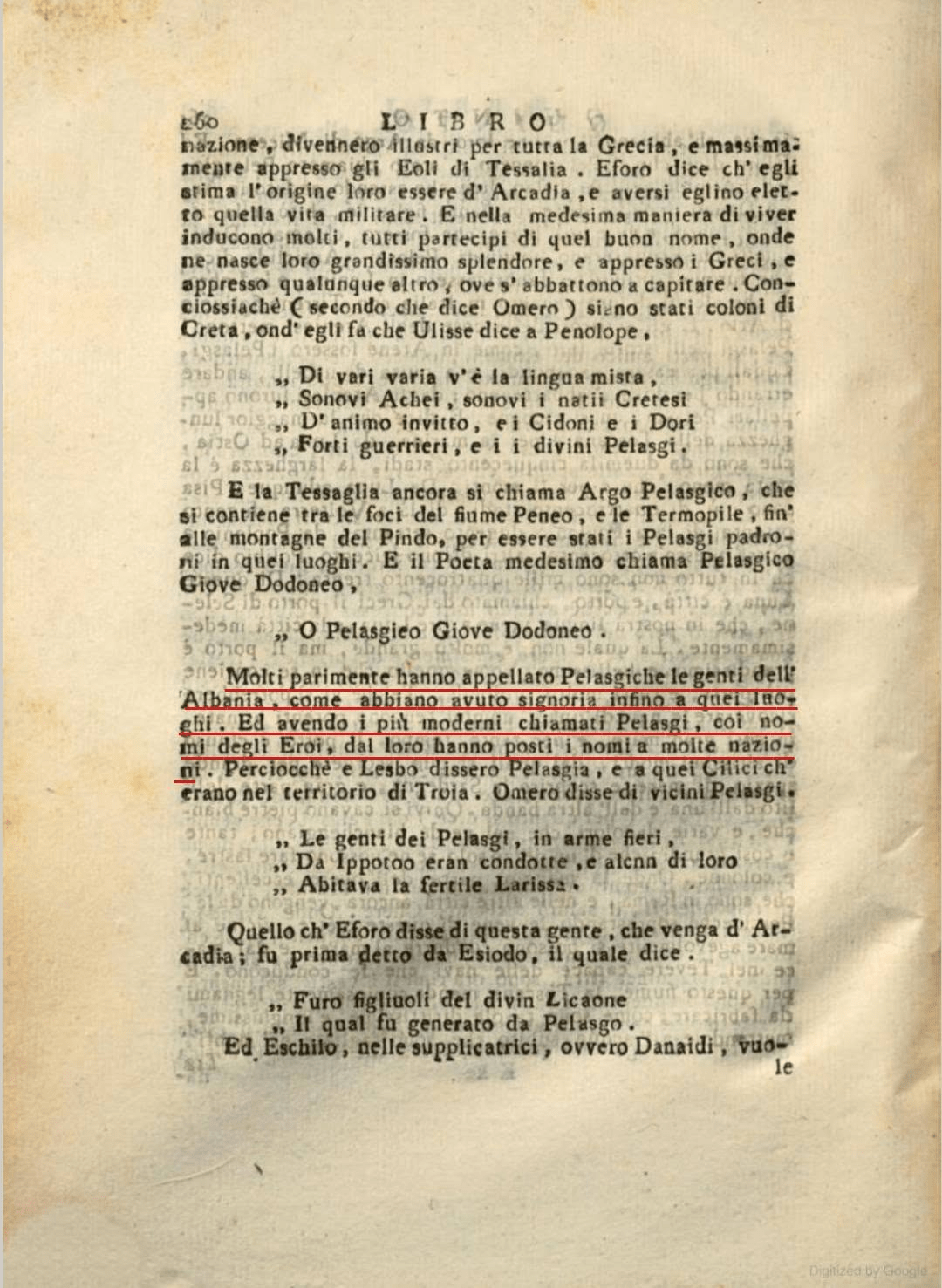

Quote:
“Many have also called the people of Albania Pelasgians, as they had lordship up to those places. And since the more modern ones have been called Pelasgi, with the names of the Heroes, from them they have given names to many nations.”
Summary
Anthropological, linguistic, and historical studies have long contributed to debates concerning the origins of the Albanian people and language. Some scholars have interpreted archaeological and anthropological evidence as supporting continuity between ancient Balkan populations and modern Albanians, often through an Illyrian or Thraco-Illyrian framework. Proponents of this view argue that the Illyrian-Thracian theory is connected to older Pelasgian traditions, citing nineteenth- and early twentieth-century historians, linguists, and philologists. However, scholars such as Eqrem Çabej approached these questions more cautiously, emphasizing linguistic evidence.
Pelasgian
As previously discussed, in addressing the origins of the people of Albania, the author identifies them as Pelasgian. Significantly, the author employs the term “many” rather than “some,” thereby suggesting that this interpretation reflected a view held by a substantial number of scholars rather than a marginal or isolated opinion. From this perspective, the Pelasgian theory was presented as a widely discussed explanation within certain historical and philological traditions.
It is also important to note that Johann Georg von Hahn was not the first scholar to advance the theory of a Pelasgian origin for the Albanians. Likewise, the view that the Illyrians constituted one of the ancestral populations of the Albanians did not originate with twentieth-century communist historiography. Rather, both theories have a longer intellectual history and can be traced to earlier European scholarship concerned with the ethnogenesis of the Balkan peoples and the historical development of the Albanian language.
Within this interpretive framework, the Albanians are regarded as descendants of populations described as Thraco-Illyrian, while the Albanian language is considered to derive from the same linguistic continuum. As argued by proponents of this position, the designation “Thraco-Illyrian” encompasses a broader prehistoric cultural and linguistic complex that some scholars have associated with the Pelasgians. Consequently, in this line of reasoning, the terms “Thraco-Illyrian” and “Pelasgian” are viewed not as mutually exclusive categories but as interconnected concepts employed to explain the ancient origins of the Albanian people and language.
Supporters of this interpretation therefore maintain that the study of linguistic, historical, archaeological, and, more recently, genetic evidence points toward a continuity between the ancient populations of the western Balkans and the modern Albanian population.
Within this historiographical tradition, the Albanian language is understood as preserving elements of the ancient Paleo-Balkan linguistic heritage, while the Albanian people are interpreted as descendants of populations associated with the Thraco-Illyrian—or, in broader formulations, Pelasgian—cultural sphere.

Eqerem Cabej: Albanian derives from Illyrian-Thracian (Pelasgian)
The anthropological study of ninety-three human skeletons recovered from different chronological periods in Albania sought to identify the physical characteristics of the region’s ancient inhabitants, commonly associated with the Illyrians. Based on the typological data available to the researchers, the study concluded that the Illyrians of the Albanian territory primarily belonged to an Adriatic-Mediterranean population type, with the presence of Nordic and Alpine elements as minority components.
The authors further argued that these findings contributed to the understanding of broader historical processes related to the origin and ethnogenesis of the Illyrians. According to the conclusions of the study, contemporary Albanians were interpreted as direct descendants of an Illyrian-Thracian population.
Within the historiography of Albanian ethnogenesis, the Illyrian-Thracian theory has often been discussed alongside the Pelasgian theory. Proponents of this perspective point to observations made by several nineteenth- and early twentieth-century scholars who regarded the Illyrians, Thracians, and Pelasgians as historically or linguistically interconnected populations.
For example, discussions published in The Classical Review referred to the work of the historian Barthold Georg Niebuhr and the archaeologist William Ridgeway, both of whom explored possible relationships between Pelasgian and Illyrian-Thracian populations in the ancient Balkans and Aegean world.
From this perspective, the Illyrian-Thracian theory is not viewed as an isolated theory but as part of a broader framework concerning the prehistoric populations of the Balkans. The study of Illyrian and Thracian languages has led numerous historians, linguists, and archaeologists to propose connections among various Paleo-Balkan Indo-European languages.
Some scholars have suggested that Illyrian and Thracian may have shared common linguistic features or may have influenced neighboring language groups throughout the region. Consequently, discussions of Illyrian-Thracian origins have frequently intersected with debates regarding the identity and historical role of the Pelasgians.
Supporters of this interpretation argue that the Illyrian-Thracian theory has been strengthened by evidence from multiple disciplines, including linguistics, archaeology, and, more recently, population genetics. Within Albanian scholarship, Eqrem Çabej played a significant role in advancing research on the origins of the Albanian language and people.
His studies emphasized the importance of the Paleo-Balkan linguistic substrate and encouraged further investigation into the relationship between Albanian and the ancient languages of the western Balkans. As a result, many scholars have regarded Albanian as a descendant of one or more ancient Balkan Indo-European languages traditionally associated with Illyrian and, in some interpretations, Thracian linguistic communities.
Some researchers have also preferred to employ the term “Thraco-Illyrian” rather than “Pelasgian” when discussing prehistoric Balkan populations. For example, references cited in publications of the Royal Geographical Society, drawing upon the work of Alexandru Sturdza, used the expression “Thracian-Illyrian Peninsula” to describe the ethnographic and historical landscape of southeastern Europe. Such terminology reflects an attempt to frame these discussions within more clearly defined historical and linguistic categories.
Additional support for the connection between Pelasgian and Illyrian-Thracian traditions has been drawn from nineteenth-century philological literature. James Bonwick, in The Treasury of Languages: A Rudimentary Dictionary of Universal Philology, discussed the Pelasgians as an ancient population of Greece whose language, according to Herodotus, was regarded as non-Greek or “barbarian.”
Bonwick further noted that some later scholars proposed classifying the prehistoric dialects of Greece alongside Illyrian and Thraco-Illyrian linguistic groups. In this interpretation, Pelasgian was viewed as an ancestral cultural or linguistic category linked to the development of later Mediterranean and Balkan populations.
Accordingly, advocates of the Illyrian-Thracian model maintain that the theory of Albanian ethnogenesis rests upon a convergence of linguistic, historical, archaeological, and genetic evidence. Within this framework, the Albanian language is interpreted as preserving elements of the ancient Paleo-Balkan linguistic continuum, while the Albanian people are regarded as descendants of populations associated with the Illyrian-Thracian cultural sphere.
Whether one accepts or rejects the broader Pelasgian dimension of this argument, the interconnectedness of these discussions has remained a recurring theme in both Albanian and international scholarship concerning the origins of the Albanian people.
Sources
Eqrem Çabej, “Mbi tezën ilire dhe pellazge” (“On the Illyrian and Pelasgian Thesis”), a text written around 1977 and published posthumously by various outlets.
Strabo. Della Geografia. Tomo I. Rome: Per Desiderj a S. Antonio de’ Portoghesi, 1792.
Della geografia. Tomo 1. [-3.]Strabone, Volume 1. Convento di Santa Maria in Aracoeli : Biblioteca, Josè Maria Fonseca de Evora.
A Rudimentary Dictionary of Universal Philology, p. 265, (2024). Author. James Bonwick
Survey of anthropological features of the Illyrians. A Dhima. PMID: 3304152. https://pubmed.ncbi.nlm.nih.gov/3304152

