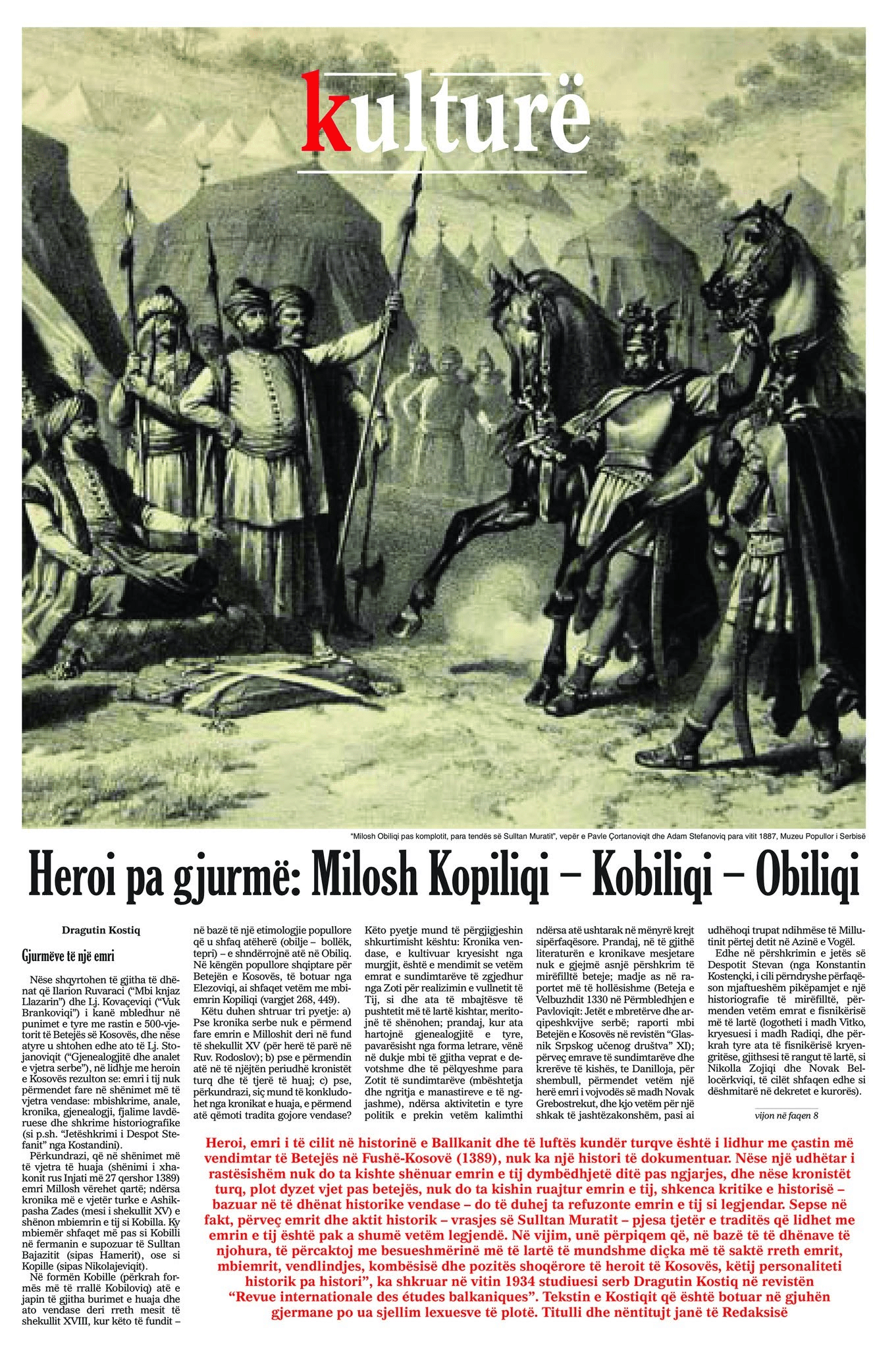

Miloš Obiliq or Milosh Kopili after the conspiracy, in front of Sultan Murat’s tent, work by Pavle Çortanović and Adam Stefanović before 1887, National Museum of Serbia.
by Dragutin Kostiq
Traces of a name
If we examine all the data that Ilarion Ruvaraci (“On Prince Lazar”) and Lj. Kovačeviqi (“Vuk Brankovići”) have collected in their works on the occasion of the 500th anniversary of the Battle of Kosovo, and if we add to them those of Lj. Stojanović (“Old Serbian Genealogies and Annals”), regarding the hero of Kosovo, it results that: his name is not mentioned at all in the oldest local records: inscriptions, annals, chronicles, genealogies, eulogies and historiographical writings (such as the “Life of Despot Stefan” by Constantine).
On the contrary, in the oldest foreign records (the record of the Russian deacon Injati on June 27, 1389) the name Milosh is clearly noted; while the oldest Turkish chronicle of Ashik-pasha Zade (mid-15th century) records his surname as Kobilla. This surname later appears as Kobilli in the supposed firman of Sultan Bayezid (according to Hamer), or as Kopille (according to Nikolajevic).
In the form Kobille (along with the rarer form Kobilović) it is given by all foreign and domestic sources until around the middle of the 18th century, when the latter based on a popular etymology that emerged at that time (obilje abundance, excess) – they transform it into Obiliq. In the Albanian folk song about the Battle of Kosovo, published by Elezovic, it appears only under the name Kopiliq (lines 268, 449).
Three questions should be asked here: a) Why does the Serbian chronicle not mention the name of Miloš at all until the end of the 15th century (for the first time in Ruv. Rodoslov); b) why do Turkish and other foreign chroniclers mention him in the same period; c) why, on the contrary, as can be concluded from foreign chronicles, does the local oral tradition mention him from that time?
These questions could be answered briefly as follows: The local chronicle, cultivated mainly by monks, is of the opinion that only the names of rulers chosen by God to carry out His will, as well as those of the holders of the highest ecclesiastical power, deserve to be recorded; therefore, when they compile their genealogies, regardless of the literary form, they point out above all the pious and pleasing deeds of the rulers before God (support and establishment of monasteries and the like), while they touch on their political activity only in passing.
The military one is completely superficial. Therefore, in the entire literature of medieval chronicles we do not find any real description of the battle; not even in the most detailed reports (Battle of Velbuzhd 1330 in Pavlović’s Collection: Lives of Serbian Kings and Archbishops; report on the Battle of Kosovo in the journal “Glas-nik Srpskog učenog društva” XI); apart from the names of rulers and church leaders, in Danilo, for example, the name of the Grand Duke Novak Grebostrek is mentioned only once, and this only for an extraordinary reason, since he led Milutin’s auxiliary troops across the sea to Asia Minor.
Even in the description of the life of Despot Stevan (by Konstantin Kostenčki, who otherwise sufficiently represents the views of a genuine historiography), only the names of the highest nobility are mentioned (the great logothete Vitko, the great leader Radić, and alongside them those of the leading nobility, certainly of high rank, such as Nikola Zojić and Novak Beločerkvić, who also appear as witnesses in the crown decrees).
The hero, whose name in the history of the Balkans and the war against the Turks is associated with the most decisive moment of the Battle of Kosovo (1389), has no documented history. If a random traveler had not noted his name twelve days after the event, and if Turkish chroniclers, a full forty years after the battle, had not preserved his name, the critical science of history based on local historical data – would have to reject his name as legendary.
Because in fact, apart from the name and the historical act – the assassination of Sultan Murat – the rest of the tradition associated with his name is more or less just legend. “In the following, I try, based on known data, to determine with the highest possible reliability something more precise about the name, surname, birthplace, nationality and social position of the hero of Kosovo, this historical personality without history,” wrote the Serbian scholar Dragutin Kostić in the journal “Revue internationale des études balkaniques” in 1934. We are bringing Kostić’s text, which was published in German, to our readers in full. The title and subtitles are the Editorial Boards.
Source
Cover of the Culture Supplement, KOHA Daily, June 14, 2026

