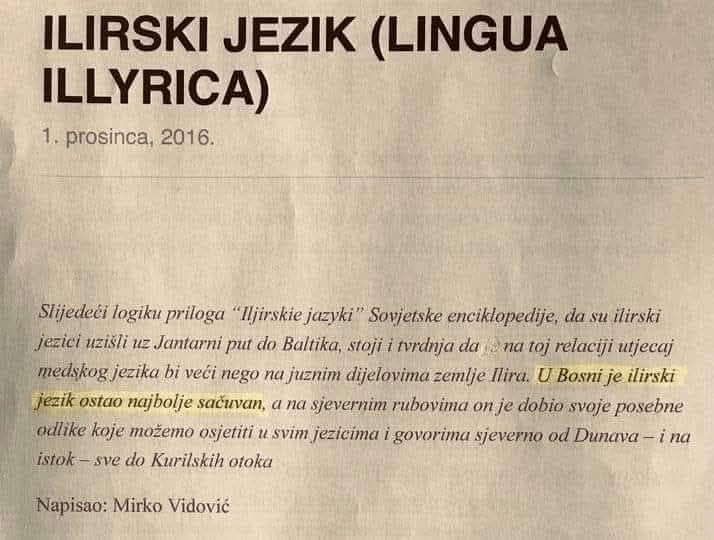

A 2016 text by Mirko Vidović, titled “Illyrian Language (Lingua Illyrica),” revives fringe ideas by misinterpreting a supposed entry from a Soviet encyclopedia. It claims Illyrian languages spread northward along the Amber Road to the Baltic Sea and that Bosnian best preserves an ancient Illyrian tongue, with influences extending across northern regions to the Kuril Islands.
These assertions represent outdated 19th-century romantic nationalism and modern pseudolinguistics, not scholarly consensus. Linguistic, historical, and genetic evidence firmly establishes South Slavic languages like Bosnian as part of the Slavic branch of Indo-European, with no direct continuity to ancient Illyrian.
Historical Context: The Rise and Fall of Illyrism
In the 15th–19th centuries, some South Slavic intellectuals used “Illyrian” as a broad, classical-inspired label for South Slavic peoples and languages. This stemmed from a desire for unity against foreign rule (Habsburg, Ottoman) and drew on ancient Roman geography, where “Illyricum” referred to western Balkan provinces. Figures like Juraj Šižgorić (15th century) and later participants in the Illyrian Movement (1830s–1840s, led by Ljudevit Gaj in Croatia) promoted a pan-South Slavic identity under this umbrella.
The Illyrian Movement was a cultural and linguistic revival effort aimed at standardizing a common South Slavic literary language (based on Štokavian) to foster unity. It contributed to modern Croatian, Serbian, Bosnian, and Montenegrin standards but was not about literal descent from ancient Illyrians. By the mid-to-late 19th century, as Slavic linguistics advanced and national identities crystallized around Slavic roots, the romantic “Illyrian” ideology largely faded among South Slavs. Scholars recognized the clear Slavic linguistic and ethnic character of the populations.
Vidović’s reference to a “Soviet encyclopedia” entry appears to cherry-pick or distort linguistic speculation about ancient Illyrian (a poorly attested Indo-European branch spoken in parts of the western Balkans before Roman times). No credible evidence supports Illyrian languages migrating to the Baltic or surviving intact in Bosnia.
Bosnian Is a Slavic Language
Modern Bosnian (also called Bosniak) is a South Slavic language, part of the Serbo-Croatian continuum. It belongs to the Indo-European family’s Balto-Slavic branch, sharing core vocabulary, grammar (e.g., cases, verb aspects), and sound changes with Serbian, Croatian, Montenegrin, and other Slavics like Bulgarian or Russian.
– Core structure
Bosnian uses Štokavian dialects (specifically Eastern Herzegovinian ijekavian), with Slavic roots in basic words (*voda* for water, *hleb* for bread, etc.).
– Influences
It includes Ottoman Turkish, Persian, and Arabic loanwords due to centuries of rule, plus some pre-Slavic substrate (Illyrian, Thracian, Latin, etc.) in toponyms and limited vocabulary. These are borrowings or remnants, not evidence of continuity.
– Ancient Illyrian
The Illyrian languages (plural, as tribes varied) are mostly extinct and sparsely attested via names and inscriptions. They form a separate Indo-European branch (linked to Albanian). No direct linguistic bridge exists to Slavic. Slavs migrated to the Balkans in the 6th–7th centuries CE, encountering, displacing, or assimilating Illyrian remnants.
Linguists classify any Illyrian traces in South Slavic as indirect (often via Latin/Romance) and minor—not a “best-preserved” core. Claims of Bosnian preserving Illyrian as its primary character are pseudoscientific.
Broader Evidence Against the Claims
– Linguistics
Slavic languages show systematic correspondences (e.g., satem characteristics, shared Proto-Slavic roots) absent in reconstructed Illyrian. The “Amber Road” migration of Illyrian languages lacks archaeological or linguistic support.
– History and Archaeology
Slavic settlement in the Balkans is well-documented by Byzantine sources (e.g., Procopius, Jordanes). Genetic studies show South Slavs as primarily Slavic-derived with Balkan admixture, not direct Illyrian descendants in language or dominant ethnicity. Albanians have stronger claims to Illyrian linguistic continuity.
– Ideological Context
Such theories echo 19th-century autochthonous myths common across Europe during national awakenings. They resurface in modern identity politics but contradict established scholarship.
Mirko Vidović’s text fits a pattern of fringe revivalism, not peer-reviewed history or linguistics.
Conclusion
The notion that Bosnian (or any South Slavic language) is a preserved “Illyrian” tongue, with vast northern extensions, is a romantic myth long debunked by the development of comparative linguistics. South Slavs are Slavs—culturally, linguistically, and historically—whose ancestors integrated with earlier Balkan populations. Illyrism served useful 19th-century unification purposes but yielded to evidence-based identity. Promoting it today as literal fact misleads and ignores rigorous scholarship.
References
Greenberg, Marc L. “The Illyrian Movement.” In *Encyclopedia of Slavic Languages and Linguistics*. Brill, n.d. Accessed via reference works.

